
Publication Ethics and Malpractice Statement
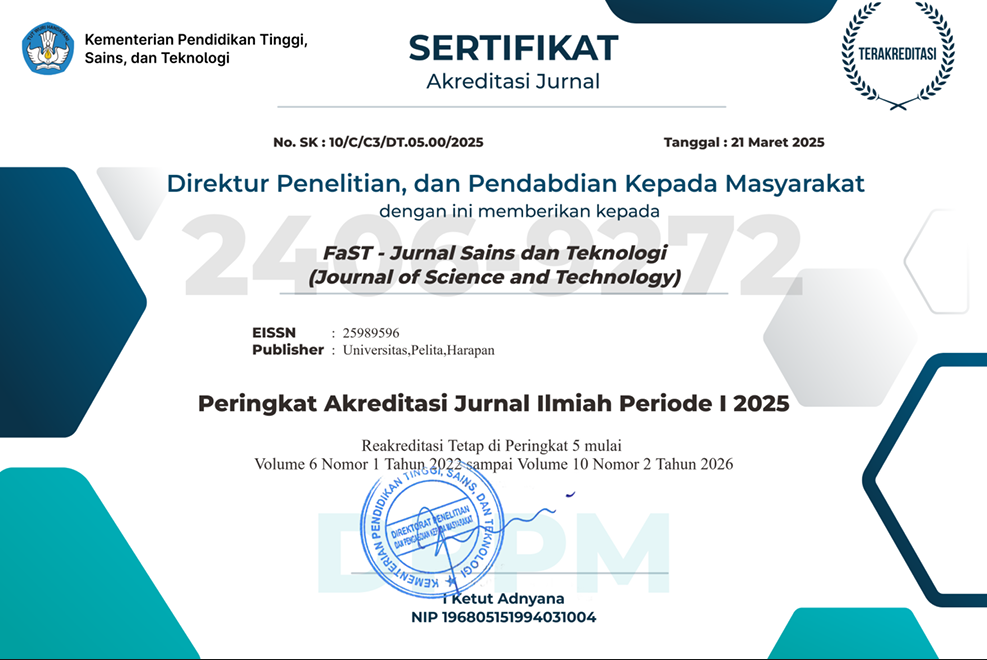
FaST- Jurnal Sains dan Teknologi Universitas Pelita Harapan
This statement describes the ethical behavior expected of all parties involved in the publication process of FaST - Jurnal Sains dan Teknologi Universitas Pelita Harapan (hereinafter referred to as FaST), including authors, editors, bestary partners (reviewers), and the publisher (Universitas Pelita Harapan).
General Ethical Guidelines for Journal Publication
Publication of an article in a peer-reviewed journal such as FaST is an essential building block in the development of a coherent and respected network of knowledge. It is a direct reflection of the quality of the work of the authors and the institutions that support them. Peer-reviewed articles embody and uphold the scientific method. Therefore, it is imperative to establish expected standards of ethical behavior for all parties involved in publishing: authors, journal editors, bestary partners, publishers, and the public.
FaST is dedicated to maintaining the highest standards of publication ethics and implements all necessary measures to address publication misconduct. FaST’s Publication Ethics and Publication Malpractice Statement is informed by various sources, including COPE’s Best Practice Guidelines for Journal Editors (refer to https://publicationethics.org/) and incorporates elements from Elsevier rules and other prevailing ethical framework statements (e.g., META).
Any articles found to be non-compliant with these standards will be retracted from the journal if any malpractice is identified, even after publication. Authors are required to confirm that they have met their obligations as outlined in this Statement. FaST examines all documents through a double-blind peer review process for all submissions. During this process, FaST may investigate potential plagiarism, research fabrication (the invention of research data), falsification (the manipulation of existing research data, tables, or images), and unethical treatment of humans or animals in research. We will report any suspected plagiarism or duplicate publication in accordance with the COPE code of conduct. FaST reserves the right to use plagiarism detection tools to review submitted papers at any time.
Duties of Editors
Publication Decisions
The Editor-in-Chief of FaST is responsible for deciding which of the articles submitted to the journal should be published. This decision is based on recommendations from the journal's editorial board members and bestary partners, following validation of the work, its importance to researchers and readers, and legal requirements regarding libel, copyright infringement, and plagiarism. The Editor-in-Chief consults with the editorial team and reviewers in making these decisions.
Non-Discrimination and Academic Integrity
Editors evaluate manuscripts solely based on their intellectual content and academic merit (importance, originality, clarity, validity, and relevance to the journal's scope), without discrimination regarding the authors' race, gender, sexual orientation, ethnic origin, citizenship, religious beliefs, political philosophy, or institutional affiliation. Decisions are made independently and are not influenced by external government or commercial policies.
Confidentiality
Editors, bestary partners, and editorial staff must not disclose any information about a submitted manuscript to anyone other than the corresponding author, reviewers, potential reviewers, other editorial advisers, and the publisher, as appropriate.
Disclosure, Conflicts of Interest, and Misconduct Investigations
- Unpublished Material: Unpublished materials disclosed in a submitted manuscript must not be used in an editor's or reviewer's own research without the express written consent of the author. Privileged information or ideas obtained through peer review must be kept confidential and not used for personal advantage.
- Recusal: Editors will recuse themselves from considering manuscripts in which they have conflicts of interest resulting from competitive, collaborative, or other relationships with any of the authors, companies, or institutions connected to the papers. In such cases, another member of the editorial board will manage the manuscript.
- Involvement in Investigations: Editors, in collaboration with the publisher (Universitas Pelita Harapan), will take prompt action when ethical concerns arise about a submitted manuscript or a published paper. Every reported act of unethical publishing behaviour will be investigated, even if it is discovered years after publication. The FaST Editor-in-Chief adheres to COPE Flowcharts when addressing cases of suspected misconduct. If confirmed, an erratum, retraction, expression of concern, or other relevant correction will be published online.
Duties of Reviewers (Bestary Partners)
Contribution to Editorial Decisions
Peer review plays a crucial role in helping editors make informed editorial decisions and assists authors in improving the quality of their manuscripts. This process is central to formal scholarly communication and scientific endeavour. The journal employs a double-blind peer review process.
Promptness
Bestary partners are committed to providing timely reviews. If a selected reviewer feels unqualified to assess the research presented or knows that a prompt review will be impossible, they must immediately notify the editor and withdraw from the review process so that the paper can be reassigned promptly.
Confidentiality
Any manuscripts received for review must be treated as confidential documents. Except as authorized by the Editor-in-Chief, reviewers must not discuss or share the manuscript content with any other person, including the authors.
Standards of Objectivity
Reviews should be conducted objectively and impartially. Review comments should be constructive, respectful, and supported by sound arguments, allowing authors to improve their work.
Acknowledgment of Sources
Reviewers should identify relevant published work that has not been cited by the authors. Any statement that an observation, derivation, or argument had been previously reported should be accompanied by the relevant citation. Reviewers must also alert the editor to any substantial similarity or overlap between the manuscript under review and any other published paper of which they have personal knowledge.
Disclosure and Conflict of Interest
Privileged information or ideas obtained through peer review must be kept confidential and not used for personal advantage. Reviewers should refrain from evaluating manuscripts in which they have conflicts of interest arising from competitive, collaborative, or other relationships/connections with any of the authors, companies, or institutions associated with the papers.
Duties of Authors
Reporting Standards and Data Access
- Accuracy: Authors must present an accurate account of the work performed and an objective discussion of its significance. Underlying data must be represented accurately. A manuscript should contain sufficient detail and references to permit others to replicate the work. Fraudulent or knowingly false statements constitute unethical conduct and are unacceptable.
- Data Retention: Authors may be asked to provide raw data for editorial review and should be prepared to provide public access to such data within a reasonable timeframe.
Originality, Plagiarism, and Concurrent Publication
- Originality: Authors must ensure their works are entirely original. If they have used the work or words of others, proper acknowledgment and citations are mandatory. Submissions containing plagiarism, fabrication, or falsification will be automatically rejected or retracted.
- Multiple/Redundant Publication: Submitting the same manuscript to more than one journal concurrently is unethical publishing behaviour and is unacceptable. Authors must confirm that the paper has not been published and is not under consideration elsewhere.
Authorship of the Paper
- Authorship Criteria: Authorship should be limited to those who have made a significant contribution to:
- Conceptualization, design, execution, data acquisition, or analysis/interpretation of the study; and
- Writing or critically revising the manuscript for intellectual content; and
- Reviewing and approving the final version for publication.
- Non-Author Contributors: Others who contributed to specific aspects of the research (e.g., technical aid, writing/editing support) should be acknowledged in the "Acknowledgements" section with their written consent.
- Corresponding Author Obligations: The corresponding author must ensure all appropriate co-authors are included on the paper and that all co-authors have reviewed, approved, and consented to the submission.
Hazards and Human or Animal Subjects
If the work involves chemicals, procedures, or equipment that have any unusual hazards inherent in their use, the author must clearly identify these in the manuscript. For research involving human participants or animal subjects, authors must confirm that all procedures complied with relevant institutional guidelines and legal regulations, that institutional ethics committee approval was granted, and that written informed consent was obtained from all human subjects while upholding their privacy rights.
Disclosure of Conflicts of Interest
Authors must disclose any financial or non-financial conflicts of interest (e.g., funding sources, honoraria, employment, consultancies, personal or professional affiliations) that might be construed to influence the results or interpretation of their manuscript. All sources of financial support for the project must be disclosed.
Engagement in Review and Manuscript Withdrawal Policy
- Revision Cooperation: Authors must fully cooperate with the Editorial Board during the review process by addressing reviewers' comments systematically and resubmitting revisions by the specified deadline.
- Withdrawal Policy: FaST agrees to review manuscripts within 1–2 months (averaging 1 month). If the review process exceeds 2 months, the author(s) is permitted to request manuscript withdrawal. Authors agree not to withdraw the manuscript during an active review process or during the first stage of revision without valid justification, as peer review requires significant time and effort from bestary partners. Unethical withdrawal during these stages will result in FaST declining any future submissions from the same author(s) for a period of one year. If the manuscript is derived from an undergraduate or graduate thesis, the thesis supervisor(s) must also approve and sign the submission agreement.
- Fundamental Errors: When an author discovers a significant error or inaccuracy in their published work, it is the author's obligation to promptly notify the journal editor or publisher and cooperate to retract or correct the paper.
Contribution to Peer Review
FaST believes that any individual or institution wishing to contribute to the scientific process must perform a fair share of reviewing. Authors should expect that they may be invited to serve as reviewers for other submissions.
Declaration of Generative AI in Scientific Writing
The use of Generative Artificial Intelligence (AI) tools is permitted only as a supporting aid for language editing, grammar checking, and writing clarity improvement. Generative AI must not be used to generate research ideas, data, analyses, results, or conclusions, and AI tools cannot be listed as authors.
If Generative AI tools are used during manuscript preparation, authors must disclose this usage in a dedicated section (e.g., Acknowledgments or Methods), stating:
- The name of the AI tool used, and
- The purpose of its use (e.g., language editing, grammar checking).
Example disclosure statement:
"Generative AI tools were used to assist with language editing and clarity improvement. The authors take full responsibility for the content of this manuscript."
Authors remain fully responsible for the originality, accuracy, and integrity of the content. The editorial board reserves the right to evaluate AI usage and reject manuscripts that violate this policy.
Note: To protect author rights, preserve intellectual property, and ensure complete research confidentiality, this journal strictly prohibits reviewers and editors from uploading or utilizing generative AI tools (such as ChatGPT) during the peer review and manuscript evaluation process.
Duties of Publisher
Handling of Unethical Publishing Behavior
In cases of alleged or proven scientific misconduct, fraudulent publication, or plagiarism, the Publisher (Universitas Pelita Harapan), in close collaboration with the Editorial Board led by the FaST Editor-in-Chief, will take all appropriate measures to address the situation. This includes the prompt publication of an erratum, clarification, or, in the most severe cases, the formal retraction of the affected work. The Publisher and Editors commit to taking reasonable steps to identify and prevent the publication of papers where research misconduct has occurred.
Commercial Considerations and Archiving
Universitas Pelita Harapan ensures that commercial revenues (such as advertising or reprints) have no impact or influence on editorial decisions. The Publisher is dedicated to guaranteeing the long-term preservation and permanent free access to all published scholarly articles through its official digital archive.


 Faculty of Science and Technology | Universitas Pelita Harapan | Lippo Karawaci, Tangerang, Indonesia, 15811 | Tel +62 21 5466057 | Fax +62 21 5461055