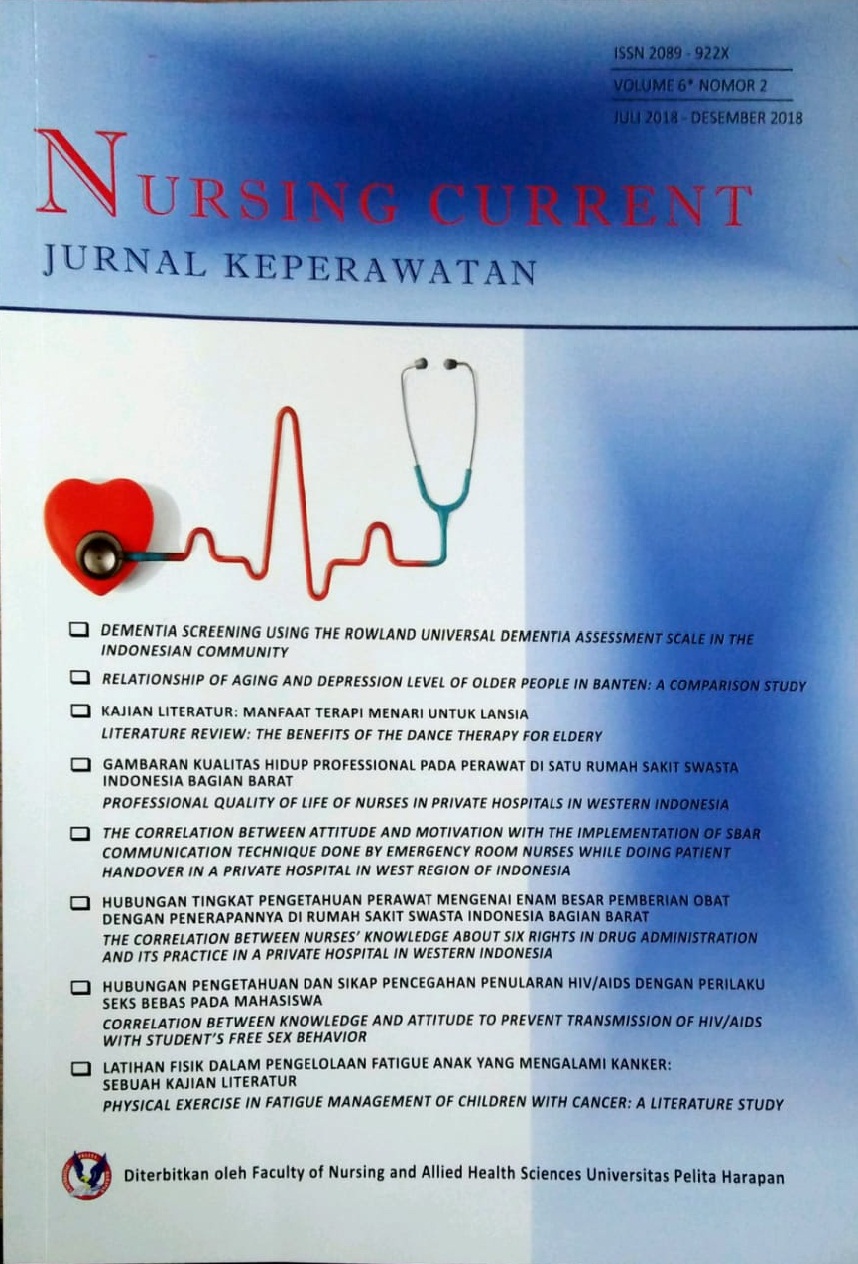
THE CORRELATION BETWEEN ATTITUDE AND MOTIVATION WITH THE IMPLEMENTATION OF SBAR COMMUNICATION TECHNIQUE DONE BY EMERGENCY ROOM NURSES WHILE DOING PATIENT HANDOVER IN A PRIVATE HOSPITAL IN WEST REGION OF INDONESIA
DOI:
https://doi.org/10.19166/nc.v6i2.1907Λέξεις-κλειδιά:
Communication, SBAR, Motivation, Attitude, HandoverΠερίληψη
The effective communication increase is one of the seven goals of patient safety. The SBARcommunication technique is part of it. There are several factors that influence the application of SBAR communication namely; knowledge, attitude and motivation. According to the Joint Commission International (JCI) and the World Health Organization (WHO) of 25,000-30,000 cases of permanent disability in patients in Australia, 11% was due to communication failure. Based on interviews by researcher with head nurses on February 19, 2018, March 3, 2018, March 4, 2018 and March 6, 2018 with several nurses and also the head nurse, and in three observations conducted in March in a Private Hospital in West Region of Indonesian, it was found that nurses had not conducted SBAR communication technique in accordance with the SOP (Standard Operational Procedure). This study was conducted to analyze the factors associated with the implementation of SBAR communication technique while doing patient handover by emergency Room nurses in a Private Hospital in West Region of Indonesia. This study employed quantitative methodology with a cross-sectional research design. Sampling was done by total sampling technique to 12 nurses. Data collection was done using a questionnaire to measure variables of the attitudes and motivation of nurses and observation sheets to assess the implementation of SBAR communication technique by nurses. The results of bivariate analysis using Chi-Square showed that there was a correlation between the attitude of emergency nurses with the implementation of SBAR communication technique while doing patient handover (p value <0.05), but there was no correlation between the motivation of nurses with the implementation of SBAR communication technique while doing patient handover (p value> 0.05). As the Suggestions for the hospital, the results of the study can be used as a reference in the implementation of SBAR communication technique by improving positive attitude of nurses.
Αναφορές
Abdullah, M. (2014). Manajemen dan Evaluasi Kinerja Karyawan. Aswaja Pressindo.
Cahyono, J. S. (2008). Membangun Budaya Keselamatan Pasien dalam Praktek Kedokteran. Kanisius.
Dingley, C., Daugherty, D. K., Derieg, M. K., & Persing, R. (2008) Improving patient safety through provider communication strategy enhancements. In K. Henriksen, J. B. Battles, M. A. Keyes, & M. L. Grady (Eds.), Advances in Patient Safety New Directions and Alternative Approaches, Vol. 3. https://www.scirp.org/(S(i43dyn45teexjx455qlt3d2q))/reference/referencespapers.aspx?referenceid=2582895" target="_blank">https://www.scirp.org/(S(i43dyn45teexjx455qlt3d2q))/reference/referencespapers.aspx?referenceid=2582895
Friesen, M. A., White, S. V., & Byers, J. F. Handoffs: Implications for nurses. In R. G., Hughes (Ed.), Patient Safety and Quality: An Evidence-Based Handbook for Nurses. Agency for Healthcare Research and Quality. https://www.ncbi.nlm.nih.gov/books/NBK2649/" target="_blank">https://www.ncbi.nlm.nih.gov/books/NBK2649/Interprofessional Communication Sbar Module. (n.d.). https://www.jefferson.edu/content/dam/tju/JIEC/files/SBAR%20IPE%20ppt.pdf" target="_blank">https://www.jefferson.edu/content/dam/tju/JIEC/files/SBAR%20IPE%20ppt.pdf
Mariani, P. D., Sudarta, W., & Listyaningsih, E. (1970, January 1). Analisis Faktor Yang Mempengaruhi Pelaksanaan komunikasi SBAR Dalam Rekam medis terintegrasi Ruang Rawat INAP III Rumah Sakit Panti Rapih Yogyakarta Februari-Maret 2014: Semantic scholar. https://www.semanticscholar.org/paper/ANALISIS-FAKTOR-YANG-MEMPENGARUHI-PELAKSANAAN-SBAR-Mariani-Sudarta/07dbc03cab43874f470a38d70d3b192adcf29ac0" target="_blank">https://www.semanticscholar.org/paper/ANALISIS-FAKTOR-YANG-MEMPENGARUHI-PELAKSANAAN-SBAR-Mariani-Sudarta/07dbc03cab43874f470a38d70d3b192adcf29ac0
Rezkiki, F., & Utami, G. S. (2016). Faktor Yang Berhubungan Dengan Penerapan Komunikasi Sbar Di Ruang Rawat Inap. Jurnal Human Care. https://repository.fdk.ac.id/journal/detail/257/faktor-faktor-yang-berhubungan-denganpenerapan-komunikasi-sbar-pada-saat-overan-dinas-di-ruang-rawat-inap-rsambukittinggi-tahun-2016" target="_blank">https://repository.fdk.ac.id/journal/detail/257/faktor-faktor-yang-berhubungan-denganpenerapan-komunikasi-sbar-pada-saat-overan-dinas-di-ruang-rawat-inap-rsambukittinggi-tahun-2016 World Health Organization. (2007, May). Communication during patient hand-overs. Patient Safety Solutions, 1, solution 3. https://www.who.int/patientsafety/solutions/patientsafety/PS-Solution3.pdf" target="_blank">https://www.who.int/patientsafety/solutions/patientsafety/PS-Solution3.pdf Peraturan menteri Kesehatan republik Indonesia 2016 sistem. (n.d.). http://hukor.kemkes.go.id/uploads/produk_hukum/PMK_No._19_ttg_Sistem_Penanggulangan_Gawat_Darurat_Terpadu_.pdf" target="_blank">http://hukor.kemkes.go.id/uploads/produk_hukum/PMK_No._19_ttg_Sistem_Penanggulangan_Gawat_Darurat_Terpadu_.pdfRiyanto, A. (2011). Aplikasi Metodologi Penelitian Kesehatan. Nuha Medika.
Santrock, J. W. (2013). Psikologi Pendidikan (2nd ed.). Kencana.
Wawan, A., & Dewi, M. (2010). Teori dan Pengukuran Pengetahuan, Sikap dan Perilaku Manusia. Nuha Medika.
Widayatun, T. R. (2009). Ilmu Perilaku M.A. 104. Sagung Seto.
Λήψεις
Δημοσιευμένα
Πώς να δημιουργήσετε Αναφορές
Τεύχος
Ενότητα
Άδεια
Authors who publish with this journal agree to the following terms:
1) Authors retain copyright and grant the journal right of first publication with the work simultaneously licensed under a Creative Commons Attribution License (CC-BY-SA 4.0) that allows others to share the work with an acknowledgement of the work's authorship and initial publication in this journal.
2) Authors are able to enter into separate, additional contractual arrangements for the non-exclusive distribution of the journal's published version of the work (e.g., post it to an institutional repository or publish it in a book), with an acknowledgement of its initial publication in this journal.
3) Authors are permitted and encouraged to post their work online (e.g., in institutional repositories or on their website). The final published PDF should be used and bibliographic details that credit the publication in this journal should be included.

This work is licensed under a Creative Commons Attribution-ShareAlike 4.0 International License.
 Faculty of Nursing | Universitas Pelita Harapan | Lippo Karawaci, Tangerang, Indonesia, 15811 |