
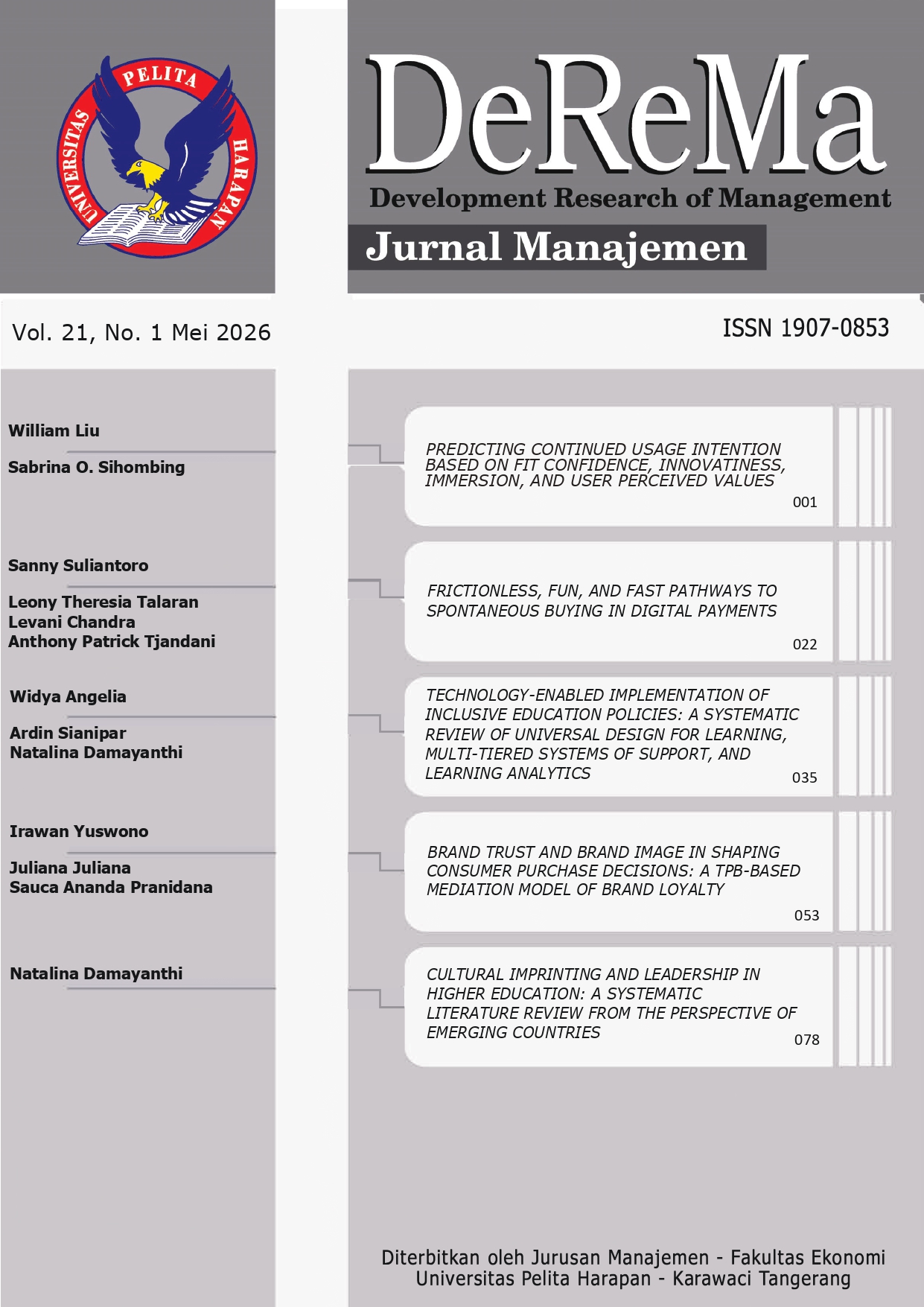
FRICTIONLESS, FUN, AND FAST: PATHWAYS TO SPONTANEOUS BUYING IN DIGITAL PAYMENTS
DOI:
https://doi.org/10.19166/derema.v21i1.10596Schlagworte:
Digital Convenience, Impulsive Buying, Perceived Usefulness, Hedonic MotivationAbstract
This study examines the effect of digital convenience on impulsive buying behavior, with perceived usefulness and hedonic motivation as mediating variables among e-wallet users in Indonesia. A quantitative explanatory research design was employed, with data collected from 157 respondents through purposive sampling using an online questionnaire. Structural Equation Modeling (SEM-PLS) was applied to analyze the relationships between variables. The results indicate that digital convenience does not have a direct effect on impulsive buying, but it significantly influences impulsive buying indirectly through both perceived usefulness and hedonic motivation. Hedonic motivation was found to be the stronger mediator, suggesting that emotional enjoyment plays a more dominant role than cognitive perceptions of usefulness in driving impulsive purchases. These findings highlight the importance of enhancing both functional convenience and hedonic experiences in digital platforms to better understand consumer behavior in the Indonesian e-commerce context.
Literaturhinweise
Acquila-Natalie, E., & Iglesias-Pradas, S. (2020). How to measure quality in multi-channel retailing and not die trying. Journal of Business Research, 109, 38–48. https://doi.org/https://doi.org/10.1016/j.jbusres.2019.10.041
Agnihotri, A. (2019). Can Brick-and-Mortar Retailers Successfully Become Multichannel Retailers ? Journal of Marketing Channels, 22, 37–41. https://doi.org/10.1080/1046669X.2015.978702
Ali, H., Hamdan, H., & Mahaputra, M. R. (2022). Faktor Eksternal Perceived Ease of Use dan Perceived Usefulness pada Aplikasi Belanja Online : Adopsi Technology Accepted Model. JIM : Jurnal Ilmu Multidisiplin, 1(3), 587–604. https://doi.org/https://doi.org/10.38035/jim.v1i3
Anwar, M. (2024). How does tam affect impulsive buying on halal fashion products via shopping mobile apps?. Journal of Islamic Marketing, 15(10), 2481-2507. https://doi.org/10.1108/jima-03-2023-0096
Craig, S. G., Hoang, E. C., & Kohlhase, J. E. (2020). Does closeness in virtual space complement urban space? Socio-Economic Planning Sciences, 58, 22–29. https://doi.org/https://doi.org/10.1016/j.seps.2016.11.002
Emanuella, J. (2023). The effect of promotion, web quality and ease of electronic payment (e-wallet) moderated by positive emotions on skincare impulse buying. Eduvest - Journal of Universal Studies, 3(12), 2043-2057. https://doi.org/10.59188/eduvest.v3i12.974
Emanuella, J. (2024). The influence of promotion, web quality, and electronic payment (e-wallet) convenience moderated by positive emotions on impulsive skincare purchases. Ekombis Review Jurnal Ilmiah Ekonomi Dan Bisnis, 12(2). https://doi.org/10.37676/ekombis.v12i2.5197
Gu, Q. and Li, P. (2024). Factors influencing user's continuance intention towards e-cny payment in shanghai, china. IJSASR, 4(4), 277-290. https://doi.org/10.60027/ijsasr.2024.4283
Hernita, N., Istiono, D., & Nur, L. Z. (2022). Hedonic Shopping Motivation and Sales Promotion Culture on Impulsive Buying Shopee E-Commerce Users. Titian : Jurnal Humaniora, 06(2). https://doi.org/https://doi.org/10.22437/titian.v6i2.21597
Iftitah, N., Hidajat, W., & Widiartanto. (2023). PENGARUH HEDONIC SHOPPING MOTIVATION DAN PROMOTION. Jurnal Ilmu Administrasi Bisnis, 12(2), 582–592. https://ejournal3.undip.ac.id/index.php/jiab
Indriawan, B. M., & Santoso, I. H. (2023). Pengaruh Sales Promotion , Content Marketing , Dan Shopping Lifestyle Content Creator Tiktok Terhadap Keputusan Impulse Buying Pada E-Commerce Shopee. Jurnal Ekombis Review, 11(1), 905–914. https://doi.org/https://doi.org/10.37676/ekombis.v11i1
Kalia, P., & Paul, J. (2021). E-service quality and e-retailers: Attribute-based multi-dimensional scaling. Computers in Human Behavior, 115. https://doi.org/https://doi.org/10.1016/j.chb.2020.106608
Lee, Y., Gan, C., & Liew, T. (2022). The impacts of mobile wallet app characteristics on online impulse buying: a moderated mediation model. Human Behavior and Emerging Technologies, 2022, 1-15. https://doi.org/10.1155/2022/2767735
Lim, C., Tiglao, L., Manuel, C., Delina, L., & Chan, J. (2024). Exploring the stimulus organism response (sor) framework that shapes impulse buying in the epoch of e-wallets in the philippines. European Journal of Theoretical and Applied Sciences, 2(2), 283-290. https://doi.org/10.59324/ejtas.2024.2(2).25
Mohammadi, S., & Dickson, G. (2020). Online Shopping for Sporting Goods: The Role of Flow, E-Satisfaction, and E-Loyalty. Global Business Review, 11(3). https://doi.org/https://doi.org/10.1177/09721509211019516
Mustikasari, A. and Ariyani, S. (2022). Impulse buying in z-generation: the influence of hedonic shopping motivation and utilitarian value in indonesian online marketplace. Manthan Journal of Commerce and Management, 9(1), 1-19. https://doi.org/10.17492/jpi.manthan.v9i1.912201
Natalie, W., Anggraini, D., & Supriyanto, S. (2022). Pengaruh Hedonic Shopping Motivation Dan Shopping Lifestyle Terhadap E-Impulse Buying pada Marketplace Shopee. JUMANAGE: Jurnal Ilimiah Manajeen dan Kewirausahaan, 3(2), 504–511. https://doi.org/10.33998/jumanage.2025.4.1.1713
Permana, G. P. L., & Parasari, A. A. A. I. (2019). Pengaruh Hedonic Motivation, Social Influence, dan Perceived Enjoyment terhadap Penggunaan Marketplace pada UMKM di Bali: Studi Kasus pada HIPMI Provinsi Bali. Jurnal Ilmiah Manajemen dan Bisnis, 4(1), 90–102. http://journal.undiknas.ac.id/index.php/manajemen
Prakarsa, G., & Nursyanti, R. (2025). Development of UTAUT Model with Hedonic Motivation to Measure the Adoption of E-Marketplace Mobile Application in Indonesia Pengembangan Model UTAUT dengan Hedonic Motivation untuk Mengukur Adopsi Penggunaan Aplikasi Mobile E-Marketplace di Indonesia. Sainteks: Jurnal Sains dan Teknik, 7(01), 160–172. http://ejournal.uicm.ac.id/index.php/sainteks/
Rahmawati, A. F. D., Sudaryanto, & Paramu, H. (2025). Repurchase Intention of Gen Z on Shopee Marketplace : A Technology Acceptance Model Approach. Jurnal Penelitian Ilmu Ekonomi, 15(2), 114–126. https://doi.org/https://doi.org/10.30741/wiga.v15i2.1564
Refiyahya, A. H., & Yulinda, A. T. (2025). Pengaruh Customer Experience dan Hedonic Shopping Value terhadap Impulsive Buying Pada Aplikasi Shopee. Jurnal Entrepreneur dan Manajemen Sains, 6(2), 581–596. https://doi.org/https://doi.org/10.36085/jems.v6i2.8343
Salsabila, F., Rohman, F., & Hapsari, R. (2025). Time pressure drives impulsive buying behavior through hedonic motivation and utilitarian motivation: an e-commerce perspective. Jurnal Fokus Manajemen Bisnis, 15(2), 169-183. https://doi.org/10.12928/fokus.v15i2.13241
Sumi, R. and Ahmed, M. (2022). Investigating young consumers’ online buying behavior in covid-19 pandemic: perspective of bangladesh. Iim Ranchi Journal of Management Studies, 1(2), 108-123. https://doi.org/10.1108/irjms-09-2021-0127
Suryano, D., Ermansyah, & Sukri, S. Al. (2021). Pengaruh Perceived Ease of Use, Perceived Usefulness, dan Trust terhadap Kepuasan Pelanggan Gojek. IJBEM: Indonesian Journal of Business Economics and Management, 1, 11–19. https://journal.irpi.or.id/index.php/ijbem
Syamilah, F., Sadat, A. M., & Berutu, M. B. (2025). The Influence of Perceived Usefulness, Perceived Ease of Use, and Perceived Value on Intention to Use E-Commerce. Jurnal Riset Manajemen Sains Indonesia, 16(2), 88–99. https://doi.org/https://doi.org/10.21009/JRMSI.016.2.7
Trade.gov. (2024). Indonesia – eCommerce (Country Commercial Guide). U.S International Trade Administration. https://www.trade.gov/country-commercial-guides/indonesia-ecommerce
Vyt, D., Jara, M., Mevel, O., & Morvan, T. (2022). International Journal of Production Economics The impact of convenience in a click and collect retail setting : A consumer-based approach. International Journal of Production Economics, 248. https://doi.org/10.1016/j.ijpe.2022.108491
Wen, H., Pookulangara, S., & Josiam, B. (2021). A comprehensive examination of consumers' intentions to use food delivery apps. British Food Journal, 124(5), 1737-1754. https://doi.org/10.1108/bfj-06-2021-0655
Downloads
Veröffentlicht
Ausgabe
Rubrik
Lizenz
Copyright (c) 2026 GRACELA MARISA SANAPANG, Sanny Suliantoro, Levani Chandra, Leony Theresia Talaran, Steven Yoel Jonathan, Anthony Patrick Tjandani

Dieses Werk steht unter der Lizenz Creative Commons Namensnennung - Weitergabe unter gleichen Bedingungen 4.0 International.
Authors who publish with this journal agree to the following terms:
1) Authors retain copyright and grant the journal right of first publication with the work simultaneously licensed under a Creative Commons Attribution License (CC-BY-SA 4.0) that allows others to share the work with an acknowledgement of the work's authorship and initial publication in this journal.
2) Authors are able to enter into separate, additional contractual arrangements for the non-exclusive distribution of the journal's published version of the work (e.g., post it to an institutional repository or publish it in a book), with an acknowledgement of its initial publication in this journal.
3) Authors are permitted and encouraged to post their work online (e.g., in institutional repositories or on their website). The final published PDF should be used and bibliographic details that credit the publication in this journal should be included.



 Department of Management | Business School | Universitas Pelita Harapan | Indonesia | +62 21 546 0901 | jurnal.derema@uph.edu