
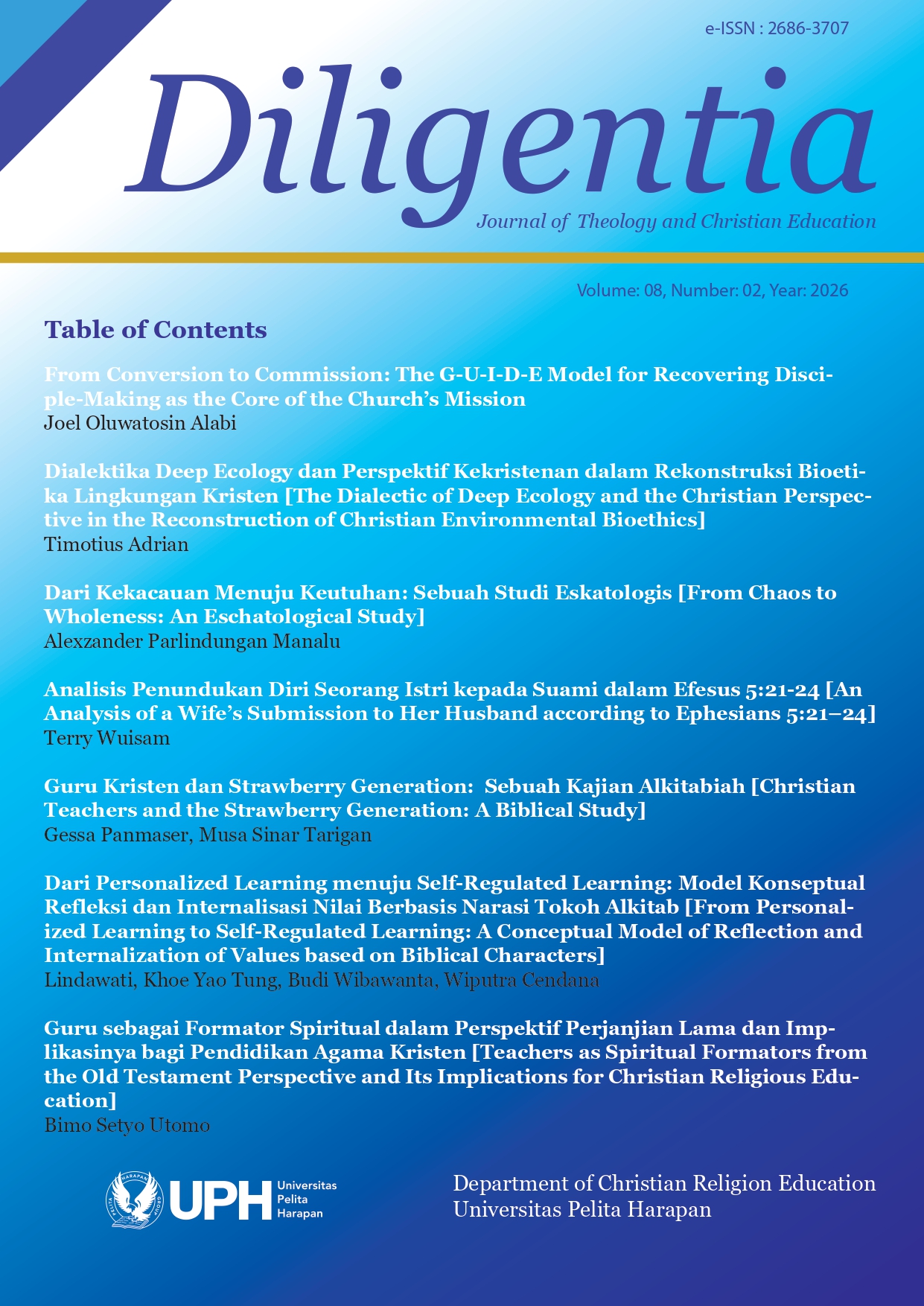
Analisis Penundukan Diri Seorang Istri Kepada Suami Dalam Efesus 5:22
##semicolon##
https://doi.org/10.19166/dil.v8i2.11005##semicolon##
wife submission##common.commaListSeparator## ephesians 5:21-24##common.commaListSeparator## hupotasso##common.commaListSeparator## hermeneutic-exegetical##common.commaListSeparator## servant leadership##common.commaListSeparator## family theology##common.commaListSeparator## mutual submission要旨
Penelitian ini menganalisis makna penundukan isteri dalam Efesus 5:21–24 dan implikasinya bagi kehidupan suami-isteri. Masalah penelitian: minimnya pemahaman hermeneutik atas konsep “tunduk” dalam bingkai ayat 21 yang menyebabkan praktik rumah tangga menyimpang dari niat teologis Paulus; serta ketegangan antara tuntutan tekstual dan dinamika sosial-kultural modern yang membuka peluang penyalahgunaan otoritas. Tujuan penelitian adalah menjelaskan makna leksikal-gramatikal istilah Yunani hupotassō dan merumuskan aplikasi pastoral yang adil dan kristosentris. Metode yang dipakai adalah penelitian kualitatif kepustakaan dengan pendekatan hermeneutik-eksegetis, meliputi analisis sejarah-kultural, studi leksikal bahasa Yunani, dan eksegesis sinkronis pada perikop Efesus 5:21–33 yang didukung teks kritis, leksikon, dan tafsiran utama. Tesis penelitian menyatakan bahwa ketundukan isteri bukan subordinasi budaya tetapi respons relasional sukarela yang berakar pada kasih dan ketaatan kepada Kristus. Temuan menunjukkan hupotassō menandai fungsi-posisional berkelanjutan dan menuntut otoritas suami sebagai kepemimpinan pengorbanan yang melindungi martabat isteri. Simpulan merekomendasikan model pembinaan keluarga yang menekankan mutual submission, kepemimpinan pelayanan, pemberdayaan isteri, mekanisme perlindungan, dan studi empiris lintas budaya.
##submission.citations##
Ademiluka, Solomon O. “‘For the Husband Is the Head of the Wife’: A Contextual Re-Reading of Ephesians 5:22–33 among Nigerian Yoruba Christians.” In die Skriflig/In Luce Verbi 55, no. 1 (February 2021): 1–10. https://doi.org/10.4102/ids.v55i1.2613.
Ademiluka, Solomon O. “Patriarchy and Marital Disharmony amongst Nigerian Christians: Ephesians 5:22–33 as a Response,” HTS Teologiese Studies/Theological Studies 77, no. 4 (March 2021): 1–9, https://doi.org/10.4102/hts.v77i4.5991.
Arnold, Clinton E. Ephesians. Zondervan Exegetical Commentary on the New Testament 10. Grand Rapids, MI: Zondervan, 2010.
Balch, David L. Let Wives be Submissive: The Domestic Code in 1 Peter. Chico, CA: Scholars Press, 1981.
Barth, Markus. Ephesians 4–6: A New Translation with Introduction and Commentary. The Anchor Bible 34A. Garden City, NY: Doubleday & Company, 1974.
Bulahari, Herling Fredriek, Muner Daliman, Tonny Andrian Stefanus, Maria Titik Windarti, and Tamba Parulian. “The Love of Christ in Husband - Wife Relationships based on Ephesians 5:22–33 - Implications for Christian Families.” Pharos Journal of Theology 105, no. 1 (January 2024): 1–14. https://doi.org/10.46222/pharosjot.1055.
“Codex Sinaiticus (GA 01).” London, 4th Century. Add MS 43725. British Library. https://www.codexsinaiticus.org/en/.
“Codex Vaticanus (GA 03).” Vatican City, 4th Century. Vat. gr. 1209. Biblioteca Apostolica Vaticana. https://digi.vatlib.it/view/MSS_Vat.gr.1209.
Cohick, Lynn H. The Letter to the Ephesians. New International Commentary on the New Testament. Grand Rapids, MI: Eerdmans, 2020.
De Carvalho, José. “An Exegetical Study of Ephesians 5:22–24: A Christo-Ethical Model for Interpreting ‘Wives, Submit to Your Husbands’.” The South African Baptist Journal of Theology 34, no. 1 (November 2025): 1–19. https://tsabjt.co.za/an-exegetical-study-of-ephesians-522-24.
Gurry, Peter J. “The Text of Eph 5.22 and the Start of the Ephesian Household Code.” New Testament Studies 67, no. 4 (October 2021): 560–581. https://doi.org/10.1017/S002868852100014X.
Hetharie, Yosa Marianta. “Ketundukan Setara pada Kasih Kristus: Tafsir Feminis atas Efesus 5:22–33 dan Implikasinya bagi Perempuan Penyintas Kekerasan.” CARAKA: Jurnal Teologi Biblika dan Praktika 4, no. 1 (May 2023): 92–111. https://doi.org/10.46348/car.v4i1.115.
Hoehner, Harold W. Ephesians: An Exegetical Commentary. Grand Rapids, MI: Baker Academic, 2002.
Keener, Craig S. Paul, Women, and Wives: Marriage and Women’s Ministry in the Letters of Paul. Peabody, MA: Hendrickson Publishers, 1992.
Keller, Timothy J., and Kathy Keller. The Meaning of Marriage: Facing the Complexities of Commitment with the Wisdom of God. New York, NY: Penguin Group, 2011.
Köstenberger, Andreas J., and David W. Jones. God, Marriage, and Family: Rebuilding the Biblical Foundation. 2nd ed. Wheaton, IL: Crossway, 2010.
Lee-Barnewall, Michelle. Neither Complementarian nor Egalitarian: A Kingdom Corrective to the Evangelical Gender Debate. Grand Rapids, MI: Baker Academic, 2016.
Lincoln, Andrew T. Ephesians. Word Biblical Commentary 42. Nashville, TN: Thomas Nelson, Inc., 1990.
MacDonald, Margaret Y. Colossians and Ephesians. Sacra Pagina Series 17, edited by Daniel J. Harrington. Collegeville, MN: Liturgical Press, 2000.
Montanaro, Andrew. “Living in the New Creation: The Household Code in Ephesians as Theological Instruction.” Religions 16, no. 2 (February 2025): 1-16. https://doi.org/10.3390/rel16020258.
Papyrus 46 (46). P. Chester Beatty II; P. Mich. Inv. 6238. Ca. AD 200. Chester Beatty Library, Dublin, and University of Michigan Library, Ann Arbor. https://viewer.cbl.ie/viewer/browse/.
Payne, Philip B. Man and Woman, One in Christ: An Exegetical and Theological Study of Paul’s Letters. Grand Rapids, MI: Zondervan, 2009.
Reumann, John. “Pauline Theology.” In Variety and Unity in New Testament Thought, The Oxford Bible Series, 71–94. New York, NY: Oxford University Press, 1991. https://doi.org/10.1093/acprof:oso/9780198262015.003.0006.
Setianto, Yusak. “‘Gender Structure’ (Biblical Perspective on Gender Equality),” Phronesis: Jurnal Teologi dan Misi 5, no. 1 (June 2022): 66–77. https://doi.org/10.47457/phr.v5i1.255.
Tracy, Steven R. “Patriarchy and Domestic Violence: Challenging Common Misconceptions.” Journal of the Evangelical Theological Society 50, no. 3 (September 2007): 573–594. https://etsjets.org/wp-content/uploads/2010/06/files_JETS-PDFs_50_50-3_JETS_50-3_573-594_Tracy.pdf.
Unachukwu, Daniel. “A Critical Analysis of Ephesians 5:21-33 in the Light of Christian Marriage in Ebonyi State, Nigeria,” Studia Historiae Ecclesiasticae 50, no. 3 (August 2024): 1–16. https://doi.org/10.25159/2412-4265/17072.
Westfall, Cynthia Long. Paul and Gender: Reclaiming the Apostle’s Vision for Men and Women in Christ. Grand Rapids, MI: Baker Academic, 2016. https://inchristus.com/wp-content/uploads/2022/05/ExcerptWestfallPaulGndr.pdf
##submission.downloads##
出版済
##submission.howToCite##
巻号
セクション
##submission.license##
##submission.copyrightStatement##
##submission.license.cc.by-sa4.footer##Authors who publish with this journal agree to the following terms:
1) Authors retain copyright and grant the journal right of first publication with the work simultaneously licensed under a Creative Commons Attribution License (CC-BY-SA 4.0) that allows others to share the work with an acknowledgement of the work's authorship and initial publication in this journal.
2) Authors are able to enter into separate, additional contractual arrangements for the non-exclusive distribution of the journal's published version of the work (e.g., post it to an institutional repository or publish it in a book), with an acknowledgement of its initial publication in this journal.
3) Authors are permitted and encouraged to post their work online (e.g., in institutional repositories or on their website). The final published PDF should be used and bibliographic details that credit the publication in this journal should be included











 Christian Religion Education | Universitas Pelita Harapan | Indonesia | +62 21 546 0901 |