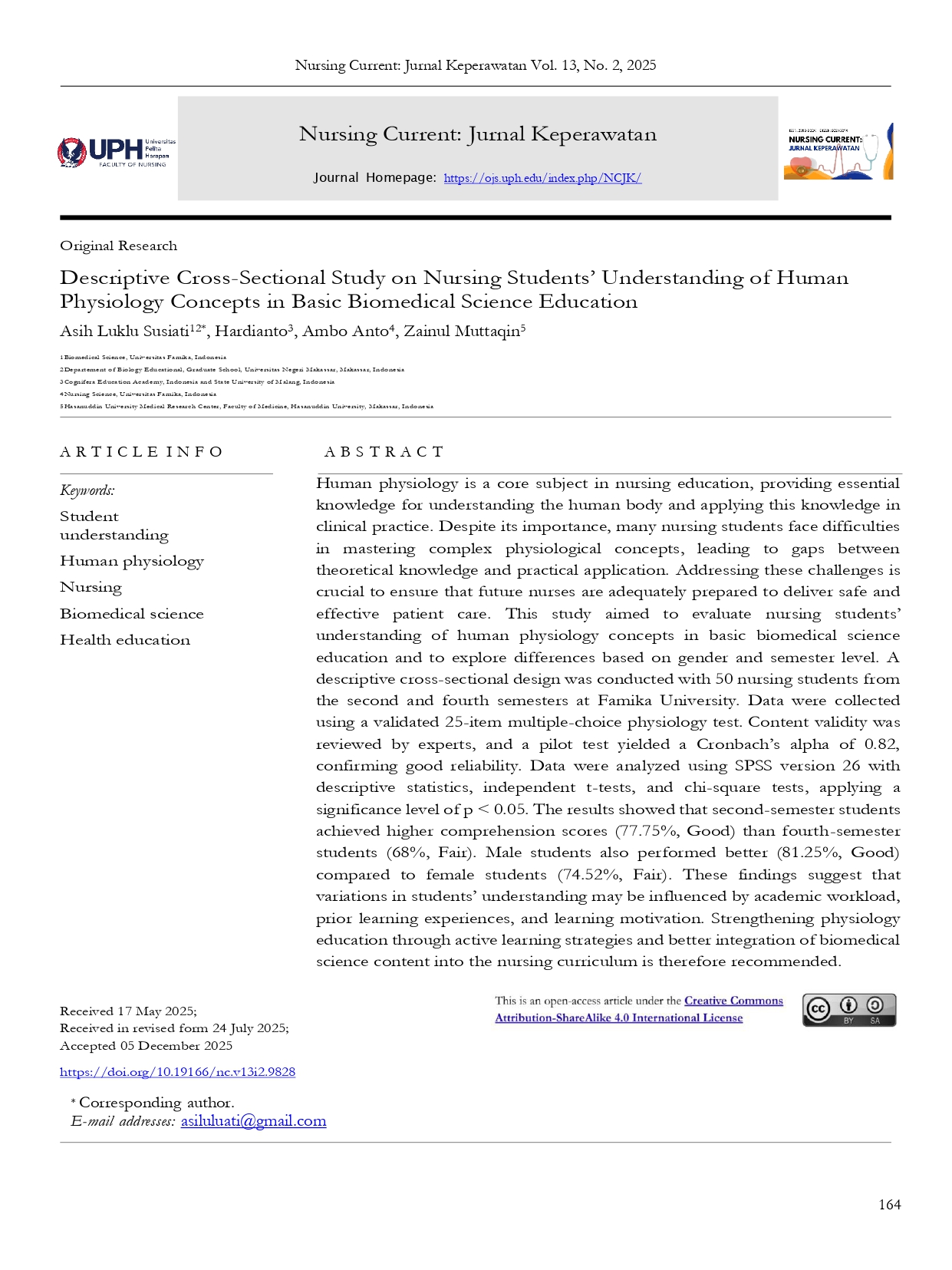
Descriptive Cross-Sectional Study on Nursing Students’ Understanding of Human Physiology Concepts in Basic Biomedical Science Education
DOI:
https://doi.org/10.19166/nc.v13i2.9828Trefwoorden:
Student understanding, Human physiology, Nursing, Biomedical science, Health educationSamenvatting
Human physiology is a core subject in nursing education, providing essential knowledge for understanding the human body and applying this knowledge in clinical practice. Despite its importance, many nursing students face difficulties in mastering complex physiological concepts, leading to gaps between theoretical knowledge and practical application. Addressing these challenges is crucial to ensure that future nurses are adequately prepared to deliver safe and effective patient care. This study aimed to evaluate nursing students’ understanding of human physiology concepts in basic biomedical science education and to explore differences based on gender and semester level. A descriptive cross-sectional design was conducted with 50 nursing students from the second and fourth semesters at Famika University. Data were collected using a validated 25-item multiple-choice physiology test. Content validity was reviewed by experts, and a pilot test yielded a Cronbach’s alpha of 0.82, confirming good reliability. Data were analyzed using SPSS version 26 with descriptive statistics, independent t-tests, and chi-square tests, applying a significance level of p < 0.05. The results showed that second-semester students achieved higher comprehension scores (77.75%, Good) than fourth-semester students (68%, Fair). Male students also performed better (81.25%, Good) compared to female students (74.52%, Fair). These findings suggest that variations in students’ understanding may be influenced by academic workload, prior learning experiences, and learning motivation. Strengthening physiology education through active learning strategies and better integration of biomedical science content into the nursing curriculum is therefore recommended.
Referenties
Aboregela, A. M., Sonpol, H. M. A., Metwally, A. S., El-Ashkar, A. M., Hashish, A. A., Mohammed, O. A., Elnahriry, T. A., Senbel, A., & Alghamdi, M. (2023). Medical students’ perception and academic performance after team-based and seminar-based learning in human anatomy. Journal of Taibah University Medical Sciences, 18(1), 65–73. https://doi.org/10.1016/j.jtumed.2022.08.005
Albloushi, M., Innab, A., Mofdy Almarwani, A., Alqahtani, N., Anazi, M., Roco, I., & Alzahrani, N. S. (2023). The Influence of Internship Year on Nursing Students’ Perceived Clinical Competence: A Multi-Site Study. Sage Open, 13(3). https://doi.org/10.1177/21582440231193198
Ashwathy, V., Avanthi, E., Narayanam, H., & Lokesh, B. (2024). Perception of undergraduate medical students on learning physiology: A descriptive cross-sectional study in a medical school of South India. Journal of Education and Health Promotion, 13(1). https://doi.org/10.4103/jehp.jehp_1077_23
Astin, F., Carroll, D. L., Ruppar, T., Uchmanowicz, I., Hinterbuchner, L., Kletsiou, E., Serafin, A., & Ketchell, A. (2015). A core curriculum for the continuing professional development of nurses: Developed by the Education Committee on behalf of the Council on Cardiovascular Nursing and Allied Professions of the ESC. European Journal of Cardiovascular Nursing, 14(3), 190–197. https://doi.org/10.1177/1474515115572048
Bandura, A. (1986). Social Foundations of Thought and Action: A social cognitive theory (Vol. 1986). Upper Saddle River, NJ: Prentice Hall.
Brown, S. J., White, S., & Power, N. (2017). Introductory anatomy and physiology in an undergraduate nursing curriculum. Advances in Physiology Education, 41(1), 56–61. https://doi.org/10.1152/advan.00112.2016
Dale, E. (1946). Audio-Visual Methods in Teaching. Dryden Press.
Horiuchi-Hirose, M., Fukuoka, T., & Saeki, Y. (2023). Integration of anatomy and physiology into nursing practice as perceived by undergraduate students and registered nurses: a scoping review. BMC Nursing, 22(1), 270. https://doi.org/10.1186/s12912-023-01436-0
Horntvedt, M.-E. T., Nordsteien, A., Fermann, T., & Severinsson, E. (2018). Strategies for teaching evidence-based practice in nursing education: a thematic literature review. BMC Medical Education, 18(1), 172. https://doi.org/10.1186/s12909-018-1278-z
Iqbal, S., Akram, R., Gohar, B., Mahmood, A., Naz, N., & Mudasar, S. (2019). Metacognitive Awareness and Academic Achievement of Medical Students in Different Medical Colleges of Lahore, Pakistan. International Journal of Contemporary Medical Research [IJCMR], 6(9). https://doi.org/10.21276/ijcmr.2019.6.9.32
Kaur, H., & Chadda, I. (2022). Online Education during COVID-19 in Punjab: A Study on Perception of Teachers. Indian Journal of Educational Technology, 4(2), 29–39.
Kuklinski, M. R., & Weinstein, R. S. (2001). Classroom and Developmental Differences in a Path Model of Teacher Expectancy Effects. Child Development, 72(5), 1554–1578. https://doi.org/10.1111/1467-8624.00365
Lazaridou, A. (2024). Gender Differences in Educational Leadership and Values: Adding Insights from a Neuro-Social Perspective. European Journal of Education and Pedagogy, 5(5), 54–61. https://doi.org/10.24018/ejedu.2024.5.5.837
Nuuyoma, V., & Fillipus, S. K. (2020). Nursing students’ perceptions and experiences of concept mapping as a learning tool in a human physiology course. African Journal of Health Professions Education, 12(3), 98. https://doi.org/10.7196/AJHPE.2020.v12i3.1330
Quiroga, M. del M., & Choate, J. K. (2019). A virtual experiment improved students’ understanding of physiological experimental processes ahead of a live inquiry-based practical class. Advances in Physiology Education, 43(4), 495–503. https://doi.org/10.1152/advan.00050.2019
Rabia Siddiqui, Saif Ullah Shaikh, Lalarukh Munawar, Iram Saddiqa, & Muhammad Faisal Fahim. (2022). Survey of assessment of teaching learning methods for physiology among undergraduate medical students at a university. The Professional Medical Journal, 29(09), 1420–1425. https://doi.org/10.29309/TPMJ/2022.29.09.7013
Teshome, D., Tiruneh, C., Berhanu, L., & Berihun, G. (2021). Medical Students’ Attitude and Perception Towards Basic Medical Science Subjects at Wollo University, Northeast Ethiopia. Advances in Medical Education and Practice, Volume 12, 431–438. https://doi.org/10.2147/AMEP.S309440
Voyer, D., & Voyer, S. D. (2014). Gender differences in scholastic achievement: A meta-analysis. Psychological Bulletin, 140(4), 1174–1204. https://doi.org/10.1037/a0036620
Wood, A. F., Chandler, C., Connolly, S., Finn, G., Redmond, C., Jolly, J., Powell, A. D., Davies, C., & Grant, A. (2020). Designing and developing core physiology learning outcomes for pre-registration nursing education curriculum. Advances in Physiology Education, 44(3), 464–474. https://doi.org/10.1152/advan.00139.2019
Zeyer, A. (2018). Gender, complexity, and science for all: Systemizing and its impact on motivation to learn science for different science subjects. Journal of Research in Science Teaching, 55(2), 147–171. https://doi.org/10.1002/tea.21413
##submission.downloads##
Gepubliceerd
Citeerhulp
Nummer
Sectie
Licentie
Copyright (c) 2025 Asih Luklu Susiati, Hardianto Hardianto, Ambo Anto, Zainul Muttaqin

Dit werk wordt verdeeld onder een Naamsvermelding-GelijkDelen 4.0 Internationaal licentie.
Authors who publish with this journal agree to the following terms:
1) Authors retain copyright and grant the journal right of first publication with the work simultaneously licensed under a Creative Commons Attribution License (CC-BY-SA 4.0) that allows others to share the work with an acknowledgement of the work's authorship and initial publication in this journal.
2) Authors are able to enter into separate, additional contractual arrangements for the non-exclusive distribution of the journal's published version of the work (e.g., post it to an institutional repository or publish it in a book), with an acknowledgement of its initial publication in this journal.
3) Authors are permitted and encouraged to post their work online (e.g., in institutional repositories or on their website). The final published PDF should be used and bibliographic details that credit the publication in this journal should be included.

This work is licensed under a Creative Commons Attribution-ShareAlike 4.0 International License.






 Faculty of Nursing | Universitas Pelita Harapan | Lippo Karawaci, Tangerang, Indonesia, 15811 |