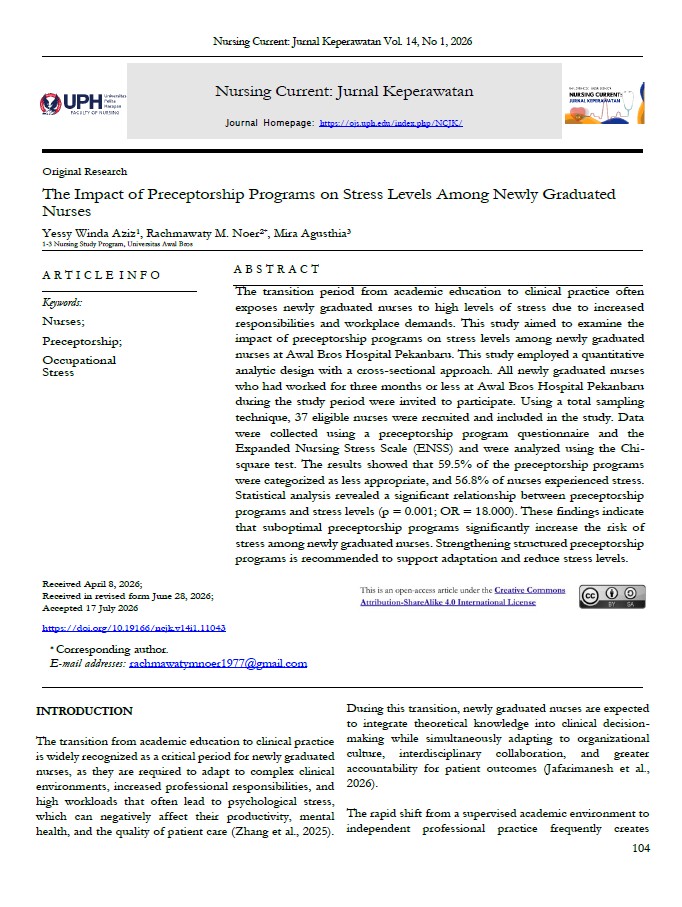
The The Impact of Preceptorship Programs on Stress Levels Among Newly Graduated Nurses
DOI:
https://doi.org/10.19166/ncjk.v14i1.11043Keywords:
Nurses, Preceptorship, Occupational StressAbstract
The transition period from academic education to clinical practice often exposes newly graduated nurses to high levels of stress due to increased responsibilities and workplace demands. This study aimed to examine the impact of preceptorship programs on stress levels among newly graduated nurses at Awal Bros Hospital Pekanbaru. This study employed a quantitative analytic design with a cross-sectional approach. All newly graduated nurses who had worked for three months or less at Awal Bros Hospital Pekanbaru during the study period were invited to participate. Using a total sampling technique, 37 eligible nurses were recruited and included in the study. Data were collected using a preceptorship program questionnaire and the Expanded Nursing Stress Scale (ENSS) and were analyzed using the Chi-square test. The results showed that 59.5% of the preceptorship programs were categorized as less appropriate, and 56.8% of nurses experienced stress. Statistical analysis revealed a significant relationship between preceptorship programs and stress levels (p = 0.001; OR = 18.000). These findings indicate that suboptimal preceptorship programs significantly increase the risk of stress among newly graduated nurses. Strengthening structured preceptorship programs is recommended to support adaptation and reduce stress levels.
References
Ainun, N., Erika, & Wahyuni, S. (2025). Literatur riview: efektifitas program mentorship terhadap peningkatan pengetahuan, keterampilan dan kompetensi perawat. Jurnal Ners Universitas Pahlawan, 9(2), 1278–1283. http://journal.universitaspahlawan.ac.id/index.php/ners
Alharbi, H. F., Alzahrani, J., Hamed, A., Althagafi, A., & Alkarani, A. S. (2023). The experiences of newly graduated nurses during their first year of practice. Healthcare (Switzerland), 11(14). https://doi.org/10.3390/healthcare11142048
Alshareef, M. H., & Flemban, A. F. (2025). How Preceptor Behaviour Shapes the Future of Medical Professionals. Advances in Medical Education and Practice, 16, 135–144. https://doi.org/10.2147/AMEP.S481620
Duchscher, J. E. B. (2009). Transition shock: the initial stage of role adaptation for newly graduated Registered Nurses. Journal of Advanced Nursing, 65(5), 1103–1113. https://doi.org/https://doi.org/10.1111/j.1365-2648.2008.04898.x
Hong, K. J., & Yoon, H. J. (2021). Effect of nurses’ preceptorship experience in educating new graduate nurses and preceptor training courses on clinical teaching behavior. International Journal of Environmental Research and Public Health, 18(3), 1–12. https://doi.org/10.3390/ijerph18030975
Ibrahim, R. K., Safi, M., Darwish, A., Alsalamah, Y. S., Babkair, L., Abdullahi, N. M., Maher, B., Alotaibi, M. N., Alfalaij, M. A., Alahmedi, S. H., Abdelaliem, S. M. F., & Hendy, A. (2025). From student to nurse: exploring transition shock through stress, locus of control, and coping strategies in newly graduated nurses. BMC Psychology, 13(1). https://doi.org/10.1186/s40359-025-03315-6
Jafarimanesh, H., Ghiyasvandian, S., Lyman, B., Ghanaati, H., & Zakerimoghadam, M. (2026). Educational and professional needs of newly graduated nurses during transition to practice: an integrative review. Teaching and Learning in Nursing, 21(2), e912–e923. https://doi.org/https://doi.org/10.1016/j.teln.2025.10.013
Lim, J. Y., Kim, G. M., & Kim, E. J. (2024). Factors Associated with Turnover Intention Among Hospital Nurses: A Systematic Review and Meta-Analysis. J Korean Acad Psychiatr Ment Health Nurs, 33(1), 70–79. https://doi.org/10.12934/jkpmhn.2024.33.1.70
Lima, M. S., & Alzyood, M. (2024). The impact of preceptorship on the newly qualified nurse and preceptors working in a critical care environment: An integrative literature review. Nursing in Critical Care, 29(5), 1178–1189. https://doi.org/https://doi.org/10.1111/nicc.13061
Pakaya, N., & Dulahu, W. Y. (2024). Identification of work stress levels on new nurses. Indonesian Journal of Global Health Research, 6(4), 2273–2280. https://jurnal.globalhealthsciencegroup.com/index.php/IJGHR/article/view/3319
Putra, R. S., Rahmadhani, T. N., & Hidayat, S. (2021). Factors Related to the risk of occupational stress among nurses in the emergency room at Sosodoro Djatikoesoemo Bojonegoro Hospital. Indonesian Journal of Occupational Safety and Health, 10(3), 299–308. https://doi.org/10.20473/ijosh.v10i3.2021.299-308
Setiadi, Farida, I., Fadila, H. S. N., & Bahtyar, H. S. (2025). Peran preceptor dengan kepuasan mahasiswa dalam praktik klinik keperawatan medikal bedah. Journal of Nursing, 2(2), 63–71. https://journal.linkpub.id/index.php/LJN/article/view/61
Wang, Q., Liu, L., Zeng, Q., Su, S., & Gao, S. (2025). Key Competencies for Effective New Nurse Preceptorship: A Scoping Review of Essential Skills and Knowledge. In Journal of Nursing Management (Vol. 2025, Number 1). John Wiley and Sons Ltd. https://doi.org/10.1155/jonm/4509979
Wea, M. E. B. W., Hariyati, Rr. T. S., Handiyani, H., & Wildani, A. A. (2025). The effectiveness of preceptorship programs in improving clinical competence among novice nurses: a systematic review. Nursing Current: Jurnal Keperawatan, 13(2), 139–148. https://doi.org/10.19166/nc.v13i2.10300
Yıldız, C. Ç., Yıldırım, D., Ergin, E., Kasap, E. U., & Korkmaz, İ. (2024). The effects of reality shock on job stress and turnover intention in newly graduated nurses. Journal of Health and Nursing Management, 11(2), 383–392. https://doi.org/10.54304/SHYD.2024.38980
Zhang, Z., Wang, T., Zhao, Y., & Shi, X. (2025). Transition shock experience of newly graduated nurses: a qualitative study. Contemporary Nurse, 61(1), 21–32. https://doi.org/10.1080/10376178.2024.2432636
Zondi, M., & Mkhize, S. W. (2025). Barriers to Effective Clinical Experiences Among Newly Qualified Registered Nurses: A Descriptive Qualitative Study. Healthcare (Switzerland), 13(18). https://doi.org/10.3390/healthcare13182
Downloads
Published
How to Cite
Issue
Section
License
Copyright (c) 2026 Yessy Winda Aziz, Rachmawaty M.Noer, Mira Agusthia

This work is licensed under a Creative Commons Attribution-ShareAlike 4.0 International License.
Authors who publish with this journal agree to the following terms:
1) Authors retain copyright and grant the journal right of first publication with the work simultaneously licensed under a Creative Commons Attribution License (CC-BY-SA 4.0) that allows others to share the work with an acknowledgement of the work's authorship and initial publication in this journal.
2) Authors are able to enter into separate, additional contractual arrangements for the non-exclusive distribution of the journal's published version of the work (e.g., post it to an institutional repository or publish it in a book), with an acknowledgement of its initial publication in this journal.
3) Authors are permitted and encouraged to post their work online (e.g., in institutional repositories or on their website). The final published PDF should be used and bibliographic details that credit the publication in this journal should be included.

This work is licensed under a Creative Commons Attribution-ShareAlike 4.0 International License.
 Published by Faculty of Nursing | Universitas Pelita Harapan | Lippo Karawaci, Tangerang, Indonesia, 15811 |