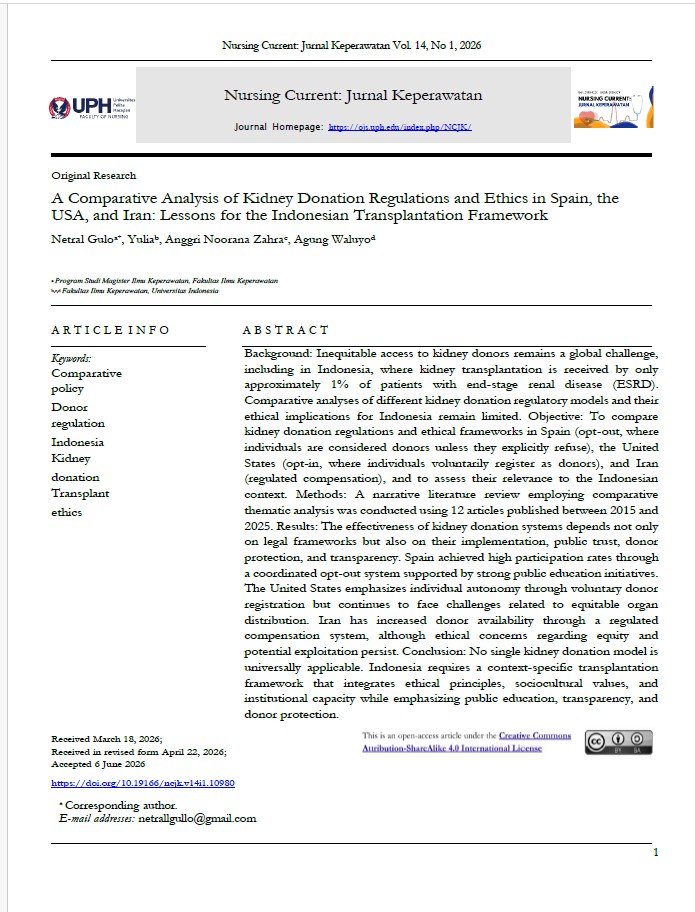
A Comparative Analysis of Kidney Donation Regulations and Ethics in Spain, the USA, and Iran: Lessons for The Indonesian
DOI:
https://doi.org/10.19166/ncjk.v14i1.10980Keywords:
comparative policy; donor regulation; Indonesia; kidney donation; transplant ethicsAbstract
Background: Inequity in kidney donor availability remains a global challenge, including in Indonesia. Comparative analyses of different regulatory models and their ethical implications for Indonesia are still limited. Objective: To compare kidney donation regulations and ethical frameworks in Spain (opt-out), the United States (opt-in), and Iran (regulated compensation), and assess their relevance for Indonesia. Methods: A narrative literature review with a comparative thematic analysis was conducted on 12 articles published between 2015 and 2025. Results: The effectiveness of kidney donation systems depends not only on legal frameworks but also on implementation, public trust, donor protection, and transparency. Spain achieved high participation through a coordinated opt-out system and strong public education. The United States emphasized autonomy through opt-in but faced challenges in equitable distribution. Iran increased donor availability via regulated compensation, though ethical concerns regarding potential exploitation remain.cConclusion: No single model is universally applicable. Indonesia requires a context-specific approach integrating ethical principles, sociocultural values, and institutional capacity, with emphasis on public education, transparency, and donor protection.
References
Booth, A., Sutton, A., & Papaioannou, D. (2016). Systematic approaches to a successful literature review (2nd ed.). SAGE Publications.
Chadban, S. J., Ahn, C., Axelrod, D. A., Foster, B. J., Kasiske, B. L., Kher, V., Kumar, V., Oberbauer, R., Pascual, J., Pastan, S. O., Permpall, J. L., Reese, P. P., Riella, L. V., Shaffer, A. A., Sijpkens, Y. W. J., Steiner, R. W., Tanabe, K., Tinckam, K. J., Wong, G., & Knoll, G. A. (2020). KDIGO clinical practice guideline on the evaluation and management of candidates for kidney transplantation. Transplantation, 104(4S), S1–S103. https://doi.org/10.1097/TP.0000000000003136
Delmonico, F. L., Domínguez-Gil, B., Matesanz, R., & Noel, L. (2011). A call for government accountability to achieve national self-sufficiency in organ donation and transplantation. Lancet (London, England), 378(9800), 1414–1418. https://doi.org/10.1016/S0140-6736(11)61486-4
Díaz-Cobacho, G., Cruz-Piqueras, M., Delgado, J., Hortal-Carmona, J., Martínez-López, M. V., Molina-Pérez, A., Padilla-Pozo, Á., Ranchal-Romero, J., & Rodríguez-Arias, D. (2022). Public perception of organ donation and transplantation policies in Southern Spain. Transplantation Proceedings, 54(3), 567–571. https://doi.org/10.1016/j.transproceed.2022.02.007
Ghods, A. J., & Savaj, S. (2006). Iranian model of paid and regulated living-unrelated kidney donation. Clinical journal of the American Society of Nephrology : CJASN, 1(6), 1136–1145. https://doi.org/10.2215/CJN.00700206
Global Observatory on Donation and Transplantation. (2023). International figures on donation and transplantation 2023. https://www.transplant-observatory.org/wp- content/uploads/2024/12/2023-data-global-report-17122024.pdf [Accessed: 10 Mei 2025]
Greenhalgh, T., Robert, G., Macfarlane, F., Bate, P., & Kyriakidou, O. (2005). Storylines of research in diffusion of innovation: A meta-narrative approach to systematic review. Social Science & Medicine, 61(2), 417–430. https://doi.org/10.1016/j.socscimed.2004.12.001
Hays, R. E. (2015). Informed consent of living kidney donors: Pitfalls and best practice. Current Transplantation Reports, 2(1), 29–34. https://doi.org/10.1007/s40472-014-0044-3
Henderson, M. L., & Gross, J. A. (2017). Living Organ Donation and Informed Consent in the United States: Strategies to Improve the Process. Journal of Law, Medicine & Ethics, 45(1), 66–76. https://doi.org/10.1177/1073110517703101
Indonesian Renal Registry. (2018). 11th report of Indonesian renal registry 2018. Indonesian Society of Nephrology.
Kelishomi, A. M., & Sgroi, D. (2024). A field study of donor behaviour in the Iranian kidney market. European Economic Review, 170, Artikel 104887. https://doi.org/10.1016/j.euroecorev.2024.104887
Kiani, M., Abbasi, M., Ahmadi, M., & Salehi, B. (2018). Organ Transplantation in Iran; Current State and Challenges with a View on Ethical Consideration. Journal of Clinical Medicine, 7(3), 45. https://doi.org/10.3390/jcm7030045
Klarman, S. E., & Formica, R. N., Jr (2020). The Broader Sharing of Deceased Donor Kidneys Is an Ethical and Legal Imperative. Journal of the American Society of Nephrology : JASN, 31(6), 1174–1176. https://doi.org/10.1681/ASN.2020020121
Kusumawati, D. (2024). Weaknesses in legal protection for victims of human trafficking criminal acts. Ratio Legis Journal, 3(3), 1–10. https://jurnal.unissula.ac.id/index.php/rlj/article/view/40082
Liberati, A., Altman, D. G., Tetzlaff, J., Mulrow, C., Gøtzsche, P. C., Ioannidis, J. P. A., &
Marbun, M. B. H., Umami, V., & Susalit, E. (2017). A 3-year survival rate of kidney transplant recipient in Cipto Mangunkusumo General Hospital in Indonesia. Journal of Renal Medicine, 1(1), 1. https://api.semanticscholar.org/CorpusID:55450131
Martinelli, V., Lumer, E. L. L., Chiappedi, M., Politi, P., Gregorini, M., Rampino, T., Peri, A., Pietrabissa, A., & Fusar-Poli, L. (2024). Ethical Issues in Living Donor Kidney Transplantation: An Update from a Psychosocial Perspective. Healthcare, 12(18), 1832. https://doi.org/10.3390/healthcare12181832
Matesanz, R., Domínguez-Gil, B., Coll, E., Mahíllo, B., & Marazuela, R. (2017). How Spain reached 40 deceased organ donors per million population. American Journal of Transplantation, 17(6), 1447–1454. https://doi.org/10.1111/ajt.14104
Moher, D. (2009). The PRISMA statement for reporting systematic reviews and meta- analyses of studies. PLoS Medicine, 6(7), e1000097. https://doi.org/10.1371/journal.pmed.1000097
Organización Nacional de Trasplantes. (2023). Annual report 2023. https://www.ont.es/ [Accessed: 10 Mei 2025]
Organ Procurement and Transplantation Network. (2015). Ethical principles in the allocation of human organs. Health Resources and Services Administration. https://optn.transplant.hrsa.gov/professionals/by-topic/ethical-considerations/ethical-principles-in-the-allocation-of-human-organs/
Patton M. Q. (1999). Enhancing the quality and credibility of qualitative analysis. Health services research, 34(5 Pt 2), 1189–1208. PMID: 10591279
Roth AE, Marino IR, Krawiec KD and Rees MA (2022) Criminal, Legal, and Ethical Kidney Donation and Transplantation: A Conceptual Framework to Enable Innovation. Transpl Int 35:10551. doi: 10.3389/ti.2022.10551
Rudge, C. J. (2018). Organ donation: Opting in or opting out? British Journal of General Practice, 68(667), 62–63. https://doi.org/10.3399/bjgp18X694445
Sharif A. (2017). Viva España-Lessons From the Spanish Organ Donation System. American journal of transplantation : official journal of the American Society of Transplantation and the American Society of Transplant Surgeons, 17(6), 1694. https://doi.org/10.1111/ajt.14246
Shimazono Y. (2007). The state of the international organ trade: a provisional picture based on integration of available information. Bulletin of the World Health Organization, 85(12), 955–962. https://doi.org/10.2471/blt.06.039370
Siloam Hospitals. (2024). Keberhasilan transplantasi ginjal. https://www.siloamhospitals.com/informasi-siloam/artikel/keberhasilan- transplantasi-ginjal [Accessed: 10 Mei 2025]
Siraj, M. S. (2022). How a compensated kidney donation program facilitates the sale of human organs in a regulated market: The implications of Islam on organ donation and sale. Philosophy, Ethics, and Humanities in Medicine, 17(1), Artikel 10. https://doi.org/10.1186/s13010-022-00122-4
Streit, S., Johnston-Webber, C., Mah, J., Prionas, A., Wharton, G., Casanova, D., Mossialos, E., & Papalois, V. (2023). Ten Lessons From the Spanish Model of Organ Donation and Transplantation. Transplant international : official journal of the European Society for Organ Transplantation, 36, 11009. https://doi.org/10.3389/ti.2023.11009
Supit, T., Nugroho, E. A., Santosa, A., Soedarso, M. A., Daniswara, N., & Addin, S. R. (2019). Kidney transplantation in Indonesia: An update. Asian journal of urology, 6(4), 305–311. https://doi.org/10.1016/j.ajur.2019.02.003
Tong, A., Flemming, K., McInnes, E., Oliver, S., & Craig, J. (2012). Enhancing transparency in reporting the synthesis of qualitative research: ENTREQ. BMC medical research methodology, 12, 181. https://doi.org/10.1186/1471-2288-12-181
United Network for Organ Sharing. (2023). Organ donation and transplantation statistics. https://unos.org/data/[Accessed: 10 Mei 2025]
Van Arendonk, K. J., Chow, E. K., James, N. T., Orandi, B. J., Ellison, T. A., Smith, J. M., Colombani, P. M., & Segev, A. D. (2015). Choosing the order of deceased donor and living donor kidney transplantation in pediatric recipients: a Markov decision process model. Transplantation, 99(2), 360–366. https://doi.org/10.1097/TP.0000000000000588
WHO. (2023). Global report on organ donation and transplantation: Trends and challenges. World Health Organization. https://www.who.int/publications/i/item/global-report-organ-donation-transplantation
Downloads
Published
How to Cite
Issue
Section
License
Copyright (c) 2026 Netral Gulo, Yulia, Anggri Noorana Zahra, Agung Waluyo

This work is licensed under a Creative Commons Attribution-ShareAlike 4.0 International License.
Authors who publish with this journal agree to the following terms:
1) Authors retain copyright and grant the journal right of first publication with the work simultaneously licensed under a Creative Commons Attribution License (CC-BY-SA 4.0) that allows others to share the work with an acknowledgement of the work's authorship and initial publication in this journal.
2) Authors are able to enter into separate, additional contractual arrangements for the non-exclusive distribution of the journal's published version of the work (e.g., post it to an institutional repository or publish it in a book), with an acknowledgement of its initial publication in this journal.
3) Authors are permitted and encouraged to post their work online (e.g., in institutional repositories or on their website). The final published PDF should be used and bibliographic details that credit the publication in this journal should be included.

This work is licensed under a Creative Commons Attribution-ShareAlike 4.0 International License.
 Published by Faculty of Nursing | Universitas Pelita Harapan | Lippo Karawaci, Tangerang, Indonesia, 15811 |