Nursing Diagnoses in Pediatric Surgical Inpatients: A Cross-Sectional Study
DOI:
https://doi.org/10.19166/ncjk.v14i1.10554Keywords:
Acute Pain, Nursing Diagnosis, Pediatric Nursing, Surgical CareAbstract
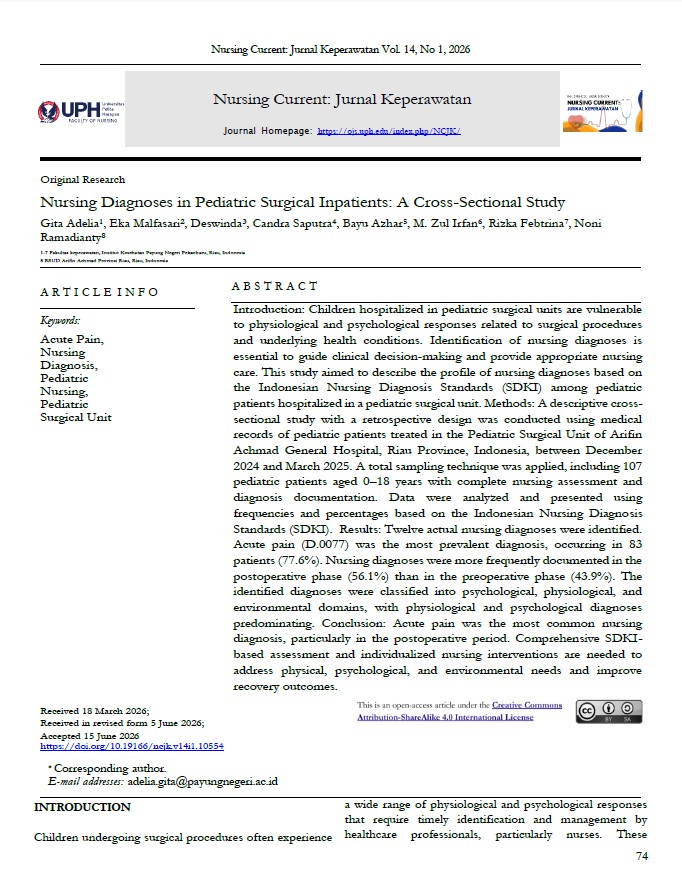
Introduction: Children in surgical units are vulnerable to nursing problems due to invasive procedures and complex medical conditions. Identifying nursing diagnoses is essential to determine appropriate and effective interventions.Objective: This study aimed to identify nursing diagnoses based on the Indonesian Nursing Diagnosis Standards (Standar Diagnostik Keperawatan Indonesia, SDKI) in pediatric patients hospitalized in a pediatric surgical care unit. Methods: This quantitative study employed a cross-sectional design using retrospective data from medical records. The study was conducted in the Pediatric Surgical Care Unit of Arifin Achmad General Hospital, Riau Province, from December 2024 to March 2025. The sample consisted of 107 children and adolescents who were hospitalized for more than 24 hours. Data were collected using pediatric nursing assessment forms and analyzed descriptively using frequency and percentage. Results: A total of 13 actual nursing problems were identified. The most common problem was acute pain (D.0077), found in 82 cases (75%). Other issues included decreased intracranial adaptive capacity (D.0066) and constipation (D.0049), each in 6 cases (6.5%), as well as urinary elimination impairment (D.0040) and anxiety (D.0080), each in 2 cases (2.2%). Conclusion: Acute pain is the most dominant nursing problem among postoperative children, accompanied by anxiety as a significant psychological issue. A systematic SDKI-based assessment of pain and anxiety, along with integrated interventions encompassing pain management and anxiety reduction, is essential to improve the quality of care and enhance postoperative recovery outcomes in children.
References
Avian, A., Messerer, B., Wünsch, G., Weinberg, A., Kiesling, A. S., & Berghold, A. (2016). Postoperative paediatric pain prevalence: A retrospective analysis in a university teaching hospital. International Journal of Nursing Studies, 62, 36‑43. https://doi.org/10.1016/j.ijnurstu.2016.07.011
Baagil, H., Baagil, H., & Gerbershagen, M. U. (2023). Preoperative Anxiety Impact on Anesthetic and Analgesic Use. 1‑11.
Bilginer, C., Punduk, M., Cetin, A., Guleroglu, F. Y., Erol, N., & Cim, N. (2025). Factors influencing surgical anxiety and postoperative pain : a comprehensive evaluation of psychological and gynecological determinants.
Bustami, A., Handayani, M. D., & Sormin, T. (2024). Pengaruh Relaksasi Napas Dalam Menggunakan Pipe Blowing Ball terhadap Skala Nyeri Anak Post Operasi. 5(1), 1‑8.
Cettler, M., Zielińska, M., Rosada-Kurasińska, J., Kubica-Cielińska, A., Jarosz, K., & Bartkowska-Śniatkowska, A. (2022). Guidelines for treatment of acute pain in children - the consensus statement of the Section of Paediatric Anaesthesiology and Intensive Therapy of the Polish Society of Anaesthesiology and Intensive Therapy. Anaesthesiology Intensive Therapy, 54(3), 197‑218. https://doi.org/10.5114/AIT.2022.118972
Chen, Y., & Li, F. (2021). Psychological Stress and Nursing Intervention of Sick Children. International Journal of Clinical Medicine, 12(05), 202‑210. https://doi.org/10.4236/ijcm.2021.125019
Chieng, Y. J. S., Chan, W. C. S., Liam, J. L. W., Klainin-Yobas, P., Wang, W., & He, H. G. (2013). Exploring influencing factors of postoperative pain in school-age children undergoing elective surgery. Journal for Specialists in Pediatric Nursing, 18(3), 243‑252. https://doi.org/10.1111/jspn.12030
Diaconescu, S., & Moisa, S. M. (2015). Communication with Pediatric Patients: More Than a Medical Act. International Journal of Communication Research, 5(4), 333.
Einhorn, L. M., Krishnan, P., Poirier, C., & Ingelmo, P. (2024). Chronic Postsurgical Pain in Children and Adolescents: A Call for Action. Journal of Pain Research, 17(May), 1967‑1978. https://doi.org/10.2147/JPR.S464009
Figueiredo, R. G., Patino, C. M., & Ferreira, J. C. (2025). Cross-sectional studies : understanding applications , methodological issues , and valuable insights. 51(1), 10‑11. https://doi.org/10.1016/j.chest.2020.03.012.
Fletke, K. J., Kaysin, A., & Jones, S. (2022). Preoperative Evaluation in Children. American Family Physician, 105(6), 640‑649.
Fortier, M. A., & Kain, Z. N. (2015). Treating Perioperative Anxiety and Pain in Children: A Tailored and Innovative Approach. Bone, 25(1), 27‑35. https://doi.org/doi:10.1111/pan.12546
Gao, P., Yujun, Z., Sun, J., Deng, C., & Wensheng, Z. (2024). The correlation between preoperative anxiety and postoperative pain in patients undergoing laparoscopic cholecystectomy Objective : Methods : Conclusion : Research Square (Research Square), 1‑15.
Hashish, M. S., Ismail, K. A., Hashish, A. A., & Zeid, M. A. (2021). A Prospective Study on the Pattern of Pediatric Surgery Admission in a Tertiary Referral Hospital in Egypt. The Medical Journal of Cairo University, 89(12), 2609‑2615. https://doi.org/10.21608/mjcu.2021.217864
Hsu, P. J., Yoon, S., & Park, K. B. (2024). Understanding pediatric surgical needs in North Korea: a modeling analysis. World Journal of Pediatric Surgery, 7(1), 1‑7. https://doi.org/10.1136/wjps-2023-000697
Jo, S.-Y., & Bang, K.-S. (2023). Clinical characteristics and nursing diagnoses of pediatric patients hospitalized with inflammatory bowel disease : a single-center retrospective study in South Korea. Child Health Nurs Res, 29(3), 218‑228.
Karišik, M., Barhanović, N. G., Vulović, T., & Simić, D. (2019). Postoperative pain and stress response: Does child’s gender have an influence? Acta Clinica Croatica, 58(2), 274‑280. https://doi.org/10.20471/acc.2019.58.02.10
Mekonnen, Z. A., Melesse, D. Y., Kassahun, H. G., Flatie, T. D., Workie, M. M., & Chekol, W. B. (2021). Prevalence and Contributing Factors Associated With Postoperative Pain in Pediatric Patients: A Cross-Sectional Follow-up Study. Perioperative Care and Operating Room Management, 23, 100159. https://doi.org/10.1016/j.pcorm.2021.100159
Naviati, E., & Sudarmiati, S. (2018). Nurse ’ s Health Education In Families Of Pediatric Surgical Clients. 18, 1‑5. https://doi.org/10.26714/mki.1.2.2018.1-5
Ni, K., Zhu, J., & Ma, Z. (2023). Preoperative anxiety and postoperative adverse events : a narrative overview. Anesthesiology and Perioperative Science, 1‑8. https://doi.org/10.1007/s44254-023-00019-1
Nursalam, N., Widodo, H., Wahyuni, E. D., & Efendi, F. (2020). Development of perioperative care instruments based on SDKI SLKI SIKI in operating room. Systematic Reviews in Pharmacy, 11(6), 1029‑1035. https://doi.org/10.31838/srp.2020.6.147
Okpara, P. (2018). Challenges of nursing care of the paediatric surgical patient. African Journal of Paediatric Surgery, 15(3‑4), 154‑157. https://doi.org/10.4103/ajps.AJPS_28_13
Olatubi, M. I., Oyediran, O. O., Faremi, F. A., & Salau, O. R. (2019). Knowledge, Perception, and Utilization of Standardized Nursing Language (SNL) (NNN) among Nurses in Three Selected Hospitals in Ondo State, Nigeria. International Journal of Nursing Knowledge, 30(1), 43‑48. https://doi.org/10.1111/2047-3095.12197
Pathak, S., Mhapsekar, R. V., Gupta, N., Surabhi, K., Bhargava, S., & Aggarwal, A. (2021). Clinical profile and outcome of pediatric surgical patients in a rural tertiary centre. International Journal of Contemporary Pediatrics, 8(11), 1770. https://doi.org/10.18203/2349-3291.ijcp20214057
Peria˜nez, C. A. H., & Castillo-Díaz, M. A. (2025). Preoperative psychological distress and acute postoperative pain among abdominal surgery patients. Journal of Psychosomatic Research, 190(October 2024). https://doi.org/10.1016/j.jpsychores.2025.112055
Purnomo, E., Novebri, N. A., & Fuad, A. (2024). Navigating Pediatric Surgery in Indonesia: A Comprehensive Tertiary-Level Epidemiological Case Study. Malaysian Journal of Medicine and Health Sciences, 20, 92‑97. https://doi.org/10.47836/mjmhs.20.s6.20
Rede, F. M., Goshu, E. M., & muzien, S. J. (2024). Severity and associated factors of postoperative pain in paediatric surgical patients aged 2 months–7 years at selected Addis Ababa Public Hospitals: a multicenter prospective longitudinal study. Annals of Medicine & Surgery, 86(3), 1275‑1282. https://doi.org/10.1097/ms9.0000000000001742
Senger, A., Bryce, R., McMahon, C., & Baerg, K. (2021). Cross-sectional study of pediatric pain prevalence, assessment, and treatment at a Canadian tertiary hospital. Canadian Journal of Pain, 5(1), 172‑182. https://doi.org/10.1080/24740527.2021.1961081
Shallik, N. A. (2018). Pain Management in Special Circumstances. IntechOpen. https://doi.org/doi: 10.5772/intechopen.74765
Stanzel, A., & Sierau, S. (2022). Pediatric Medical Traumatic Stress (PMTS) following Surgery in Childhood and Adolescence: a Systematic Review. Journal of Child and Adolescent Trauma, 15(3), 795‑809. https://doi.org/10.1007/s40653-021-00391-9
The Royal College of Emergency Medicine. (2018). Pain in children: Clinical Audit 2017/2018 National Report. Dans Core Topics in Pain (Numéro October, p. 183‑190). https://doi.org/10.1017/CBO9780511544583.029
Tim Pokja SDKI DPP PPN. (2016). Standar Diagnosis Keperawatan Indonesia (SDKI) (1re éd.). Persatuan Perawat Indonesia.
Widodo, H., Nursalam, N., & Wahyuni, E. D. (2020). Analysis of Implementation of Perioperative Care Instrument Based on Standards of Nursing Diagnosis, Intervention and Outcomes in Indonesia. Jurnal Ners, 15(1 Special Issue), 57‑62. https://doi.org/10.20473/jn.v15i1Sp.18911
Zhang, H. (2025). Predictive Factors of Acute Pain After Day Surgery : A Meta-Analysis. October.
Downloads
Published
How to Cite
Issue
Section
License
Copyright (c) 2026 Gita Adelia, Eka Malfasari, Deswinda Deswinda, Candra Saputra, Bayu Azhar, M Zul 'irfan, Rizka Febtrina, Noni Ramadianty

This work is licensed under a Creative Commons Attribution-ShareAlike 4.0 International License.
Authors who publish with this journal agree to the following terms:
1) Authors retain copyright and grant the journal right of first publication with the work simultaneously licensed under a Creative Commons Attribution License (CC-BY-SA 4.0) that allows others to share the work with an acknowledgement of the work's authorship and initial publication in this journal.
2) Authors are able to enter into separate, additional contractual arrangements for the non-exclusive distribution of the journal's published version of the work (e.g., post it to an institutional repository or publish it in a book), with an acknowledgement of its initial publication in this journal.
3) Authors are permitted and encouraged to post their work online (e.g., in institutional repositories or on their website). The final published PDF should be used and bibliographic details that credit the publication in this journal should be included.

This work is licensed under a Creative Commons Attribution-ShareAlike 4.0 International License.
 Published by Faculty of Nursing | Universitas Pelita Harapan | Lippo Karawaci, Tangerang, Indonesia, 15811 |