Family Assessment Device Among Families with Stunted Children Under Five Years in Kadu Village, Tangerang
DOI:
https://doi.org/10.19166/nc.v13i2.10532Keywords:
Family functioning, Nutrition, Parental roles, Stunting, Toddler growthAbstract
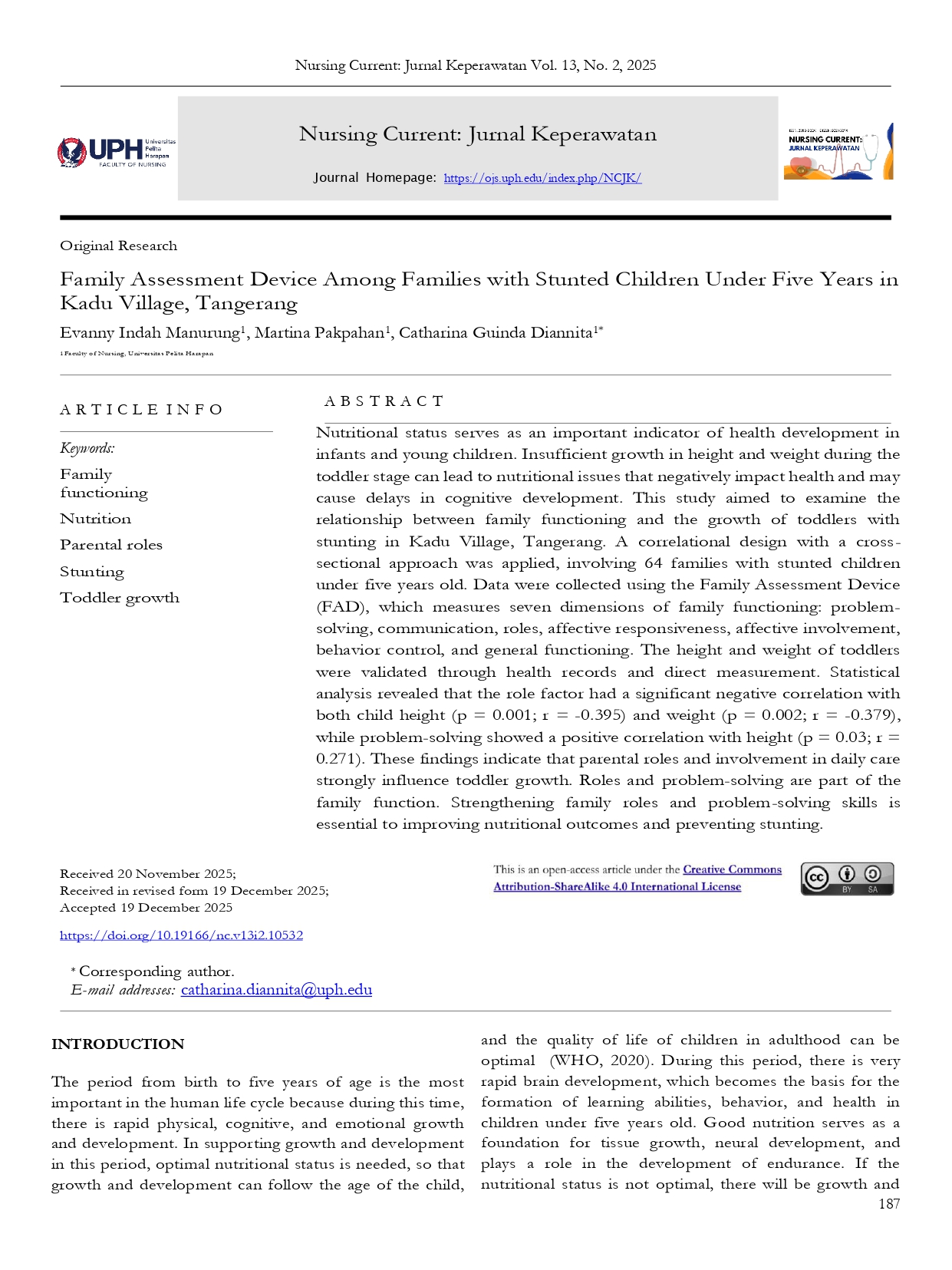
Nutritional status serves as an important indicator of health development in infants and young children. Insufficient growth in height and weight during the toddler stage can lead to nutritional issues that negatively impact health and may cause delays in cognitive development. This study aimed to examine the relationship between family functioning and the growth of toddlers with stunting in Kadu Village, Tangerang. A correlational design with a cross-sectional approach was applied, involving 64 families with stunted children under five years old. Data were collected using the Family Assessment Device (FAD), which measures seven dimensions of family functioning: problem-solving, communication, roles, affective responsiveness, affective involvement, behavior control, and general functioning. The height and weight of toddlers were validated through health records and direct measurement. Statistical analysis revealed that the role factor had a significant negative correlation with both child height (p = 0.001; r = -0.395) and weight (p = 0.002; r = -0.379), while problem-solving showed a positive correlation with height (p = 0.03; r = 0.271). These findings indicate that parental roles and involvement in daily care strongly influence toddler growth. Roles and problem-solving are part of the family function. Strengthening family roles and problem-solving skills is essential to improving nutritional outcomes and preventing stunting.
References
Al Isnaini, F., Susanto, T., Susumaningrum, L. A., Rasnii, H., Siswayo, S., Keperawatan, F., Jember, U., Gizi, D. K., Kegawatdaruratan, D., & Panti, P. (2020). Hubungan Fungsi Keluarga Dengan Status Gizi Balita Pada Keluarga Tiri Di Kecamatan Panti Kabupaten Jember. Jurnal Ilmu Keperawatan Komunitas, 3(1), 1–10. https://doi.org/10.32584/JIKK.V3I1.558
Badan Pusat Statistik Provinsi Banten. (2023). Profil Kesehatan Provinsi Banten 2022. https://banten.bps.go.id/id/publication/2023/09/29/121a8057198bf151f32f8c3a/profil-kesehatan-provinsi-banten-2022.html
Ciptanurani, C., & Chen, H. J. (2021). Household structure and concurrent stunting and overweight among young children in Indonesia. Public Health Nutrition, 24(9), 2629. https://doi.org/10.1017/S1368980021001385
Dariotis, J. K., Chen, F. R., Park, Y. R., Nowak, M. K., French, K. M., & Codamon, A. M. (2023). Parentification Vulnerability, Reactivity, Resilience, and Thriving: A Mixed Methods Systematic Literature Review. International Journal of Environmental Research and Public Health 2023, Vol. 20, Page 6197, 20(13), 6197. https://doi.org/10.3390/IJERPH20136197
Gandini, A. L. A., Ummu Salmah, A., Stang, Arsunan Arsin, A., & Mallongi, A. (2024). The Role of Parents in Monitoring the Growth and Development of Toddlers: A Systematic Review. Pharmacognosy Journal, 16(3), 682–686. https://doi.org/10.5530/pj.2024.16.114
Gross, D., Bettencourt, A. F., Taylor, K., Francis, L., Bower, K., & Singleton, D. L. (2019). What is Parent Engagement in Early Learning? Depends Who You Ask. Journal of Child and Family Studies 2019 29:3, 29(3), 747–760. https://doi.org/10.1007/S10826-019-01680-6
Handayani, S., Kebidanan, J., & Kesehatan Kemenkes Jakarta, P. I. (2023). Selamatkan Generasi Bangsa Dari Bahaya Stunting. Journal of Midwifery Science and Women’s Health, 3. https://doi.org/10.36082/jmswh.v3i2.1082
Handina, W. P. (2024). mrizal1,+18.+Artikel+BAHAYA+STUNTING. Jurnal Review Pendidikan Dan Pengajaran, 2(7), 4650–4653. http://journal.universitaspahlawan.ac.id/index.php/jrpp
Hanifah, U. A., Arisanti, N., Agustian, D., & Hilmanto, D. (2017). Hubungan Fungsi Keluarga dengan Status Gizi Anak di Kecamatan Soreang Kabupaten Bandung. Jurnal Sistem Kesehatan, 2, 200–206. https://doi.org/https://doi.org/10.24198/jsk.v2i4.12498
Illahi, R. K. (2017). Hubungan Pendapatan Keluarga, Berat Lahir, dan Panjang Lahir dengan Kejadian Stunting Balita 24-59 Bulan di Bangkalan. Jurnal Manajemen Kesehatan Yayasan RS. Dr. Soetomo, 3(1), 1–7. https://doi.org/10.29241/JMK.V3I1.85
Irene Fioresta, A., Trisnawati, E., Studi Kesehatan Masyarakat Fakultas Ilmu Kesehatan Universitas Muhammadiyah Pontianak, P., & Penulis, K. (2024). Perilaku Nenek dalam Praktik Pemberian Makan pada Balita Stunting di Wilayah Komunitas Dayak Kabupaten Landak: Media Publikasi Promosi Kesehatan Indonesia (MPPKI), 7(1), 194–200. https://doi.org/10.56338/MPPKI.V7I1.4275
Kasumayanti, E., & Z.R, Z. (2020). Hubungan Pendapatan Keluarga Dengan Status Gizi Balita Di Desa Tambang Wilayah Kerja Puskesmas Tambang Kabupaten Kampar Tahun 2019. Jurnal Ners, 4(1). http://journal.universitaspahlawan.ac.id/index.php/ners
Kemenkes RI. (2019). Pedoman Pencegahan Dan Tatalaksana Gizi Buruk Pada Balita. Kementerian Kesehatan Republik Indonesia, 1–120.
Kurniawati, P., & Kulla, P. D. K. (2022). Hubungan Fungsi Keluarga dengan Status Gizi Balita Usia 0-24 Bulan di Wilayah Kerja Puskesmas Kuta Baro Kecamatan Kuta Baro Kabupaten Aceh Besar. JOURNAL OF HEALTHCARE TECHNOLOGY AND MEDICINE, 8(2), 575–589. https://jurnal.uui.ac.id/index.php/JHTM/article/view/2305
Lufthiani, Karota, E., Siregar, C. T., Ariga, R. A., Nasution, S. Z., Tanjung, D., & Wardani, A. (2023). Parents’ Role in Monitoring the Children’s Growth and Development. AIP Conference Proceedings, 2626(1). https://doi.org/10.1063/5.0136038/2892845
Manurung, E. I., Pakpahan, M., Gultom, E. C. V., Siregar, D., & Tahulending, P. S. (2022). Orang Tua Peduli Gizi Balita di Masa Pandemi. JURNAL KREATIVITAS PENGABDIAN KEPADA MASYARAKAT (PKM), 5(11), 3707–3719. https://doi.org/10.33024/jkpm.v5i11.7273
Mutiah, D., Mayasari, R., & Deviana, T. (2023). Validating an Indonesian version of the Family Assessment Device among Indonesian Muslim university students during the COVID-19 pandemic. Mental Health, Religion and Culture, 26(4), 324–338. https://doi.org/10.1080/13674676.2021.1976124
Odoms-Young, A., Brown, A. G. M., Agurs-Collins, T., & Glanz, K. (2024). Food Insecurity, Neighborhood Food Environment, and Health Disparities: State of the Science, Research Gaps and Opportunities. American Journal of Clinical Nutrition, 119(3), 850–861. https://doi.org/10.1016/j.ajcnut.2023.12.019
Priana, A. W., Ningsih, R., Tambunan, E. S., Supartini, Y., & Sulastri, T. (2023). Perilaku Ibu dan Pemenuhan Gizi pada Balita Usia 3-5 Tahun. JKEP (Jurnal Keperawatan), 8(1).
Rachmawati, P. D., Triharini, M., & Suciningtyas, P. D. (2021). The contribution of family functions, knowledge and attitudes in children under five with stunting. Enfermería Clínica, 31, S296–S300. https://doi.org/10.1016/J.ENFCLI.2020.12.035
Rahayuwati, L., Yani, D. I., Hendrawati, S., Setiawan, A. S., Irza, D., & Fauziah, S. R. (2025). Correlations between family characteristics and childcare in optimizing the growth of children under six years. BMC Public Health 2025 25:1, 25(1), 807-. https://doi.org/10.1186/S12889-025-21931-0
Setyorini, C., & Lieskusumastuti, A. D. (2021). Gambaran Status Gizi Bayi Dan Balita Pada Masa Covid-19 Di Kelurahan Jetis Sukoharjo. Avicenna : Journal of Health Research, 4(1996), 6. https://doi.org/https://doi.org/10.36419/avicenna.v4i1.465
Siramaneerat, I., Astutik, E., Agushybana, F., Bhumkittipich, P., & Lamprom, W. (2024). Examining determinants of stunting in Urban and Rural Indonesian: a multilevel analysis using the population-based Indonesian family life survey (IFLS). BMC Public Health, 24(1), 1–13. https://doi.org/10.1186/S12889-024-18824-Z/TABLES/4
Siregar, E. (2016). Hubungan Peran Keluarga , Status Ekonomi Dan Penyakit Infeksi Terhadap Status Gizi Balita Di Wilayah Kerja Puskesmas Paal V Kota Jambi Tahun 2015 Pendahuluan Anak umur 0-5 tahun merupakan periode penting dalam tumbuh kembang anak , karena masa ini merupak. Scientia Journal, 4(04), 343–350.
Susilowati, E., Saputro, H., & Acob, J. R. U. (2022). Analysis of the Family’s Role on the Status of Weight and Height of Children at Pelita Hati Early Childhood Education. Open Access Health Scientific Journal, 3(2), 50–57. https://doi.org/10.55700/oahsj.v3i2.29
Tarmizi, S. N. (2024). Membentengi Anak Dari Stunting. https://link.kemkes.go.id/mediakom
Wahyudi, F., Nugraheni, A., Margawati, A., Suharto, Hariyana, B., & Adespin, D. A. (2023). Correlation Between Family Function with Stunting. Unnes Journal of Public Health, 12(2), 26–35. https://doi.org/10.15294/UJPH.V12I2.54953
Wardita, Y., Suprayitno, E., & Kurniyati, E. M. (2021). Determinan Kejadian Stunting pada Balita. Journal Of Health Science (Jurnal Ilmu Kesehatan), 6(1), 7–12. https://doi.org/10.24929/jik.v6i1.1347
WHO. (2020). Levels And Trends in Child Malnutrition. https://www.who.int/publications/i/item/9789240003576
Yanti, N. L. G. P., & Laksmi, I. G. A. P. S. (2021). Hubungan Fungsi Perawatan Kesehatan Keluarga Dengan Pemberian MP-ASI pada Balita Usia 6-12 Bulan. Jurnal Ilmu Keperawatan Anak, 4(1), 19–26. https://doi.org/10.32584/JIKA.V4I1.970
Downloads
Published
How to Cite
Issue
Section
License
Copyright (c) 2025 Catharina Guinda Diannita, Evanny Indah Manurung, Martina Pakpahan

This work is licensed under a Creative Commons Attribution-ShareAlike 4.0 International License.
Authors who publish with this journal agree to the following terms:
1) Authors retain copyright and grant the journal right of first publication with the work simultaneously licensed under a Creative Commons Attribution License (CC-BY-SA 4.0) that allows others to share the work with an acknowledgement of the work's authorship and initial publication in this journal.
2) Authors are able to enter into separate, additional contractual arrangements for the non-exclusive distribution of the journal's published version of the work (e.g., post it to an institutional repository or publish it in a book), with an acknowledgement of its initial publication in this journal.
3) Authors are permitted and encouraged to post their work online (e.g., in institutional repositories or on their website). The final published PDF should be used and bibliographic details that credit the publication in this journal should be included.

This work is licensed under a Creative Commons Attribution-ShareAlike 4.0 International License.
 Published by Faculty of Nursing | Universitas Pelita Harapan | Lippo Karawaci, Tangerang, Indonesia, 15811 |