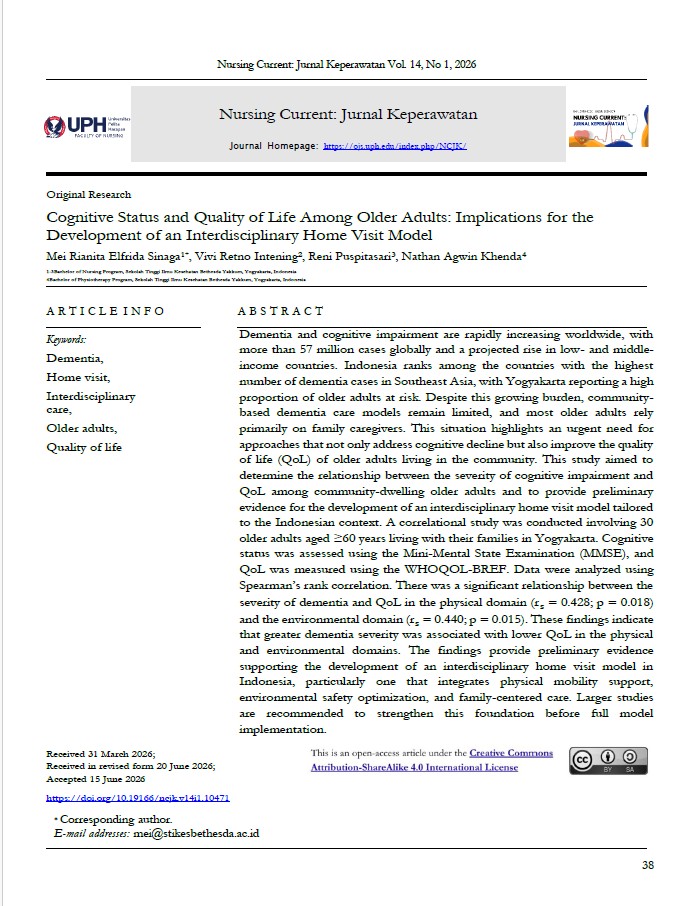
Cognitive Status and Quality of Life Among Older Adults: Implications for the Development of an Interdisciplinary Home Visit Model
DOI:
https://doi.org/10.19166/ncjk.v14i1.10471Keywords:
Dementia, Elderly, home visit, interdisciplinary, Quality Of LifeAbstract
Dementia and cognitive impairment are rapidly increasing worldwide, with more than 57 million cases globally and a projected rise in low- and middle-income countries. Indonesia ranks among the countries with the highest number of dementia cases in Southeast Asia, with Yogyakarta reporting a high proportion of older adults at risk. Despite this growing burden, community-based dementia care models remain limited, and most older adults rely primarily on family caregivers. This situation highlights an urgent need for approaches that not only address cognitive decline but also improve the quality of life (QoL) of older adults living in the community. This study aimed to determine the relationship between the severity of cognitive impairment and QoL among community-dwelling older adults and to provide preliminary evidence for the development of an interdisciplinary home visit model tailored to the Indonesian context. A correlational study was conducted involving 30 older adults aged ≥60 years living with their families in Yogyakarta. Cognitive status was assessed using the Mini-Mental State Examination (MMSE), and QoL was measured using the WHOQOL-BREF. Data were analyzed using Spearman’s rank correlation. There was a significant relationship between the severity of dementia and QoL in the physical domain (rₛ = 0.428; p = 0.018) and the environmental domain (rₛ = 0.440; p = 0.015). These findings indicate that greater dementia severity was associated with lower QoL in the physical and environmental domains. The findings provide preliminary evidence supporting the development of an interdisciplinary home visit model in Indonesia, particularly one that integrates physical mobility support, environmental safety optimization, and family-centered care. Larger studies are recommended to strengthen this foundation before full model implementation.
References
Alam, R. B., Ashrafi, S. A., Pionke, J. J., & Schwingel, A. (2021). Role of Community Health Workers in Addressing Dementia: A Scoping Review and Global Perspective. Journal of applied gerontology : the official journal of the Southern Gerontological Society, 40(12), 1881–1892. https://doi.org/10.1177/07334648211001190
Alzeimer’s Disease International (2024) Dementia statistics. Available at: https://doi.org/https://www.alzint.org/what-we-do/partnerships/world-health-organization/who-global-plan-on-dementia/.
Arneliwati et al. (2025) Bunga Rampai Keperawatan Keluarga Dalam Perawatan Lansia. Edited by H. Hastuti. Jakarta: Nuansa Fajar Cemerlang.
Bendowska, A. and Baum, E. (2023) ‘The Significance of Cooperation in Interdisciplinary Health Care Teams as Perceived by Polish Medical Students’, International Journal of Environmental Research and Public Health, 20(2), pp. 1–14. Available at: https://doi.org/10.3390/ijerph20020954.
Bosch, B. and Mansell, H. (2015) ‘Interprofessional collaboration in health care: Lessons to be learned from competitive sports’, Canadian Pharmacists Journal, 148(4), pp. 176–179. Available at: https://doi.org/10.1177/1715163515588106.
Cepoiu-martin, M. et al. (2016) ‘Predictors of long-term care placement in persons with dementia : A systematic review and meta-analysis’, International Journal od Geriatric Psychiatry [Preprint]. Available at: https://doi.org/10.1002/gps.4449.
Ch Salim, O. et al. (2007) ‘Validity and reliability of World Health Organization Quality of Life-BREF to assess the quality of life in the elderly’, 26(1), pp. 27–38.
Da, L. et al. (2025) ‘Objectively measured environmental features and their association with cognition and dementia: A systematic review and meta-analysis’, Ageing Research Reviews, 104(February).
Elmiyanti, N.K. and Salamung, N. (2023) ‘Effect cognitive stimulation therapy for dementia: Systematic Review’, Indonesian Nursing Journal of Education and Clinic (INJEC), 7(2), pp. 270–281. Available at: https://doi.org/10.24990/injec.v7i2.539.
Farina, N. et al. (2023) ‘Comprehensive measurement of the prevalence of dementia in low- and middle-income countries: STRiDE methodology and its application in Indonesia and South Africa’, BJPsych Open, 9(4), pp. 1–7. Available at: https://doi.org/10.1192/bjo.2023.76.
Fridolin, A., Musthofa, S.B. and Suryoputro, A. (2022) ‘Factors affecting the quality of life elderly in the work area of the Gayamsari health center Semarang city’, Jurnal Kesehatan Komunitas, 8(2), pp. 381–389.
Intening, V.R., Permina, Y. and Setyanto, Y.E. (2022) ‘Online Interprofessional Education (IPE) evaluation for healthcare students as Interprofessional Collaboration (IPC) optimization’, JHeS (Journal of Health Studies), 6(1), pp. 17–27. Available at: https://doi.org/10.31101/jhes.1785.
Iso-Markku P, Kujala UM, Knittle K, et al Physical activity as a protective factor for dementia and Alzheimer’s disease: systematic review, meta-analysis and quality assessment of cohort and case–control studies British Journal of Sports Medicine 2022;56:701-709.
Jayakody, S. and Arambepola, C. (2022) ‘Determinants of quality of life among people with dementia: evidence from a South Asian population’, BMC Geriatrics, 22(1), pp. 1–7. Available at: https://doi.org/10.1186/s12877-022-03443-3.
Kartika, A.W. et al. (2019) ‘Pelatihan Tugas Perawatan Kesehatan Keluarga Caregiver Lansia dalam Program RURAL (Rumah Ramah Lansia)’, Jurnal Pengabdian kepada Masyarakat (Indonesian Journal of Community Engagement), 5(3), p. 448. Available at: https://doi.org/10.22146/jpkm.45139.
Kenne Malaha, A. et al. (2025) ‘Quality of Life of Elderly Living With Dementia and Caregiver Strain in Benin’, Value in Health Regional Issues, 47, p. 101080. Available at: https://doi.org/10.1016/j.vhri.2025.101080.
Mahendradhata, Y., Trisnantoro, L., Listyadewi, S., Soewondo, P., Marthias, T., Harimurti, P., & Prawira, J. (2017) ‘WHO Regional Office for South-East Asia.’, The republic of Indonesia health system review, 7. Available at: https://apps.who.int/iris/handle/10665/254716.
Marinho, V. et al. (2021) ‘Cognitive stimulation therapy for people with dementia in Brazil (CST ‐ Brasil): Results from a single blind randomized controlled trial’, International Journal of Geriatric Psychiatry, 36(2), pp. 286–293. Available at: https://doi.org/10.1002/gps.5421.
Rahardian, G.A. and Juniwati, A. (2023) ‘Fasilitas Hunian dan Perawatan Lansia Demensia di Yogyakarta’, JURNAL eDIMENSI ARSITEKTUR, XI(1), pp. 441–448.
Reed, C. et al. (2017) ‘How useful is the EQ-5D in assessing the impact of caring for people with Alzheimer ’ s disease ?’, Health and Quality of Life Outcomes, 15(16), pp. 1–9. Available at: https://doi.org/10.1186/s12955-017-0591-2.
Sari, Y.M. et al. (2024) ‘Experiences of Indonesian people with dementia and carers undertaking an online-delivered exercise program’, Dementia, 23(4), pp. 584–609. Available at: https://doi.org/10.1177/14713012241235688.
Sinaga, M.R.E., Simanjuntak, S.R. and Locsin, R.C. (2022) ‘Factors affecting the quality of life of older people during the Covid-19 pandemic’, Nurse Media Journal of Nursing, 12(August), pp. 185–195.
Telenius, E.W., Tangen, G.G., Eriksen, S. et al. Fun and a meaningful routine: the experience of physical activity in people with dementia. BMC Geriatr 22, 500 (2022). https://doi.org/10.1186/s12877-022-03149-6
Thea, S., Devy, M.S. and Hardi, N. (2022) ‘Cognitive Impairment And Depression : A Cross-Sectional Study Among Elderly Undergoing’, Prociding of the 15th continuing Medical Education [Preprint], (ISSN 2721-2882).
Tori, K. et al. (2020) ‘Association between dementia and psychiatric disorders in long-term care residents: An observational clinical study’, Medicine, 99(31), pp. 1–7.
Venegas-Sanabria, L. C., Martínez-Vizcaino, V., Cavero-Redondo, I., Chavarro-Carvajal, D. A., Cano-Gutierrez, C. A., & Álvarez-Bueno, C. (2021). Effect of physical activity on cognitive domains in dementia and mild cognitive impairment: overview of systematic reviews and meta-analyses. Aging & mental health, 25(11), 1977–1985. https://doi.org/10.1080/13607863.2020.1839862
Warren, J.L. and Warren, J.S. (2023) ‘The Case for Understanding Interdisciplinary Relationships in Health Care’, Ochsner Journal, 23(2), pp. 94–97. Available at: https://doi.org/10.31486/toj.22.0111.
World Health Organization (2017) Integrated care for older people: Guidelines on community-level interventions to manage declines in intrinsic capacity. Geneva.
World Health Organization (2025) Dementia. Available at: https://doi.org/https://www.who.int/news-room/fact-sheets/detail/dementia.
Young, D.K. (2020) ‘Multicomponent intervention combining a cognitive stimulation group and tai chi to reduce cognitive decline among community-dwelling elderly with probable dementia : A multi-center , randomized controlled trial’, Dementia, 19(6), pp. 2073–2089. Available at: https://doi.org/10.1177/1471301218814637.
Downloads
Published
How to Cite
Issue
Section
License
Copyright (c) 2026 Mei Rianita Elfrida Sinaga, Vivi Retno Intening, Reni Puspitasari, Nathan Agwin Khenda

This work is licensed under a Creative Commons Attribution-ShareAlike 4.0 International License.
Authors who publish with this journal agree to the following terms:
1) Authors retain copyright and grant the journal right of first publication with the work simultaneously licensed under a Creative Commons Attribution License (CC-BY-SA 4.0) that allows others to share the work with an acknowledgement of the work's authorship and initial publication in this journal.
2) Authors are able to enter into separate, additional contractual arrangements for the non-exclusive distribution of the journal's published version of the work (e.g., post it to an institutional repository or publish it in a book), with an acknowledgement of its initial publication in this journal.
3) Authors are permitted and encouraged to post their work online (e.g., in institutional repositories or on their website). The final published PDF should be used and bibliographic details that credit the publication in this journal should be included.

This work is licensed under a Creative Commons Attribution-ShareAlike 4.0 International License.
 Published by Faculty of Nursing | Universitas Pelita Harapan | Lippo Karawaci, Tangerang, Indonesia, 15811 |