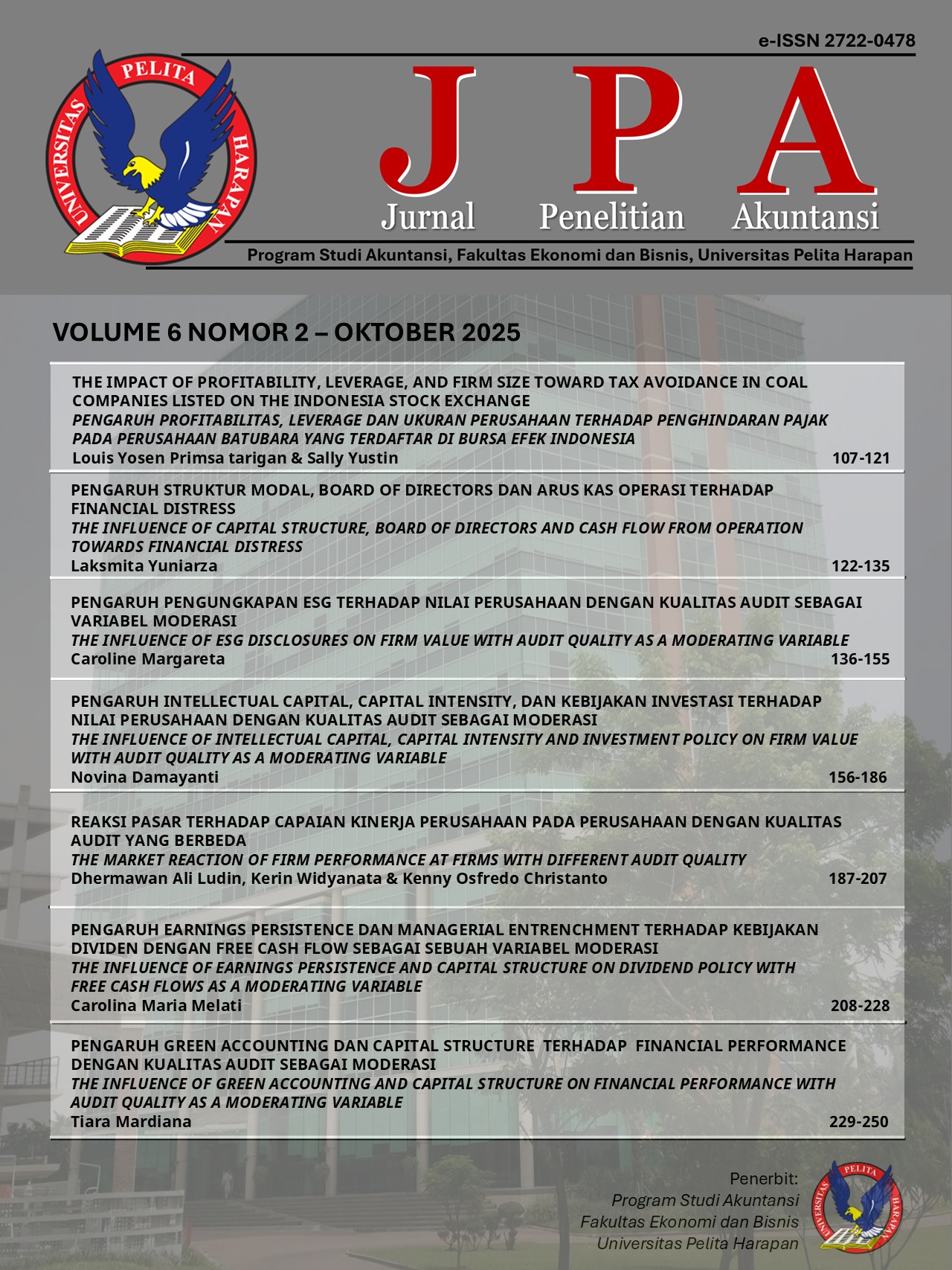
Pengaruh Earnings Persistence dan Managerial Entrenchment terhadap Kebijakan Dividen dengan Free Cash Flow Sebagai Sebuah Variabel Moderasi
Λέξεις-κλειδιά:
free cash flow, earnings persistence, managerial entrenchment, CEO tenure, kepemilikan manajerial, kebijakan dividenΠερίληψη
Penelitian ini bertujuan untuk menguji pengaruh eanings persistence dan managerial entrenchment terhadap kebijakan dividen yang dimoderasi oleh free cash flow. Data yang digunakan berasal dari S&P Capital IQ dengan sampel perusahaan energi tambang di ASEAN sebanyak 89 perusahaan dari tahun 2019-2023 dengan total observasi sebanyak 391 firm year. Hasil penelitian menunjukkan bahwa 1) earnings persistence tidak mempengaruhi kebijakan dividen; 2) managerial entrenchment dengan proksi CEO tenure tidak mempengaruhi kebijakan dividen; 3) managerial entrenchment dengan proksi kepemilikan manajerial tidak mempengaruhi kebijakan dividen; 4) free cash flow tidak dapat memoderasi hubungan antara earnings persistence dengan kebijakan dividen; 5) free cash flow tidak dapat memoderasi hubungan antara managerial entrenchment yang menggunakan proksi CEO tenure dengan kebijakan dividen; 6) free cash flow tidak dapat memoderasi hubungan antara managerial entrenchment yang menggunakan proksi kepemilikan manajerial dengan kebijakan dividen. Penelitian ini dapat digunakan sebagai referensi untuk penelitian selanjutnya.
Αναφορές
Allani, G., Mard, Y., Allani, G., Mard, Y., Policy, D., Quality, E., Relationship, A. C., Mard, Y., & Auvergne, U. C. (2024). Dividend Policy and Earnings Quality : A Curvilinear Relationship To cite this version : HAL Id : hal-04415679 Dividend Policy and Earnings Quality : A Curvilinear Relationship.
Amalia, E. W., & Dura, J. (2022). Pengaruh Managerial Entrenchment, Struktur Modal, Profitabilitas, Dan Likuiditas Terhadap Kualitas Laba. JAS (Jurnal Akuntansi Syariah), 6(1), 1–14. https://doi.org/10.46367/jas.v6i1.525
Amin, N. F., Garancang, S., & Abunawas, K. (2023). Konsep Umum Populasi dan Sampel dalam Penelitian. Jurnal Pilar, 14(1), 15–31.
Annah, A., & Suhendah, R. (2023). Faktor Yang Mempengaruhi Earnings Quality Pada Perusahaan Manufaktur Yang Terdaftar Di Bei. Jurnal Paradigma Akuntansi, 5(1), 312–320. https://doi.org/10.24912/jpa.v5i1.22389
Bilel, H. (2020). Does entrenchment of managers affect entrepreneurial dividend decision and investor sentiment? Asia Pacific Journal of Innovation and Entrepreneurship, 14(3), 275–288. https://doi.org/10.1108/apjie-10-2019-0072
Canina, L., & Potter, G. (2019). Determinants of Earnings Persistence and Predictability for Lodging Properties. Cornell Hospitality Quarterly, 60(1), 40–51. https://doi.org/10.1177/1938965518791729
Caskey, J., & Hanlon, M. (2013). Dividend Policy at Firms Accused of Accounting Fraud. Contemporary Accounting Research, 30(2), 818–850. https://doi.org/https://doi.org/10.1111/j.1911-3846.2012.01173.x
Chang, K., Kang, E., & Li, Y. (2016). Effect of institutional ownership on dividends: An agency-theory-based analysis. Journal of Business Research, 69(7), 2551–2559. https://doi.org/10.1016/J.JBUSRES.2015.10.088
Damanik, M. W., Ndraha, J. S., & Afrilia, D. (2023). Analisis Faktor-Faktor yang Berpengaruh Terhadap Kebijakan Dividen pada Perusahaan Manufaktur. MUFAKAT: Jurnal Ekonomi, Manajemen, Dan Akutansi, Vol 2, No.
Dawis, A., Meylani, Y., Heryana, N., Alfathoni, M., Sriwahyuni, E., Ristiyana, R., Januarsi, Y., Wiratmo, P., Dasman, S., Mulyani, S., Agit, A., Shoffa, S., & Baali, I. (2023). PENGANTAR METODOLOGI PENELITIAN.
Deitiana, T., Yap, S., & Ersania. (2021). Dividend Payout Ratio Dan Faktor Yang Mempengaruhinya Pada Perusahaan Makanan Dan Minuman Di Bursa Efek Indonesia. Media Bisnis, 12(2), 119–126. https://doi.org/10.34208/mb.v12i2.916
Di Meo, F., García Lara, J. M., & Surroca, J. A. (2017). Managerial entrenchment and earnings management. Journal of Accounting and Public Policy, 36(5), 399–414. https://doi.org/10.1016/j.jaccpubpol.2017.07.003
Easterbrook, F. H. (1984). Two Agency-Cost Explanations of Dividends. The American Economic Review, 74(4), 650–659. http://www.jstor.org/stable/1805130
Fagbemi, T. O., Osemene, O. F., & Agbaje, O. (2020). Management Entrenchment, Firm Characteristics and Earnings Management Of Conglomerate Companies In Nigeria. Jurnal Administrasi Bisnis, 9(1), 1–14. https://doi.org/10.14710/jab.v9i1.28576
Firizq, N. K., Rahmiyati, N., & Ratnawati, T. (2019). Dampak Manajemen Aset Dan Manajemen Utang Terhadap Likuiditas Dan Profitabilitas BUMN Terdaftar Di Bursa Efek Indonesia. JMM17 Jurnal Ilmu Ekonomi Dan Manajemen, 6(01), 16–27. https://doi.org/10.30996/jmm17.v6i01.2445
Florackis, C., Kostakis, A., & Ozkan, A. (2009). Managerial ownership and performance. Journal of Business Research, 62(12), 1350–1357. https://doi.org/https://doi.org/10.1016/j.jbusres.2008.12.001
Francis, J., LaFond, R., Olsson, P., & Schipper, K. (2005). Costs of Capital and Earnings Attributes. SSRN Electronic Journal. https://doi.org/10.2139/ssrn.414125
Frankel, R., & Litov, L. (2009). Earnings persistence. Journal of Accounting and Economics, 47(1–2), 182–190. https://doi.org/10.1016/J.JACCECO.2008.11.008
Guermazi, A., & Bouri, A. (2017). The Effect of Free Cash Flow on the Relationship Between Managerial Entrenchment and Debt : Evidence From French Firms. 8(2), 77–85.
Gyimah, D., & Gyapong, E. (2021). Managerial entrenchment and payout policy: A catering effect. International Review of Financial Analysis, 73(January), 1–9. https://doi.org/10.1016/j.irfa.2020.101600
Hambrick, D. C., & Fukutomi, G. D. S. (1991). The Seasons of a CEO’s Tenure. The Academy of Management Review, 16(4), 719–742. https://doi.org/10.2307/258978
Hasan, J. M., & Septiningrum, L. D. (2023). PENGARUH EFFECTIVE TAX RATE, ARUS KAS, DAN KEPEMILIKAN MANAJERIAL TERHADAP KEBIJAKAN DIVIDEN (Studi Empiris Pada Perusahaan Barang Konsumsi yang Terdaftar di BEI Periode 2017-2021). SCIENTIFIC JOURNAL OF REFLECTION : Economic, Accounting, Management and Business, 6(4), 820–829. https://doi.org/10.37481/sjr.v6i4.743
Indrayati, Rachmat, B., & Slamet. (2021). Assets Growth, Earnings Persistence, Investment Opportunity Setand Earnings Management on Dividend Policy and Firm Value (Study at Bank Companies in Indonesia). Journal of Southwest Jiaotong University, 56(2), 220–234. https://doi.org/10.35741/issn.0258-2724.56.2.18
Lang, L. H. P., & Litzenberger, R. H. (1989). Dividend announcements. Cash flow signalling vs. free cash flow hypothesis? Journal of Financial Economics, 24(1), 181–191. https://doi.org/10.1016/0304-405X(89)90077-9
Lestari, I. A., & Agustiningsih, W. (2023). Pengaruh struktur modal, ukuran perusahaan, dan perencanaan pajak terhadap profitabilitas. AKURASI: Jurnal Riset Akuntansi Dan Keuangan, 5(2), 113–128. https://doi.org/10.36407/akurasi.v5i2.909
Li, W., Jingqi, Z., & Chen, L. (2023). Cash dividends, return on equity and earnings persistence. Economic Research-Ekonomska Istrazivanja , 36(1), 2298–2319. https://doi.org/10.1080/1331677X.2022.2097106
Makhsun, A., Yuliansyah, Y., Pahlevi, M. R., Razimi, M. S. B. A., & Muhammad, I. (2018). Persistence of earnings after IFRS adoption in banking companies listed on Indonesian stock exchange. Academy of Accounting and Financial Studies Journal, 22(Specialissue), 1–6.
Maulita, N. A., & Dewi, N. G. (2023). Pengaruh Leverage, Likuiditas, Profitabilitas, dan Ukuran Perusahaan Terhadap Kualitas Laba. Jurnal Bina Akuntansi, 10(2), 432–445.
Meila, K. D. (2021). Pengaruh Perencanaan Pajak, Free Cash Flow Dan Earning Pressure Terhadap Manajemen Laba Pada Perusahaan Manufaktur Sub Sektor Makanan Dan Minuman Yang Terdaftar Di Bei Periode 2017- 2019. Jurnal Bisnis, Ekonomi, Dan Sains, 01(1), 10–20. https://doi.org/10.37278/insearch.v20i2.424
Mohamed, B. (2021). Managerial Entrenchment and Firm Performance: Evidence from Moroccan Listed Companies. Central European Management Journal, 29(3), 40–62. https://doi.org/10.7206/cemj.2658-0845.53
Mursalim. (2011). Likuiditas Saham, Kebijakan Dividen Dan Nilai Perusahaan. Jurnal Akuntansi Dan Auditing Indonesia, 15, 21–29.
Mutmainnah, M., Puspitaningtyas, Z., & Puspita, Y. (2019). The Influence of Dividend Policy, Investment Decisions, Firm Size and Managerial Ownership on Firm Value. Buletin Studi Ekonomi, 24(1), 18.
Naibaho, E. A. B., & Naurah, Z. (2023). Free Cash Flow in Moderated Capital Structure, Profitability, Institutional Ownership on Dividend Policy. Jrak, 15(2), 198–208.
Nathaniel, F., & Arfianti, R. I. (2020). Moderasi Free Cash Flow Terhadap Faktor-Faktor Yang Memengaruhi Earnings Response Coefficient. Jurnal Akuntansi, 8(2). https://doi.org/10.46806/ja.v8i2.617
Oktavira, Rowina. Mudjijah, S. (2021). Oikos: Jurnal Kajian Pendidikan Ekonomi dan Ilmu Ekonomi, PENGARUH CURRENT RATIO, DEBT TO EQUITY RATIO, TOTAL ASSET TURNOVER, DAN FIRM SIZE TERHADAP PROFITABILITAS (Pada Perusahaan Sub Sektor Tekstil Dan Garmen yang Terdaftar pada BEI Periode 2015-2020). Jurnal Kajian Pendidikan Ekonomi Dan Ilmu Ekonomi, VII(1), 62–71.
Pangestika, M., Mayasari, I., & Kurniawan, A. (2021). Pengaruh DAR dan TATO terhadap ROA pada Perusahaan Subsektor Makanan dan Minuman di BEI Tahun 2014-2020. Indonesian Journal of Economics and Management, 2(1), 197–207. https://doi.org/10.35313/ijem.v2i1.3137
Parsian, H., & Koloukhi, A. S. (2014). A study on the effect of free cash flow and profitability current ratio on dividend payout ratio: Evidence from Tehran Stock Exchange. Management Science Letters, 4, 63–70. https://doi.org/10.5267/j.msl.2013.11.033
Prof. Dr. Suryana, Ms. (2012). Metodologi Penelitian : Metodologi Penelitian Model Prakatis Penelitian Kuantitatif dan Kualitatif. Universitas Pendidikan Indonesia, 1–243. https://doi.org/10.1007/s13398-014-0173-7.2
Putri, N. R., & Irawati, W. (2019). Pengaruh Kepemilikan Manajerial dan Effective Tax Rate terhadap Kebijakan Dividen dengan Likuiditas sebagai Variabel Moderating. Jurnal Kajian Akuntansi, 3(1), 93. https://doi.org/10.33603/jka.v3i1.1971
Rozeff, M. S. (1982). GROWTH, BETA AND AGENCY COSTS AS DETERMINANTS OF DIVIDEND PAYOUT RATIOS. Journal of Financial Research, 5(3), 249–259. https://doi.org/https://doi.org/10.1111/j.1475-6803.1982.tb00299.x
Shen, W. (2003). The Dynamics of the CEO-Board Relationship: An Evolutionary Perspective. The Academy of Management Review, 28(3), 466–476. https://doi.org/10.2307/30040733
Sherine, & Setijaningsih, H. T. (2024). Faktor yang Memengaruhi Kebijakan Dividen... VI(2), 549–559.
Shleifer, A., & Vishny, R. W. (1989). Management entrenchment. The case of manager-specific investments. Journal of Financial Economics, 25(1), 123–139. https://doi.org/10.1016/0304-405X(89)90099-8
Sloan, R. G. (1996). Do stock prices fully reflect information in accruals and cash flows about future earnings? Accounting Review, 71(3), 289–315. https://doi.org/10.2469/dig.v27.n1.5
Suhandi, N., & Sutrisno, P. (2022). the Effect of Earnings Persistence, Systematic Risk, and Conservatism on Earnings Response Coefficient. Jurnal Bisnis Dan Akuntansi, 24(1), 87–100. https://doi.org/10.34208/jba.v24i1.972
Usboko, Y., & Ayu W, P. (2024). Manajerial Entrenchment dan Earnings Management. Journal of Economic, Management, Accounting and Technology, 7(1), 1–8. https://doi.org/10.32500/jematech.v7i1.2625
Δημοσιευμένα
Τεύχος
Ενότητα
Άδεια
Πνευματική ιδιοκτησία (c) 2026 Carolina Maria Melati

Αυτή η εργασία είναι αδειοδοτημένη υπό το Creative Commons Attribution-ShareAlike 4.0 International License.
Authors who publish with this journal agree to the following terms:
1) Authors retain copyright and grant the journal right of first publication with the work simultaneously licensed under a Creative Commons Attribution License (CC-BY-SA 4.0) that allows others to share the work with an acknowledgement of the work's authorship and initial publication in this journal.
2) Authors are able to enter into separate, additional contractual arrangements for the non-exclusive distribution of the journal's published version of the work (e.g., post it to an institutional repository or publish it in a book), with an acknowledgement of its initial publication in this journal.
3) Authors are permitted and encouraged to post their work online (e.g., in institutional repositories or on their website). The final published PDF should be used and bibliographic details that credit the publication in this journal should be included.
 Accounting Study Program | Faculty of Economics and Business | Universitas Pelita Harapan | Lippo Karawaci, Tangerang, Indonesia, 15811 | Tel +62 21 5460901 | Fax +62 21 5460910