
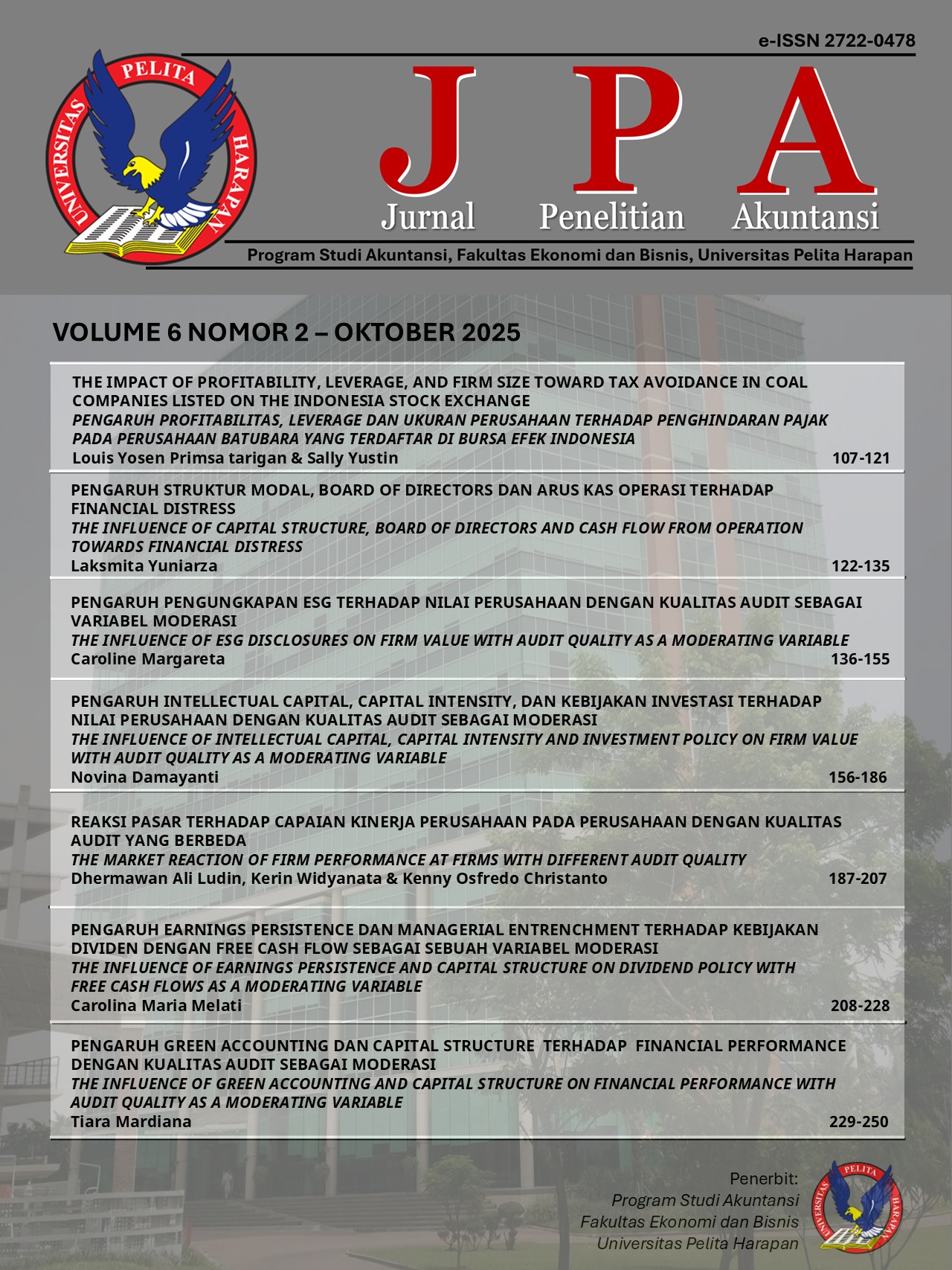
The Impact of Profitability, Leverage, and Firm Size Toward Tax Avoidance in Coal Companies Listed on the Indonesia Stock Exchange
Schlagworte:
Profitability, Leverage, Firm Size, Tax AvoidanceAbstract
The objective of this research is to analyze the impact of profitability, leverage, and firm size toward tax avoidance in coal companies listed on the Indonesia Stock Exchange for the period of 2020 to 2022. The independent variables used in this research are profitability measured by Return on Assets Ratio (RoA), leverage measured by Debt-to-Equity Ratio (DER) and firm size measured by total assets. Meanwhile, the dependent variable in this research is tax avoidance measured by Effective Tax Rate (ETR).
The population in this research is coal companies listed on the Indonesia Stock Exchange for the period of 2020 to 2022, in which the samples are determined by using the Purposive Sampling Method, resulting in 11 companies selected with a total of 33 samples. The data analysis method used descriptive statistics, classical assumption tests, multiple linear regression, and hypothesis tests, which are processed utilizing SPSS 26.
The research result shows that profitability and leverage partially do not have significant impact toward tax avoidance. Meanwhile, firm size partially has a significant impact toward tax avoidance. Moreover, profitability, leverage, and firm size simultaneously have a significant impact toward tax avoidance.
Literaturhinweise
Albers, M. J. (2017). Introduction to Quantitative Data Analysis in the Behavioral and Social Sciences. John Wiley & Sons.
Black, K. (2019). Business Statistics, John Wiley & Sons.
Danardhito, A, Widjanarko, H, & Kristanto, H. (2023). Determinan Penghindaran Pajak: Likuiditas, Leverage, Aktivitas, Profitabilitas, Pertumbuhan, dan Nilai Perusahaan. Jurnal Pajak Indonesia (JPI), 7(1), 45–56.
Davidson, W. (2020). Financial Statement Analysis: Basis for Management Advice. Wiley.
Drake, P. P., & Fabozzi, F. (2012). Analysis of Financial Statements (3rd ed.). Wiley.
Eisenhardt, K. M. (1989). Agency Theory: An Assessment and Review. The Academy of Management Review, 14(1), 57–74. https://doi.org/10.2307/258191
Esdm.go.id. (2023). Peranan Sektor Pertambangan dalam Mendorong Perekenomian Nasional @www.esdm.go.id.
Fauzan, F., Ayu, D. A., & Nurhajanti, N. N. (2019). The Effect of Audit Committee, Leverage, Return on Assets, Company Size, and Sales Growth on Tax Avoidance. Riset Akuntansi dan Keuangan Indonesia, 4(3). 171 – 185.
Fiesty Utami & Adih Supriadi. (2023). Size of Company, Return on Assets, and Leverage on Tax Avoidance. Fiesty (Vol. 8, Issue 1). https://doi.org/10.33087/jmas.v8i1.1021
Gupta, B. C. (2021). Statistical Quality Control. John Wiley & Sons.
Jensen, M. C., & Meckling, W. H. (1976). Theory of the Firm: Managerial Behavior, Agency Costs and Ownership Structure. Corporate Governance: Values, Ethics and Leadership, 77–132. https://doi.org/10.4159/9780674274051-006
Kontan.co.id. (2023). Kontribusi Sektor Pertambangan dan Penggalian ke Pertumbuhan Ekonomi Terus Meningkat @ nasional.kontan.co.id.
Lestari, J., & Solikhah, B. (2019). The Effect of CSR, Tunneling Incentive, Fiscal Loss Compensation, Debt Policy, Profitability, Firm Size to tax Avoidance. Accounting Analysis Journal, 8(1), 31–37. https://doi.org/10.15294/aaj.v8il.23103
Mariana, C., Riyadi, S. A., Fauzi, L. S. L., Khairunnisa, S. A., Yudhistira, R., & Mutisania, K. (2021). Leverage and Profitability on Tax Avoidance: Evidence on Mining Sector Companies Listed on The Indonesia Stock Exchange (Idx). Review of International Geographical Education (RIGEO), 11(3), 1542–1358. https://doi.org/10.33403/rigeo.800599
Mulyati, Y., Subing, H. J. T., Fathonah, A. N., & Prameela, A. (2019). Effect of Profitability, Leverage, and Company Size on Tax Avoidance. International Journal of Innovation, Creativity and Change, 6(8), 26–35.
Nasution, A. F., Anggraini, T., & Lubis, A. W. (2022). Pengaruh Ukuran Perusahaan, Umur Perusahaan, Profitabilitas, Leverage, dan Pertumbuhan Penjualan terhadap Tax Avoidance pada Perusahaan Manufaktur Sektor Makanan Dan Minuman Yang Terdaftar di Bursa Efek Indonesia Periode 2017- 2020. 3(2), 510–529.
Prapitasari, A., & Safrida, L. (2019). the Effect of Profitability, Leverage, Firm Size, Political Connection and Fixed Asset Intensity on Tax Avoidance (Empirical Study on Mining Companies Listed in Indonesia Stock Exchange 2015-2017). ACCRUALS (Accounting Research Journal of Sutaatmadja), 3(2), 247–258. https://doi.org/10.35310/accruals.v3i2.56
Sari, D., Wardani, R. K., Lestari, D. F., Sari, D., Wardani, R. K., & Lestari, D. F. (2021). The Effect of Leverage, Profitability and Company Size on Tax Avoidance (An Empirical Study on Mining Sector Companies Listed on Indonesia Stock Exchange Period 2013-2019). 12(4), 860–868.
Schmidlin, N. (2014). The Art of Company Valuation and Financial Statement Analysis. Wiley Finance Series.
Sofiamanan, N. Z., Machmuddah, Z., & T.A.H, N. (2023). Profitability, Capital Intensity, and Company Size against Tax Avoidance with Leverage as an Intervening Variable. Journal of Applied Accounting and Taxation, 8(1), 21–29. https://doi.org/10.30871/jaat.v8il.4821
Watson, R. (2015). Quantitative Research. Nurs Stand. 29 (31): 44 – 8. Doi: 10.7748/ns.29.31.44.e8681.PMID:25828021.
Wirawan, S. L., Yuniarwati (2022). Faktor-Faktor Yang Mempengaruhi Tax Avoidance pada Perusahaan Barang Konsumsi di Indonesia. 318–337
Downloads
Veröffentlicht
Ausgabe
Rubrik
Lizenz
Copyright (c) 2026 Louis Yosen Primsa Tarigan, Sally Yustin

Dieses Werk steht unter der Lizenz Creative Commons Namensnennung - Weitergabe unter gleichen Bedingungen 4.0 International.
Authors who publish with this journal agree to the following terms:
1) Authors retain copyright and grant the journal right of first publication with the work simultaneously licensed under a Creative Commons Attribution License (CC-BY-SA 4.0) that allows others to share the work with an acknowledgement of the work's authorship and initial publication in this journal.
2) Authors are able to enter into separate, additional contractual arrangements for the non-exclusive distribution of the journal's published version of the work (e.g., post it to an institutional repository or publish it in a book), with an acknowledgement of its initial publication in this journal.
3) Authors are permitted and encouraged to post their work online (e.g., in institutional repositories or on their website). The final published PDF should be used and bibliographic details that credit the publication in this journal should be included.
 Accounting Study Program | Faculty of Economics and Business | Universitas Pelita Harapan | Lippo Karawaci, Tangerang, Indonesia, 15811 | Tel +62 21 5460901 | Fax +62 21 5460910