
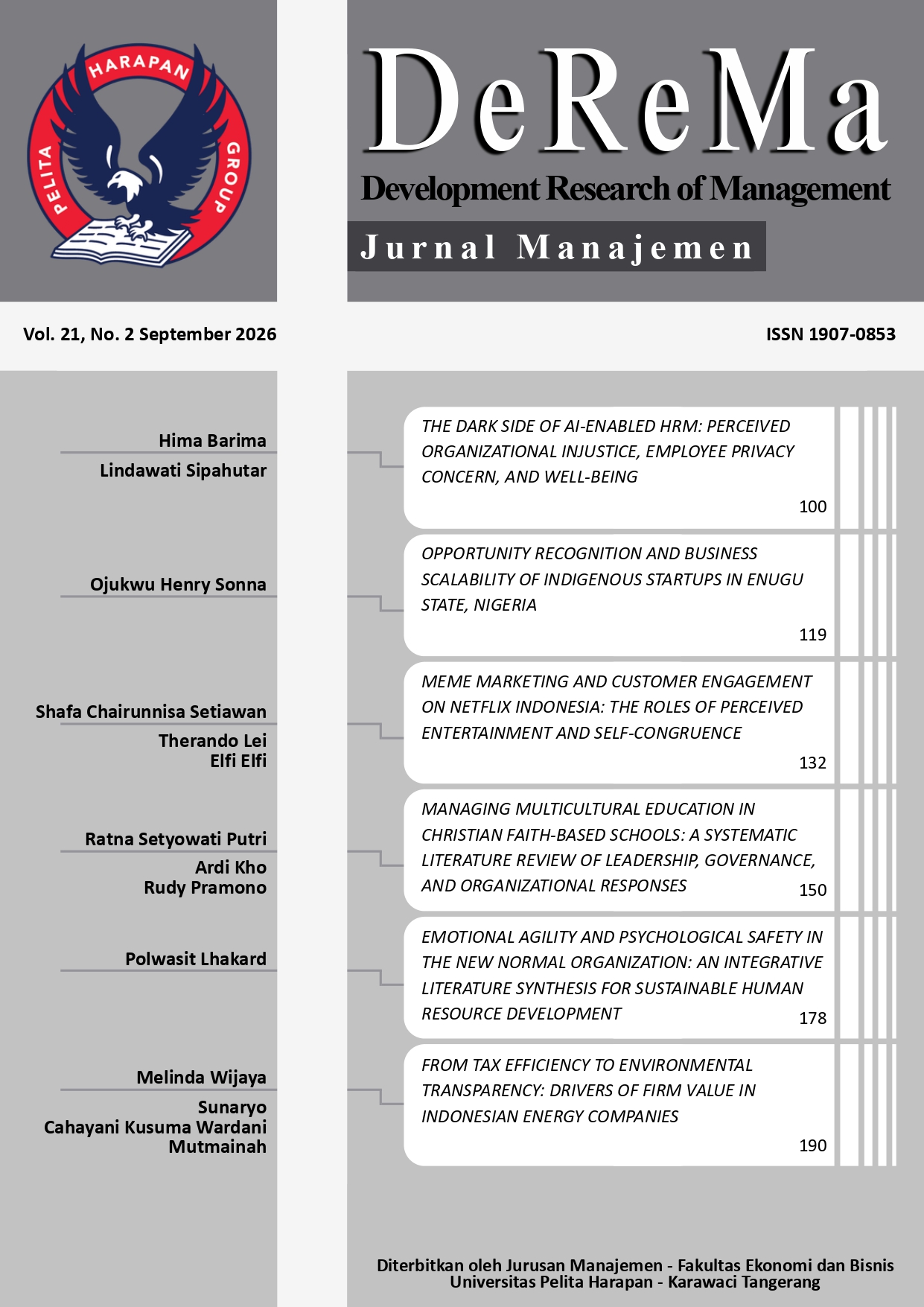
OPPORTUNITY RECOGNITION AND BUSINESS SCALABILITY OF INDIGENOUS STARTUPS IN ENUGU STATE, NIGERIA
DOI:
https://doi.org/10.19166/derema.v21i2.11271Trefwoorden:
Opportunity Recognition, Business Scalability, Environmental Scanning Capability, Prior Entrepreneurial Knowledge, Indigenous Startups, nigeriaSamenvatting
This study examined the effect of opportunity recognition on business scalability among indigenous startups in Enugu State, Nigeria. The study specifically investigated the influence of environmental scanning capability and prior entrepreneurial knowledge on business scalability. A descriptive survey research design based on a quantitative approach was adopted. Data were collected from 268 indigenous startups operating within their first five years across Enugu, Nsukka, Oji River, and Awgu using structured questionnaires. Descriptive and inferential statistics were employed for data analysis, and hypotheses were tested using multiple regression analysis in SPSS. The findings revealed that environmental scanning capability and prior entrepreneurial knowledge both exert significant positive effects on business scalability, with environmental scanning capability emerging as the stronger predictor. The study concludes that opportunity recognition is a critical determinant of startup scalability in dynamic and resource-constrained entrepreneurial environments. The study recommends strengthening environmental scanning practices, entrepreneurial learning systems, and market intelligence support mechanisms to improve startup growth and sustainability.
Abstrak dalam Bahasa Indonesia :
Penelitian ini mengkaji pengaruh pengenalan peluang terhadap skalabilitas bisnis pada startup lokal di Negara Bagian Enugu, Nigeria. Secara khusus, penelitian ini menganalisis pengaruh kemampuan pemindaian lingkungan dan pengetahuan kewirausahaan sebelumnya terhadap skalabilitas bisnis. Penelitian ini menggunakan desain survei deskriptif dengan pendekatan kuantitatif. Data dikumpulkan dari 268 startup lokal yang beroperasi dalam lima tahun pertama di wilayah Enugu, Nsukka, Oji River, dan Awgu dengan menggunakan kuesioner terstruktur. Analisis data dilakukan dengan statistik deskriptif dan inferensial, sedangkan pengujian hipotesis menggunakan analisis regresi berganda melalui SPSS. Hasil penelitian menunjukkan bahwa kemampuan pemindaian lingkungan dan pengetahuan kewirausahaan sebelumnya sama-sama memiliki pengaruh positif yang signifikan terhadap skalabilitas bisnis, dengan kemampuan pemindaian lingkungan sebagai prediktor yang lebih kuat. Penelitian ini menyimpulkan bahwa pengenalan peluang merupakan determinan penting bagi skalabilitas startup dalam lingkungan kewirausahaan yang dinamis dan memiliki keterbatasan sumber daya. Penelitian ini merekomendasikan penguatan praktik pemindaian lingkungan, sistem pembelajaran kewirausahaan, serta mekanisme dukungan intelijen pasar untuk meningkatkan pertumbuhan dan keberlanjutan startup.
Referenties
Akanbi, T. A., & Salisu, O. A. (2022). Entrepreneurial opportunity recognition and SME growth in emerging economies. Journal of Small Business and Enterprise Development, 29(4), 512–528.
Anwar, M., Clauss, T., & Issah, W. B. (2022). Entrepreneurial orientation and new venture performance in emerging markets: The mediating role of opportunity recognition. Review of Managerial Science, 16(3), 769–796. https://doi.org/10.1007/s11846-021-00457-w
Ardichvili, A., Cardozo, R., & Ray, S. (2003). A theory of entrepreneurial opportunity identification and development. Journal of Business Venturing, 18(1), 105–123. https://doi.org/10.1016/S0883-9026(01)00068-4
Ayoade, J. O., Adegbite, T. A., & Olaniyan, O. T. (2022). Structural constraints and entrepreneurial performance in developing economies. African Journal of Business Management, 16(3), 45–59.
Baron, R. A. (2006). Opportunity recognition as pattern recognition: How entrepreneurs “connect the dots” to identify new business opportunities. Academy of Management Perspectives, 20(1), 104–119. https://doi.org/10.5465/amp.2006.19873412
Bello, M. S., & Okoye, L. U. (2024). Entrepreneurial capability and startup scalability in Sub-Saharan Africa. Journal of African Business, 25(1), 1–18.
Delmar, F., Davidsson, P., & Gartner, W. B. (2003). Arriving at the high-growth firm. Journal of Business Venturing, 18(2), 189–216. https://doi.org/10.1016/S0883-9026(02)00080-0
Donbesuur, F., Boso, N., & Hultman, M. (2022). External knowledge resources and new venture success in developing economies. Technological Forecasting and Social Change, 185, 122034. https://doi.org/10.1016/j.techfore.2022.122034
Eze, U. S., Nwankwo, C. A., & Kanyangale, M. I. (2022). Effect of entrepreneurial orientation on performance of agro-processing small and medium enterprises in Anambra State, Nigeria. International Journal of Entrepreneurship, 26(1), 1–14.
Ezurike, B. C. (2023). Digital intelligence and entrepreneurial adaptability in African SMEs. International Journal of Entrepreneurship and Small Business, 48(2), 210–228.
García, M., & Martínez, J. (2024). Entrepreneurial capabilities and venture growth disparities in emerging markets. Journal of Business Research, 168, 114–126.
Ibrahim, A. S., & Yusuf, R. T. (2023). Environmental scanning and small business competitiveness in developing economies. Journal of Entrepreneurship in Emerging Economies, 15(2), 233–250.
Kumar, V., & Sharma, P. (2024). Entrepreneurial capability development and startup scalability in digital economies. Journal of Business Venturing Insights, 21, e00456.
Lu, J. W., & Beamish, P. W. (2006). SME internationalization and performance: Growth versus profitability. Journal of International Business Studies, 37(4), 485–504. https://doi.org/10.1057/palgrave.jibs.8400200
Morrison, A., & Clarke, J. (2024). Entrepreneurial cognition and opportunity recognition in emerging markets: Evidence from small business growth dynamics. Journal of Business Venturing Insights, 21, e00456. https://doi.org/10.1016/j.jbvi.2024.e00456
Mwangi, J., & Kimani, D. (2024). Dynamic capabilities and SME growth performance in Africa. African Journal of Economic and Management Studies, 15(1), 88–105.
Nwankwo, F. C., & Eze, B. U. (2023). Institutional constraints and entrepreneurial performance in Nigeria. Journal of Developmental Entrepreneurship, 28(3), 2350012.
Ocasio, W. (1997). Towards an attention-based view of the firm. Strategic Management Journal, 18(S1), 187–206. https://doi.org/10.1002/(SICI)1097-0266(199707)18:1+<187::AID-SMJ936>3.0.CO;2-K
Organisation for Economic Co-operation and Development. (2024). SME and entrepreneurship outlook 2024. OECD Publishing.
Ojubanire, O. A., & Idowu, H. O. A. (2023). Adapting entrepreneurial orientation for business performance of medium-sized business in South-West Nigeria. Financial Metrics in Business, 4(2), 18–32. https://doi.org/10.25082/FMB.2023.02.002
Okafor, C. N., & Nwosu, P. I. (2024). Digital capability and SME scalability in Nigeria. Journal of African Business, 25(2), 145–162.
Okwu, A. T., & Eze, J. C. (2024). Digital capability and performance outcomes in Nigerian SMEs. Technology in Society, 76, 102435.
Olaniyan, O. T., & Kalu, I. U. (2023). Entrepreneurial resources and SME performance in Nigeria. International Journal of Entrepreneurial Behavior & Research, 29(5), 1120–1138.
Olatunji, O. S., & Nwosu, P. I. (2024). Strategic orientation and startup scalability in emerging economies. Journal of Small Business Management, 62(1), 77–95.
Oluigbo-Moses, C., & Nwankwo, G. C. (2023). Opportunity-seizing capability and business performance: The experience of small and medium-scale enterprises in agribusiness. Nigerian Journal of Management Sciences, 24(2a), 1–15.
Otache, I., Edopkolor, J. E., Sani, I. A., & Umar, K. (2024). Entrepreneurship education and entrepreneurial intentions: Do entrepreneurial self-efficacy, alertness and opportunity recognition matter? The International Journal of Management Education, 22(1), 100917. https://doi.org/10.1016/j.ijme.2023.100917
Partech Africa. (2024). Africa tech venture capital report 2024. Partech Partners.
Rataj, O., & Türkeli, S. (2024). Success factors for scaling up and raising investment by circular entrepreneurs in emerging markets and developing economies. Circular Economy and Sustainability, 4(3), 1021–1046. https://doi.org/10.1007/s43615-023-00319-5
Shane, S. (2000). Prior knowledge and the discovery of entrepreneurial opportunities. Organization Science, 11(4), 448–469. https://doi.org/10.1287/orsc.11.4.448.14602
Shane, S., & Venkataraman, S. (2000). The promise of entrepreneurship as a field of research. Academy of Management Review, 25(1), 217–226. https://doi.org/10.5465/amr.2000.2791611
Shettima, M. B., Sulaiman, A. K., & Gemu, A. (2023). Entrepreneurial competencies and SMEs performance in Yobe State: Moderating role of entrepreneurial commitment. Nigerian Journal of Rural Finance and Entrepreneurship, 1(1–2), 57–78.
SMEDAN, & NBS. (2021). National MSME survey report. Small and Medium Enterprises Development Agency of Nigeria & National Bureau of Statistics. https://doi.org/10.61955/nghmxq
Teece, D. J. (2007). Explicating dynamic capabilities: The nature and microfoundations of (sustainable) enterprise performance. Strategic Management Journal, 28(13), 1319–1350. https://doi.org/10.1002/smj.640
Teece, D. J., Pisano, G., & Shuen, A. (1997). Dynamic capabilities and strategic management. Strategic Management Journal, 18(7), 509–533. https://doi.org/10.1002/(SICI)1097-0266(199708)18:7<509::AID-SMJ882>3.0.CO;2-Z
World Bank. (2022). World development report 2022: Finance for an equitable recovery. World Bank. https://doi.org/10.1596/978-1-4648-1730-4
Zahra, S. A., & George, G. (2002). Absorptive capacity: A review, reconceptualization, and extension. Academy of Management Review, 27(2), 185–203. https://doi.org/10.5465/amr.2002.6587995
Zhang, Y., & Liu, H. (2024). Digital transformation and entrepreneurial scalability in emerging markets. Technological Forecasting and Social Change, 198, 123456.
##submission.downloads##
Gepubliceerd
Nummer
Sectie
Licentie
Copyright (c) 2026 Henry Sonna Ojukwu

Dit werk wordt verdeeld onder een Naamsvermelding-GelijkDelen 4.0 Internationaal licentie.
Authors who publish with this journal agree to the following terms:
1) Authors retain copyright and grant the journal right of first publication with the work simultaneously licensed under a Creative Commons Attribution License (CC-BY-SA 4.0) that allows others to share the work with an acknowledgement of the work's authorship and initial publication in this journal.
2) Authors are able to enter into separate, additional contractual arrangements for the non-exclusive distribution of the journal's published version of the work (e.g., post it to an institutional repository or publish it in a book), with an acknowledgement of its initial publication in this journal.
3) Authors are permitted and encouraged to post their work online (e.g., in institutional repositories or on their website). The final published PDF should be used and bibliographic details that credit the publication in this journal should be included.



 Department of Management | Business School | Universitas Pelita Harapan | Indonesia | +62 21 546 0901 | jurnal.derema@uph.edu