
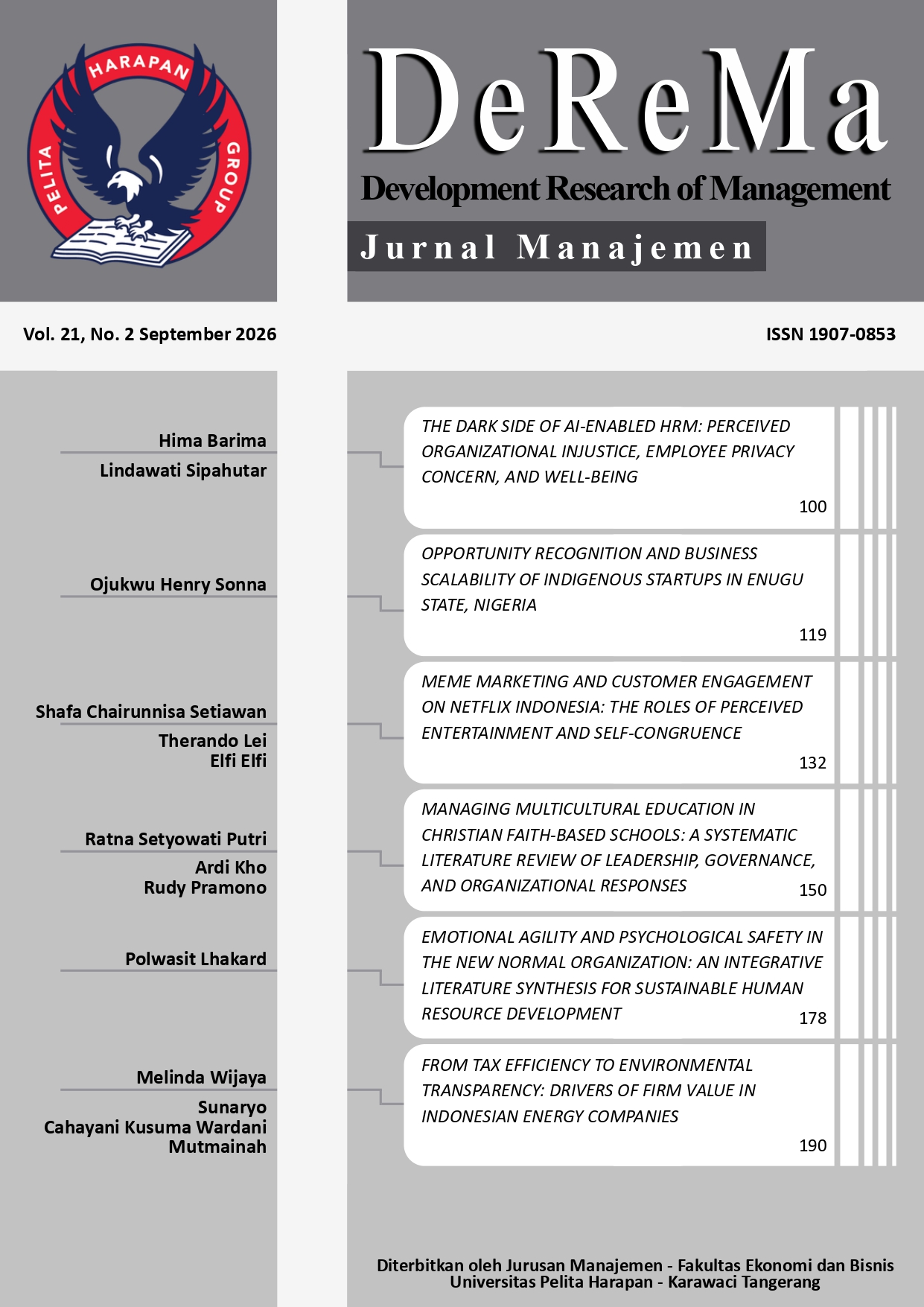
MEME MARKETING AND CUSTOMER ENGAGEMENT ON NETFLIX INDONESIA: THE ROLES OF PERCEIVED ENTERTAINMENT AND SELF-CONGRUENCE
##semicolon##
https://doi.org/10.19166/derema.v21i2.11476##semicolon##
meme marketing##common.commaListSeparator## self-congruence##common.commaListSeparator## perceived entertainment##common.commaListSeparator## customer engagement초록
This study examines the effect of meme marketing on customer engagement in the context of Netflix Indonesia’s Instagram account, with self-congruence and perceived entertainment as explanatory variables. The study is motivated by the relatively low engagement rate observed despite the increasing use of meme-based content as a digital marketing strategy among Generation Z. Data were collected through an online questionnaire from 117 Generation Z respondents who actively use Instagram and had been exposed to Netflix Indonesia’s meme content. The data were analyzed using Partial Least Squares Structural Equation Modeling (PLS-SEM). The results show that meme marketing has positive and significant effects on both self-congruence and perceived entertainment. Perceived entertainment has a positive and significant effect on customer engagement, whereas self-congruence does not significantly affect customer engagement. Meme marketing also has no significant direct effect on customer engagement. These findings indicate that perceived entertainment is more strongly associated with customer engagement than self-congruence in the context examined. The study suggests that using memes alone may not be sufficient to generate engagement; audience perceptions of entertainment are particularly important for generating engagement. The findings provide practical implications for digital entertainment brands by emphasizing the importance of humor, creativity, and entertainment value when designing meme-based content for Generation Z audiences.
Abstrak dalam Bahasa Indonesia :
Penelitian ini menganalisis pengaruh meme marketing terhadap customer engagement dalam konteks akun Instagram Netflix Indonesia, dengan self-congruence dan perceived entertainment sebagai variabel penjelas. Penelitian ini dilatarbelakangi oleh relatif rendahnya tingkat engagement meskipun penggunaan konten berbasis meme sebagai strategi pemasaran digital semakin meningkat di kalangan Generasi Z. Data dikumpulkan melalui kuesioner daring dari 117 responden Generasi Z yang aktif menggunakan Instagram dan pernah terpapar konten meme Netflix Indonesia. Data dianalisis menggunakan Partial Least Squares Structural Equation Modeling (PLS-SEM). Hasil penelitian menunjukkan bahwa meme marketing berpengaruh positif dan signifikan terhadap self-congruence dan perceived entertainment. Perceived entertainment berpengaruh positif dan signifikan terhadap customer engagement, sedangkan self-congruence tidak berpengaruh signifikan terhadap customer engagement. Selain itu, meme marketing tidak memiliki pengaruh langsung yang signifikan terhadap customer engagement. Temuan ini menunjukkan bahwa perceived entertainment memiliki hubungan yang lebih kuat dengan customer engagement dibandingkan self-congruence dalam konteks yang diteliti. Penelitian ini mengindikasikan bahwa penggunaan meme saja belum tentu mampu menghasilkan engagement; audiens perlu merasakan bahwa konten tersebut benar-benar menghibur. Temuan ini memberikan implikasi praktis bagi merek di sektor hiburan digital dengan menekankan pentingnya humor, kreativitas, dan nilai hiburan dalam merancang konten berbasis meme bagi audiens Generasi Z.
##submission.citations##
Algesheimer, R., Dholakia, U. M., & Herrmann, A. (2005). The social influence of brand community: Evidence from European car clubs. Journal of Marketing, 69(3), 19–34. https://doi.org/10.1509/jmkg.69.3.19.66363
Brodie, R. J., Hollebeek, L. D., Juric, B., & Ilic, A. (2011). Customer engagement: Conceptual domain, fundamental propositions, and implications for research. Journal of Service Research, 14(3), 252–271. https://doi.org/10.1177/1094670511411703
Calder, B. J., Malthouse, E. C., & Schaedel, U. (2009). An experimental study of the relationship between online engagement and advertising effectiveness. Journal of Interactive Marketing, 23(4), 321–332. https://doi.org/10.1016/j.intmar.2009.07.002
Childers, T. L., Carr, C. L., Peck, J., & Carson, S. (2001). Hedonic and utilitarian motivations for online retail shopping behavior. Journal of Retailing, 77(4), 511–535. https://doi.org/10.1016/S0022-4359(01)00056-2
Cohen, J. (1988). Statistical power analysis for the behavioral sciences (2nd ed.). L. Erlbaum Associates.
Davis, F. D., Bagozzi, R. P., & Warshaw, P. R. (1992). Extrinsic and intrinsic motivation to use computers in the workplace. Journal of Applied Social Psychology, 22(14), 1111–1132. https://doi.org/10.1111/j.1559-1816.1992.tb00945.x
Dessart, L., Veloutsou, C., & Morgan-Thomas, A. (2015). Consumer engagement in online brand communities: A social media perspective. Journal of Product & Brand Management, 24(1), 28–42. https://doi.org/10.1108/JPBM-06-2014-0635
Djafarova, E., & Bowes, T. (2021). “Instagram made me buy it”: Generation Z impulse purchases in fashion industry. Journal of Retailing and Consumer Services, 59, 102345. https://doi.org/10.1016/j.jretconser.2020.102345
Ducoffe, R. H. (1995). How consumers assess the value of advertising. Journal of Current Issues & Research in Advertising, 17(1), 1–18. https://doi.org/10.1080/10641734.1995.10505022
Eroglu, S. A., Machleit, K. A., & Davis, L. M. (2001). Atmospheric qualities of online retailing: A conceptual model and implications. Journal of Business Research, 54(2), 177–184.
Faul, F., Erdfelder, E., Buchner, A., & Lang, A.-G. (2009). Statistical power analyses using G*Power 3.1: Tests for correlation and regression analyses. Behavior Research Methods, 41(4), 1149–1160. https://doi.org/10.3758/BRM.41.4.1149
Franke, G., & Sarstedt, M. (2019). Heuristics versus statistics in discriminant validity testing: A comparison of four procedures. Internet Research, 29(3), 430–447. https://doi.org/10.1108/IntR-12-2017-0515
Gummerus, J., Liljander, V., Weman, E., & Pihlström, M. (2012). Customer engagement in a Facebook brand community. Management Research Review, 35(9), 857–877. https://doi.org/10.1108/01409171211256578
Hair, J. F., Sarstedt, M., Ringle, C. M., & Gudergan, S. P. (2024). Advanced issues in partial least squares structural equation modeling (2nd ed.). SAGE Publications, Inc.
Hollebeek, L. D., Glynn, M. S., & Brodie, R. J. (2014). Consumer brand engagement in social media: Conceptualization, scale development and validation. Journal of Interactive Marketing, 28(2), 149–165. https://doi.org/10.1016/j.intmar.2013.12.002
Islam, J., & Rahman, Z. (2017). The impact of online brand community characteristics on customer engagement: An application of stimulus-organism-response paradigm. Telematics and Informatics, 34(4), 330–340. https://doi.org/10.1016/j.tele.2016.06.008
Islam, J. U., & Rahman, Z. (2016). The transpiring journey of customer engagement research in marketing: A systematic review of the past decade. Management Decision, 54(8), 2008–2034. https://doi.org/10.1108/MD-01-2016-0028
Japutra, A., Ekinci, Y., & Simkin, L. (2018). Positive and negative behaviours resulting from brand attachment: The moderating effects of attachment styles. European Journal of Marketing, 52(5–6), 1185–1202. https://doi.org/10.1108/EJM-10-2016-0566
Katz, E., Blumler, J. G., & Gurevitch, M. (1974). Uses and gratifications research. In J. G. Blumler & E. Katz (Eds.), The uses of mass communications: Current perspectives on gratifications research (pp. 19–32). Sage Publications. https://www.jstor.org/stable/2747854
Logan, K., Bright, L. F., & Gangadharbatla, H. (2012). Facebook versus television: Advertising value perceptions among females. Journal of Research in Interactive Marketing, 6(3), 164–179. https://doi.org/10.1108/17505931211274651
Ly-Le, T.-M. (2025). From recruitment to retention: Strategic marketing communication for higher education management in Vietnam. DeReMa (Development Research of Management): Jurnal Manajemen, 20(2), 135–146. https://doi.org/10.19166/derema.v20i2.10035
Malär, L., Krohmer, H., Hoyer, W. D., & Nyffenegger, B. (2011). Emotional brand attachment and brand personality: The relative importance of the actual and the ideal self. Journal of Marketing, 75(4), 35–52. https://doi.org/10.1509/jmkg.75.4.35
Malodia, S., Dhir, A., Bilgihan, A., Sinha, P., & Tikoo, T. (2022). Meme marketing: How can marketers drive better engagement using viral memes? Psychology & Marketing, 39(9), 1775–1801. https://doi.org/10.1002/mar.21702
Mehrabian, A., & Russell, J. A. (1974). An approach to environmental psychology. MIT Press.
Memon, M. A., Ting, H., Cheah, J.-H., Thurasamy, R., Chuah, F., & Cham, T. H. (2020). Sample size for survey research: Review and recommendations. Journal of Applied Structural Equation Modeling, 4(2), i–xx. https://doi.org/10.47263/jasem.4(2)01
Milner, R. M. (2018). The world made meme: Public conversations and participatory media. MIT Press.
Podsakoff, P. M., MacKenzie, S. B., & Podsakoff, N. P. (2012). Sources of method bias in social science research and recommendations on how to control it. Annual Review of Psychology, 63, 539–569. https://doi.org/10.1146/annurev-psych-120710-100452
Razzaq, A., Shao, W., & Quach, S. (2024). Meme marketing effectiveness: A moderated-mediation model. Journal of Retailing and Consumer Services, 78, 103702. https://doi.org/10.1016/j.jretconser.2023.103702
Shifman, L. (2013). Memes in digital culture. MIT Press.
Sirgy, M. J. (1982). Self-concept in consumer behavior: A critical review. Journal of Consumer Research, 9(3), 287–300. https://doi.org/10.1086/208924
Sirgy, M. J., Grewal, D., Mangleburg, T. F., Park, J.-O., Chon, K.-S., Claiborne, C. B., Johar, J. S., & Berkman, H. (1997). Assessing the predictive validity of two methods of measuring self-image congruence. Journal of the Academy of Marketing Science, 25(3), 229–241. https://doi.org/10.1177/0092070397253004
Steviano, A., & Sihombing, S. O. (2023). Pengaruh manajemen hubungan masyarakat dan orientasi pemasaran hubungan terhadap loyalitas merek dengan keterlibatan pelanggan dan kepercayaan merek sebagai variabel mediasi. DeReMa (Development Research of Management): Jurnal Manajemen, 18(2), 86–108. https://doi.org/10.19166/derema.v18i2.6808
Venkatesh, V. (2000). Determinants of perceived ease of use: Integrating control, intrinsic motivation, and emotion into the technology acceptance model. Information Systems Research, 11(4), 342–365. https://doi.org/10.1287/isre.11.4.342.11872
Vivek, S. D., Beatty, S. E., & Morgan, R. M. (2012). Customer engagement: Exploring customer relationships beyond purchase. Journal of Marketing Theory and Practice, 20(2), 122–146. https://doi.org/10.2753/MTP1069-6679200201
##submission.downloads##
출판됨
권
세션
##submission.license##
##submission.copyrightStatement##
##submission.license.cc.by-sa4.footer##Authors who publish with this journal agree to the following terms:
1) Authors retain copyright and grant the journal right of first publication with the work simultaneously licensed under a Creative Commons Attribution License (CC-BY-SA 4.0) that allows others to share the work with an acknowledgement of the work's authorship and initial publication in this journal.
2) Authors are able to enter into separate, additional contractual arrangements for the non-exclusive distribution of the journal's published version of the work (e.g., post it to an institutional repository or publish it in a book), with an acknowledgement of its initial publication in this journal.
3) Authors are permitted and encouraged to post their work online (e.g., in institutional repositories or on their website). The final published PDF should be used and bibliographic details that credit the publication in this journal should be included.



 Department of Management | Business School | Universitas Pelita Harapan | Indonesia | +62 21 546 0901 | jurnal.derema@uph.edu