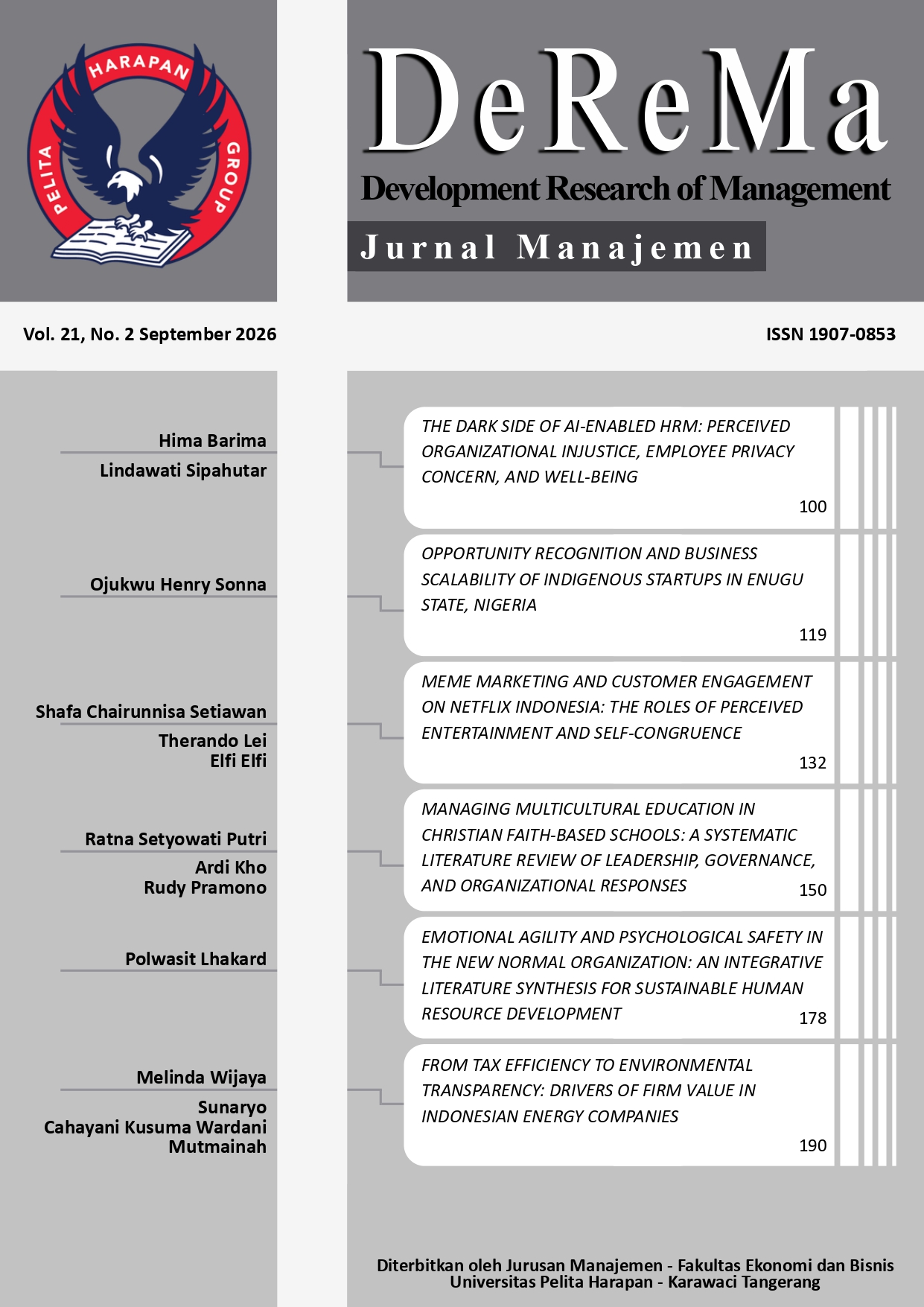
EMOTIONAL AGILITY AND PSYCHOLOGICAL SAFETY IN THE NEW NORMAL ORGANIZATION: AN INTEGRATIVE LITERATURE SYNTHESIS FOR SUSTAINABLE HUMAN RESOURCE DEVELOPMENT
##semicolon##
https://doi.org/10.19166/derema.v21i2.11482##semicolon##
emotional agility##common.commaListSeparator## psychological safety##common.commaListSeparator## psychological flexibility##common.commaListSeparator## hybrid work##common.commaListSeparator## agile leadership##common.commaListSeparator## sustainable human resource development##common.commaListSeparator## well-being要旨
The move toward the new normal organization—hybrid and distributed work, deepening digital mediation, and the swift uptake of artificial intelligence—has widened employees’ flexibility while sharpening their psychological strain. Human resource development (HRD) models built for stable, co-located settings sit uneasily with the emotional vulnerability this shift produces. This article reviews two literatures that have matured largely apart: emotional agility, an individual capacity for engaging adaptively with one’s inner emotional life that draws on the science of emotion regulation and psychological flexibility; and psychological safety, a team-level belief that interpersonal risk-taking is safe. Drawing on an integrative literature review of Scopus, Web of Science, and the Thai-Journal Citation Index, searched on 15 January 2026, and synthesizing 25 peer-reviewed and foundational sources through thematic and conceptual integration rather than meta-analytic pooling, the review clarifies each construct, examines the obstacles the new normal places before both, and proposes—as a theoretical antecedent relationship for future empirical testing, not an established finding—that individual emotional agility serves as a proximal antecedent of team psychological safety, with agile and empathetic leadership acting as the connecting mechanism. The synthesis yields a multilevel framework that links the new normal environment, leadership, emotional agility, psychological safety, and sustainable HRD outcomes—retention, well-being, and innovation—and closes with implications for practice and a research agenda.
Abstrak dalam Bahasa Indonesia : Perubahan menuju organisasi new normal yang ditandai dengan kerja hibrida, digitalisasi, dan adopsi kecerdasan buatan meningkatkan fleksibilitas sekaligus tekanan psikologis karyawan. Kondisi ini menuntut pendekatan pengembangan sumber daya manusia (SDM) yang lebih adaptif terhadap dinamika emosional di tempat kerja. Artikel ini mengintegrasikan dua konstruk yang berkembang secara terpisah, yaitu emotional agility, sebagai kemampuan individu untuk merespons dan mengelola emosi secara adaptif, dan psychological safety, sebagai keyakinan tim bahwa lingkungan kerja aman untuk mengambil risiko interpersonal. Melalui tinjauan literatur integratif terhadap 25 sumber dari Scopus, Web of Science, dan Thai-Journal Citation Index yang ditelusuri pada 15 Januari 2026, artikel ini menganalisis kedua konstruk tersebut dalam konteks new normal. Sintesis konseptual mengusulkan bahwa emotional agility individu dapat menjadi anteseden proksimal psychological safety pada tingkat tim, dengan kepemimpinan yang lincah dan empatik sebagai mekanisme penghubung. Kerangka multilevel yang dihasilkan menghubungkan lingkungan new normal, kepemimpinan, emotional agility, psychological safety, serta hasil SDM berkelanjutan berupa retensi, kesejahteraan, dan inovasi. Artikel ini memberikan implikasi bagi praktik SDM dan agenda penelitian empiris di masa mendatang.
##submission.citations##
Ashkanasy, N. M., & Dorris, A. D. (2017). Emotions in the workplace. Annual Review of Organizational Psychology and Organizational Behavior, 4, 67–90. https://doi.org/10.1146/annurev-orgpsych-032516-113231
Bailenson, J. N. (2021). Nonverbal overload: A theoretical argument for the causes of Zoom fatigue. Technology, Mind, and Behavior, 2(1). https://doi.org/10.1037/tmb0000030
Bradley, B. H., Postlethwaite, B. E., Klotz, A. C., Hamdani, M. R., & Brown, M. E. (2012). Reaping the benefits of task conflict in teams: The critical role of team psychological safety climate. Journal of Applied Psychology, 97(1), 151–158. https://doi.org/10.1037/a0024200
Carmeli, A., Brueller, D., & Dutton, J. E. (2009). Learning behaviours in the workplace: The role of high-quality interpersonal relationships and psychological safety. Systems Research and Behavioral Science, 26(1), 81–98. https://doi.org/10.1002/sres.932
Corneliuson, C., Babapour Chafi, M., Tornevi, A., Stjernbrandt, A., & Wahlström, V. (2026). Psychosocial work experience after implementing hybrid work: A longitudinal study. BMC Public Health, 26, 1359. https://doi.org/10.1186/s12889-026-27487-x
Côté, S. (2014). Emotional intelligence in organizations. Annual Review of Organizational Psychology and Organizational Behavior, 1, 459–488. https://doi.org/10.1146/annurev-orgpsych-031413-091233
David, S., & Congleton, C. (2013). Emotional agility. Harvard Business Review, 91(11), 125–128.
Edmondson, A. C. (1999). Psychological safety and learning behavior in work teams. Administrative Science Quarterly, 44(2), 350–383. https://doi.org/10.2307/2666999
Edmondson, A. C. (2018). The fearless organization: Creating psychological safety in the workplace for learning, innovation, and growth. John Wiley & Sons.
Edmondson, A. C., & Lei, Z. (2014). Psychological safety: The history, renaissance, and future of an interpersonal construct. Annual Review of Organizational Psychology and Organizational Behavior, 1, 23–43. https://doi.org/10.1146/annurev-orgpsych-031413-091305
Feitosa, J., & Salas, E. (2020). Today’s virtual teams: Adapting lessons learned to the pandemic context. Organizational Dynamics, 49(1), 100777. https://doi.org/10.1016/j.orgdyn.2020.100777
Frazier, M. L., Fainshmidt, S., Klinger, R. L., Pezeshkan, A., & Vracheva, V. (2017). Psychological safety: A meta-analytic review and extension. Personnel Psychology, 70(1), 113–165. https://doi.org/10.1111/peps.12183
Grandey, A. A., & Melloy, R. C. (2017). The state of the heart: Emotional labor as emotion regulation reviewed and revised. Journal of Occupational Health Psychology, 22(3), 407–422. https://doi.org/10.1037/ocp0000074
Gross, J. J. (2015). Emotion regulation: Current status and future prospects. Psychological Inquiry, 26(1), 1–26. https://doi.org/10.1080/1047840X.2014.940781
Kashdan, T. B., & Rottenberg, J. (2010). Psychological flexibility as a fundamental aspect of health. Clinical Psychology Review, 30(7), 865–878. https://doi.org/10.1016/j.cpr.2010.03.001
Kniffin, K. M., Narayanan, J., Anseel, F., Antonakis, J., Ashford, S. P., Bakker, A. B., Bamberger, P., Bapuji, H., Bhave, D. P., Choi, V. K., Creary, S. J., Demerouti, E., Flynn, F. J., Gelfand, M. J., Greer, L. L., Johns, G., Kesebir, S., Klein, P. G., Lee, S. Y., Ozcelik, H., Petriglieri, J. L., Rothbard, N. P., Rudolph, C. W., Shaw, J. D., Sirola, N., Wanberg, C. R., Whillans, A., Wilmot, M. P., & Vugt, M. K. (2021). COVID-19 and the workplace: Implications, issues, and insights for future research and action. American Psychologist, 76(1), 63–77. https://doi.org/10.1037/amp0000716
Kramar, R. (2014). Beyond strategic human resource management: Is sustainable human resource management the next approach? The International Journal of Human Resource Management, 25(8), 1069–1089. https://doi.org/10.1080/09585192.2013.816863
Kramar, R. (2022). Sustainable human resource management: Six defining characteristics. Asia Pacific Journal of Human Resources, 60(1), 146–170. https://doi.org/10.1111/1744-7941.12321
Nembhard, I. M., & Edmondson, A. C. (2006). Making it safe: The effects of leader inclusiveness and professional status on psychological safety and improvement efforts in health care teams. Journal of Organizational Behavior, 27(7), 941–966. https://doi.org/10.1002/job.413
Newman, A., Donohue, R., & Eva, N. (2017). Psychological safety: A systematic review of the literature. Human Resource Management Review, 27(3), 521–535. https://doi.org/10.1016/j.hrmr.2017.01.001
Tinnerholm Ljungberg, H., Wallberg, M., Aboagye, E., Bergström, G., Björklund, C., Kwak, L., Toivanen, S., Jensen, I., & Vacchiano, M. (2025). ‘Wish you were here’: Managers’ experiences of hybrid work in higher education. PLOS ONE, 20(12), e0339120. https://doi.org/10.1371/journal.pone.0339120
Torraco, R. J. (2005). Writing integrative literature reviews: Guidelines and examples. Human Resource Development Review, 4(3), 356–367. https://doi.org/10.1177/1534484305278283
Wang, B., Liu, Y., Qian, J., & Parker, S. K. (2021). Achieving effective remote working during the COVID-19 pandemic: A work design perspective. Applied Psychology, 70(1), 16–59. https://doi.org/10.1111/apps.12290
Wang, Y., Ravazzani, S., & Anton, A. (2025). Generative AI risks: Are European communication professionals ready? A study on individual and organizational readiness. Journal of Communication Management. Advance online publication. https://doi.org/10.1108/JCOM-12-2024-0256
Yang, L., Holtz, D., Jaffe, S., Suri, S., Sinha, S., Weston, J., Joyce, C., Shah, N., Sherman, K., Hecht, B., & Teevan, J. (2022). The effects of remote work on collaboration among information workers. Nature Human Behaviour, 6(1), 43–54. https://doi.org/10.1038/s41562-021-01196-4
##submission.downloads##
出版済
巻号
セクション
##submission.license##
##submission.copyrightStatement##
##submission.license.cc.by-sa4.footer##Authors who publish with this journal agree to the following terms:
1) Authors retain copyright and grant the journal right of first publication with the work simultaneously licensed under a Creative Commons Attribution License (CC-BY-SA 4.0) that allows others to share the work with an acknowledgement of the work's authorship and initial publication in this journal.
2) Authors are able to enter into separate, additional contractual arrangements for the non-exclusive distribution of the journal's published version of the work (e.g., post it to an institutional repository or publish it in a book), with an acknowledgement of its initial publication in this journal.
3) Authors are permitted and encouraged to post their work online (e.g., in institutional repositories or on their website). The final published PDF should be used and bibliographic details that credit the publication in this journal should be included.



 Department of Management | Business School | Universitas Pelita Harapan | Indonesia | +62 21 546 0901 | jurnal.derema@uph.edu