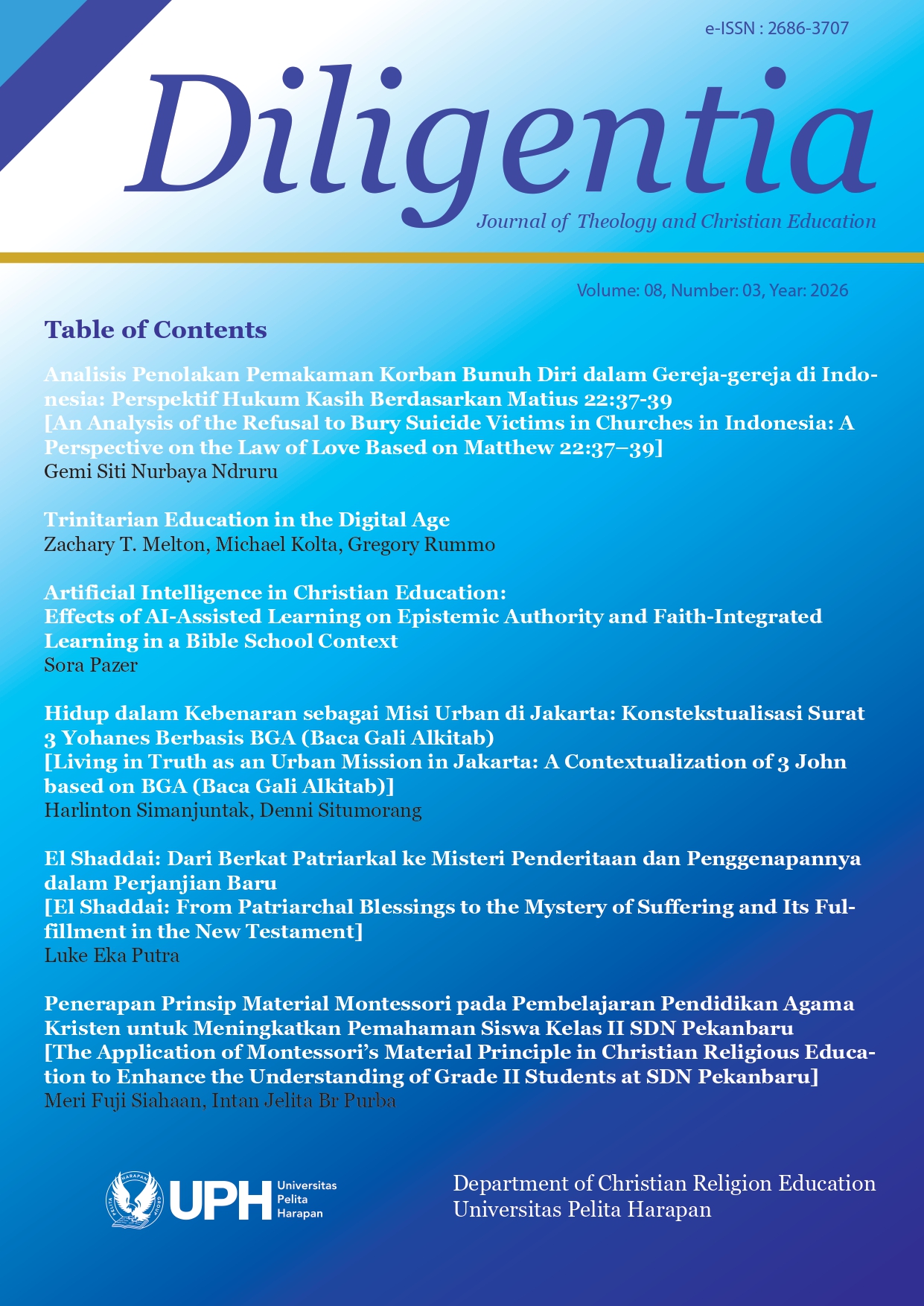
Hidup dalam Kebenaran sebagai Misi Urban di Jakarta: Konstekstualisasi Surat 3 Yohanes Berbasis BGA (Baca Gali Alkitab) [Living in Truth as an Urban Mission in Jakarta: A Contextualization of 3 John based on BGA (Baca Gali Alkitab)]
DOI:
https://doi.org/10.19166/dil.v8i3.11596Keywords:
Living in Truth, Urban Mission, 3 John, Contextual Hermeneutics, Read and Explore the BibleAbstract
Christians in Jakarta, as part of an urban community, are at risk of becoming trapped in an attitude of individualism. This is because the fast-paced nature of life in Jakarta demands efficiency and effectiveness in various activities, which, in certain situations, can lead people to prioritise their own interests. This tendency runs counter to the Christian calling to live in truth. Therefore, this study aims to analyse and construct the concept of living in truth as an urban mission in Jakarta through the contextualisation of 3 John using a contextual hermeneutical approach based on the ‘Baca Gali Alkitab’ (BGA) method. The research findings indicate that living in truth as an urban mission in Jakarta can serve as a response to the trend of individualism in urban society through the practices of faithfulness, hospitality and the witness of life. Faithfulness is grounded in the conviction that every person belongs to Christ. Hospitality is utilised as a means of strategic partnership to bridge the proclamation of the Gospel. A life of witness serves as an integrator in honour of God. Thus, this research contributes to the development of contextual theology and mission theology, whilst also proposing the further development of ‘Baca Gali Alkitab’ as a contextual method of biblical exegesis.
References
Anista, Ria. “Transformasi Kebudayaan: Dampak Perkembangan Teknologi dan Media Sosial.” Jurnal Pendidikan Sosial Indonesia 1, no. 1 (June 2023): 35–43. https://doi.org/10.62238/jupsi.v1i1.97.
Bernadette, Phoebe. “Menjawab Permasalahan Kanonisasi Surat 3 Yohanes: Otoritas Penulis dan Pesan Teologis serta Implikasi Surat Ini bagi Gereja Masa Kini.” Seminari Alkitab Asia Tenggara (SAAT), 2021. Institutional Repository SAAT. https://repository.seabs.ac.id/server/api/core/bitstreams/226af1be-b772-454d-83c8-722cfc75f0ba/content.
Bin Mat Saad, Mohammad Saffuan, Ahmad Shobah bin Mohd Isa, Muhammad Sukri bin Saud, Nor Fadila binti Mohd Amin, and Hanifah binti Jambari. “Revolusi Industri dan Masyarakat 5.0.” eJPI: e-Jurnal Penyelidikan dan Inovasi 7 (December 2020): 29–44. https://ejpi.uis.edu.my/index.php/ejpi/article/view/41.
Carman, Jon-Michael. “Scaling Gaius and Diotrephes: Socio-economic Stratification in 1 and 3 John.” Journal for the Study of the New Testament 43, no. 1 (September 2020): 28–43. https://doi.org/10.1177/0142064X20949029.
Chia, Philip Suciadi, and Elisabeth Sulastri. Pelayan Tuhan yang Baik vs Pelayan Tuhan yang Buruk: Surat 3 Yohanes (3 Yohanes 1:1-15). Yogyakarta, Indonesia: Stiletto Indie Book, 2020.
Ghofur, M. Abdul, Latif Fianto, and Elang Bhaskoro Adi. “Jakarta dan Masyarakat Urban dalam Film Jakarta vs Everybody.” Jurnal Komunikasi Nusantara 5, no. 1 (June 2023): 128–37. https://doi.org/10.33366/jkn.v5i1.306.
GP, Harianto. Gospel for City: Strategi Transformasi melalui Misi Penginjilan. Yogyakarta, Indonesia: PBMR ANDI, 2025.
Henry, Matthew. Tafsiran Matthew Henry: Surat Ibrani, Yakobus, 1&2 Petrus, 1-3 Yohanes, Yudas, Kitab Wahyu. Translated by Iris Ardaneswari, Herdian Aprilani, Lanny Murtihardjana, Paul A. Rajoe, Vera Setyawati, and Tanti Susilawati. Surabaya, Indonesia: Penerbit Momentum, 2016.
Kirk, J. Andrew. Apa Itu Misi? Suatu Penelusuran Teologis. Translated by Pericles Katoppo. Jakarta: BPK Gunung Mulia, 2012.
Kusuma, Rafles Abdi. “Dampak Perkembangan Teknologi Informasi dan Komunikasi terhadap Perilaku Intoleransi dan Antisosial di Indonesia.” Mawa'izh: Jurnal Dakwah dan Pengembangan Sosial Kemanusiaan 10, no. 2 (December 2019): 273–91. https://rumahjurnal.iainsasbabel.ac.id/maw/article/view/932.
Lase, Arianus, and Ayub Sugiharto. “Pendekatan Misi Kontekstual dalam Komunitas Urban dan Multikultural.” Jurnal Teologi Nusantara 3, no. 1 (June 2025): 53–65. https://ojs.sttin.ac.id/index.php/jtn/article/view/24.
Marlin, John. “Praescriptio Surat 3 Yohanes: Sebuah Kepedulian terhadap Kesehatan Mental Hamba Tuhan.” Predica Verbum: Jurnal Teologi dan Misi 4, no. 2 (December 2024): 130–44. https://doi.org/10.51591/predicaverbum.v4i2.107.
Meylan, Mutiara, Natasya Purba, Monika Gultom, and Andar Gunawan Pasaribu. “Implementasi Pendidikan: Menanamkan dan Menumbuhkan Karakter Anti Korupsi Menurut Kitab 3 Yohanes.” Pediaqu: Jurnal Pendidikan Sosial dan Humaniora 4, no. 3 (July 2025): 5120–31. https://publisherqu.com/index.php/pediaqu/article/view/2399.
Pamantung, Salmon. “Hermeneutika Kontekstual: Sebuah Dialektika Sudut Pandang Penafsir dan Teks dalam Memahami Kitab Suci.” KURIOS: Jurnal Teologi dan Pendidikan Agama Kristen 10, no. 3 (December 2024): 614–25. https://doi.org/10.30995/kur.v10i3.1226.
Pratama, Hendri, dan Ahmad Fauzan Pratama. “Perubahan Identitas Budaya Masyarakat Urban di Era Modern.” PERSEPTIF: Jurnal Ilmu Sosial dan Humaniora 2, no. 2 (May 2024): 66–74. https://doi.org/10.70716/perseptif.v2i2.397.
Saputri, Yulia Widya, Shella Rhodinia, and Bagus Setiawan. “Dampak Globalisasi terhadap Perubahan Gaya Hidup di Indonesia.” Maximal Journal: Jurnal Ilmiah Bidang Sosial, Ekonomi, Budaya dan Pendidikan 1, no. 5 (June 2024): 208–17. http://malaqbipublisher.com/index.php/MAKSI/article/view/192.
Smith, D. Moody. First, Second, and Third John (Interpretation, A Bible Commentary for Teaching and Preaching). Louisville, KY: John Knox Press, 1991.
Violita, Natasya. “Tindakan ‘Hospitalitas dan Inhospitalitas’ dalam Surat 3 Yohanes untuk Merespons Pengajar-Pengajar Sesat.” Seminari Alkitab Asia Tenggara (SAAT), 2023. Institutional Repository SAAT. https://repository.seabs.ac.id/items/56466954-29fb-4087-9b51-69e82d4e940f.
Yakin, Ipa Hafsiah. Metode Penelitian Kualitatif. Garut, Indonesia: Aksara Global Akademia, 2023.
Downloads
Published
How to Cite
Issue
Section
License
Copyright (c) 2026 Harlinton Simanjuntak, Denni Situmorang

This work is licensed under a Creative Commons Attribution-ShareAlike 4.0 International License.
Authors who publish with this journal agree to the following terms:
1) Authors retain copyright and grant the journal right of first publication with the work simultaneously licensed under a Creative Commons Attribution License (CC-BY-SA 4.0) that allows others to share the work with an acknowledgement of the work's authorship and initial publication in this journal.
2) Authors are able to enter into separate, additional contractual arrangements for the non-exclusive distribution of the journal's published version of the work (e.g., post it to an institutional repository or publish it in a book), with an acknowledgement of its initial publication in this journal.
3) Authors are permitted and encouraged to post their work online (e.g., in institutional repositories or on their website). The final published PDF should be used and bibliographic details that credit the publication in this journal should be included