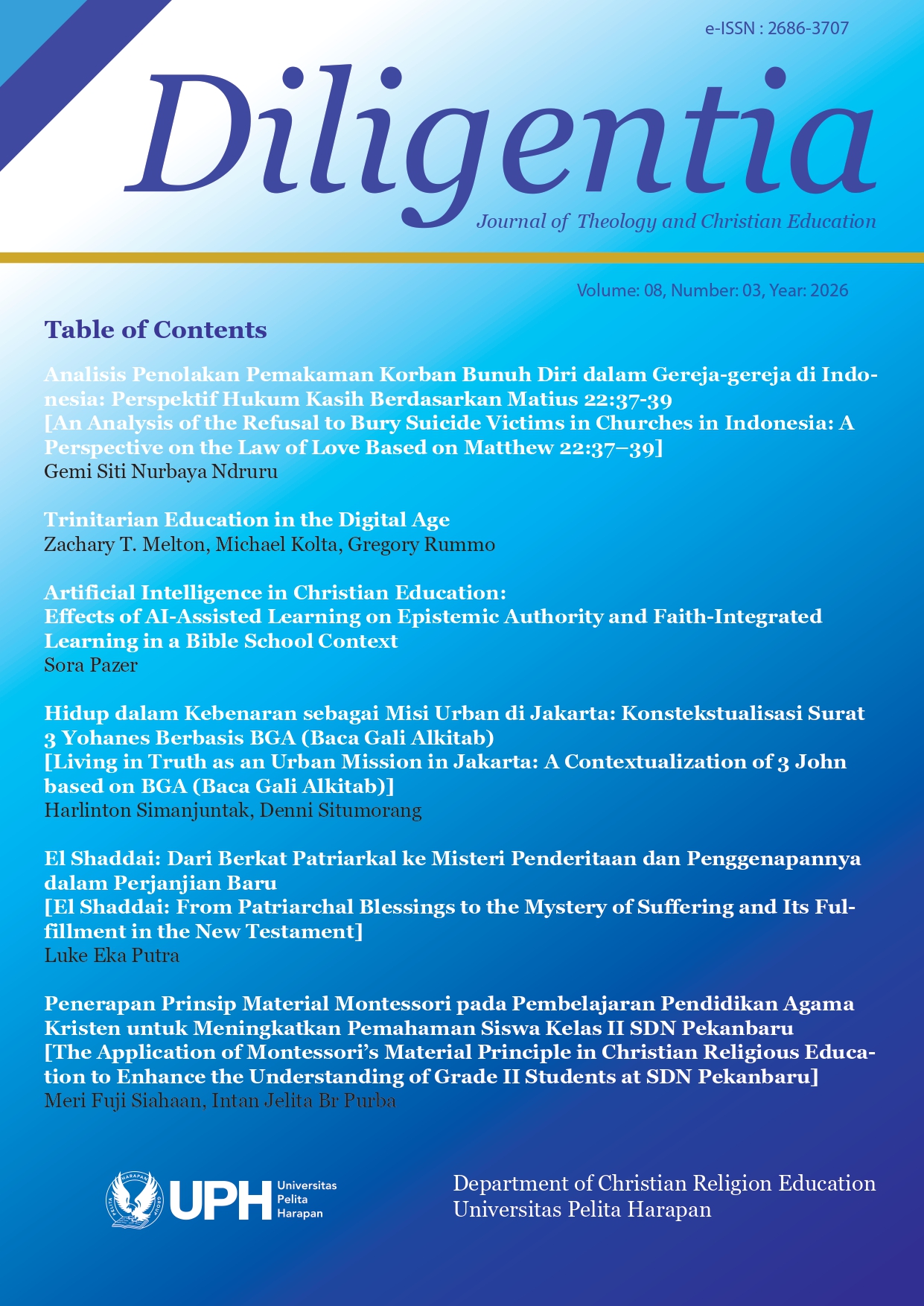
Artificial Intelligence in Christian Education: Effects of AI-Assisted Learning on Epistemic Authority and Faith-Integrated Learning in a Bible School Context
DOI:
https://doi.org/10.19166/dil.v8i3.11462Keywords:
AI in Christian education, epistemic authority, faith-integrated learning, Bible school, quasi-experimental, theological education, generative AIAbstract
Background: The integration of generative artificial intelligence into theological education raises distinct challenges for Bible schools and seminaries, where Scripture, confessional tradition, and instructor authority traditionally anchor legitimate knowledge. Aim: This quasi-experimental study examined the effects of AI-assisted learning on theological knowledge acquisition, epistemic authority attribution, and faith-integrated learning among Bible school students. Method: A sample of 121 evangelical-Protestant students (58% male; Mage = 22.4, SD = 3.1) was assigned to an AI-assisted condition (n = 61) or a control condition (n = 60) across one academic semester, with pre- and post-test measures of theological knowledge, epistemic authority attribution, and faith-integration. Results: The AI-assisted group showed significantly higher post-test achievement (d = 0.99) and stronger attribution of epistemic authority to AI (d = 1.01), but significantly lower faith-integration scores (d = −0.41) than controls. AI usage intensity and AI-attributed epistemic authority negatively predicted faith-integration, while Christian Worldview Strength buffered this effect. Conclusion: AI-assisted theological learning entails a genuine epistemological risk: cognitive gains may come at the cost of faith-integration unless institutions deliberately embed worldview formation within AI-mediated pedagogy.
References
Baidoo-Anu, David, and Leticia Owusu Ansah. "Education in the Era of Generative Artificial Intelligence (AI): Understanding the Potential Benefits of ChatGPT in Promoting Teaching and Learning." Journal of AI 7, no. 1 (December 2023): 52–62. https://doi.org/10.61969/jai.1337500.
Biesta, Gert J. J. Good Education in an Age of Measurement: Ethics, Politics, Democracy. Boulder, CO: Paradigm Publishers, 2010.
Chen, Lijia, Pingping Chen, and Zhijian Lin. "Artificial Intelligence in Education: A Review." IEEE Access 8 (April 2020): 75264–78. https://openresearch.amsterdam/nl/page/73414/artificial-intelligence-in-education.
Floridi, Luciano, Josh Cowls, Monica Beltrametti, Raja Chatila, Patrice Chazerand, Virginia Dignum, Christoph Luetge, Robert Madelin, Ugo Pagallo, Francesca Rossi, Burkhard Schafer, Peggy Valcke, and Effy Vayena. "AI4 People – An Ethical Framework for a Good AI Society: Opportunities, Risks, Principles, and Recommendations." Minds and Machines 28 (November 2018): 689–707. https://doi.org/10.1007/s11023-018-9482-5.
Gerlich, Michael. "AI Tools in Society: Impacts on Cognitive Offloading and the Future of Critical Thinking." Societies 15, no. 1 (January 2025): 1-28. https://doi.org/10.3390/soc15010006.
Glanzer, Perry L., and Nathan F. Alleman. The Outrageous Idea of Christian Teaching. New York, NY: Oxford University Press, 2019.
Graves, Mark. "ChatGPT’s Significance for Theology." Theology and Science 21, no. 2 (May 2023): 201–204. https://doi.org/10.1080/14746700.2023.2188366.
Guo, Kai, Yuchun Zhong, Danling Li, and Samuel Kai Wah Chu. "Investigating Students’ Engagement in Chatbot-Supported Classroom Debates." Interactive Learning Environments 32, no 9 (May 2023). https://doi.org/10.1080/10494820.2023.2207181.
Hayes, Andrew F. Introduction to Mediation, Moderation, and Conditional Process Analysis: A Regression-Based Approach. 3rd ed. New York, NY: Guilford Press, 2022.
Herzfeld, Noreen L. In Our Image: Artificial Intelligence and the Human Spirit. Minneapolis, MN: Fortress Press, 2002.
Logg, Jennifer M., Julia A. Minson, and Don A. Moore. "Algorithm Appreciation: People Prefer Algorithmic to Human Judgment." Organizational Behavior and Human Decision Processes 151 (March 2019): 90–103. https://doi.org/10.1016/j.obhdp.2018.12.005.
Middleton, J. Richard. The Liberating Image: The Imago Dei in Genesis 1. Grand Rapids, MI: Brazos Press, 2005.
Papakostas, Christos. "Artificial Intelligence in Religious Education: Ethical, Pedagogical, and Theological Perspectives." Religions 16, no. 5 (April 2025): 1-22. https://doi.org/10.3390/rel16050563.
Plantinga, Alvin. "Advice to Christian Philosophers." Faith and Philosophy: Journal of the Society of Christian philosophers 1, no. 3 (July 1984): 253–71. https://doi.org/10.5840/faithphil19841317.
Selwyn, Neil. Should Robots Replace Teachers? AI and the Future of Education (Digital Futures). Cambridge, UK: Polity Press, 2019.
Smith, David I. On Christian Teaching: Practicing Faith in the Classroom. Grand Rapids, MI: Eerdmans, 2018.
Smith, David I., and James K. A. Smith, eds. Teaching and Christian Practices: Reshaping Faith and Learning. Grand Rapids, MI: Eerdmans, 2011.
Smith, James K. A. Desiring the Kingdom: Worship, Worldview, and Cultural Formation. Grand Rapids, MI: Baker Academic, 2009.
Sperber, Dan, Fabrice Clément, Christophe Heintz, Olivier Mascaro, Hugo Mercier, Gloria Origgi, and Deirdre Wilson. "Epistemic Vigilance." Mind & Language 25, no. 4 (September 2010): 359–93. https://doi.org/10.1111/j.1468-0017.2010.01394.x.
Van Brummelen, Harro. Walking with God in the Classroom: Christian Approaches to Learning and Teaching. 3rd ed. Colorado Springs, CO: Purposeful Design, 2009.
Wolters, Albert M. Creation Regained: Biblical Basics for a Reformational Worldview. Grand Rapids, MI: Eerdmans, 1985.
Wolterstorff, Nicholas. Reason within the Bounds of Religion. 2nd ed. Grand Rapids, MI: Eerdmans, 1984.
World Medical Association. "World Medical Association Declaration of Helsinki: Ethical Principles for Medical Research Involving Human Subjects." JAMA 310, no. 20 (November 2013): 2191–94. https://doi.org/10.1001/jama.2013.281053.
Zawacki-Richter, Olaf, Victoria I. Marín, Melissa Bond, and Franziska Gouverneur. "Systematic Review of Research on Artificial Intelligence Applications in Higher Education—Where Are the Educators?" International Journal of Educational Technology in Higher Education 16, no. 39 (October 2019): 1–27. https://doi.org/10.1186/s41239-019-0171-0.
Zhai, Xuesong, Xiaoyan Chu, Ching Sing Chai, Morris Siu Yung Jong, Andreja Istenič, Michael Spector, Jia-Bao Liu, Jing Yuan, and Yan Li. "A Review of Artificial Intelligence (AI) in Education from 2010 to 2020." Complexity 2021 (April 2021):1–18. https://doi.org/10.1155/2021/8812542.
Downloads
Published
How to Cite
Issue
Section
License
Copyright (c) 2026 Sora Pazer

This work is licensed under a Creative Commons Attribution-ShareAlike 4.0 International License.
Authors who publish with this journal agree to the following terms:
1) Authors retain copyright and grant the journal right of first publication with the work simultaneously licensed under a Creative Commons Attribution License (CC-BY-SA 4.0) that allows others to share the work with an acknowledgement of the work's authorship and initial publication in this journal.
2) Authors are able to enter into separate, additional contractual arrangements for the non-exclusive distribution of the journal's published version of the work (e.g., post it to an institutional repository or publish it in a book), with an acknowledgement of its initial publication in this journal.
3) Authors are permitted and encouraged to post their work online (e.g., in institutional repositories or on their website). The final published PDF should be used and bibliographic details that credit the publication in this journal should be included