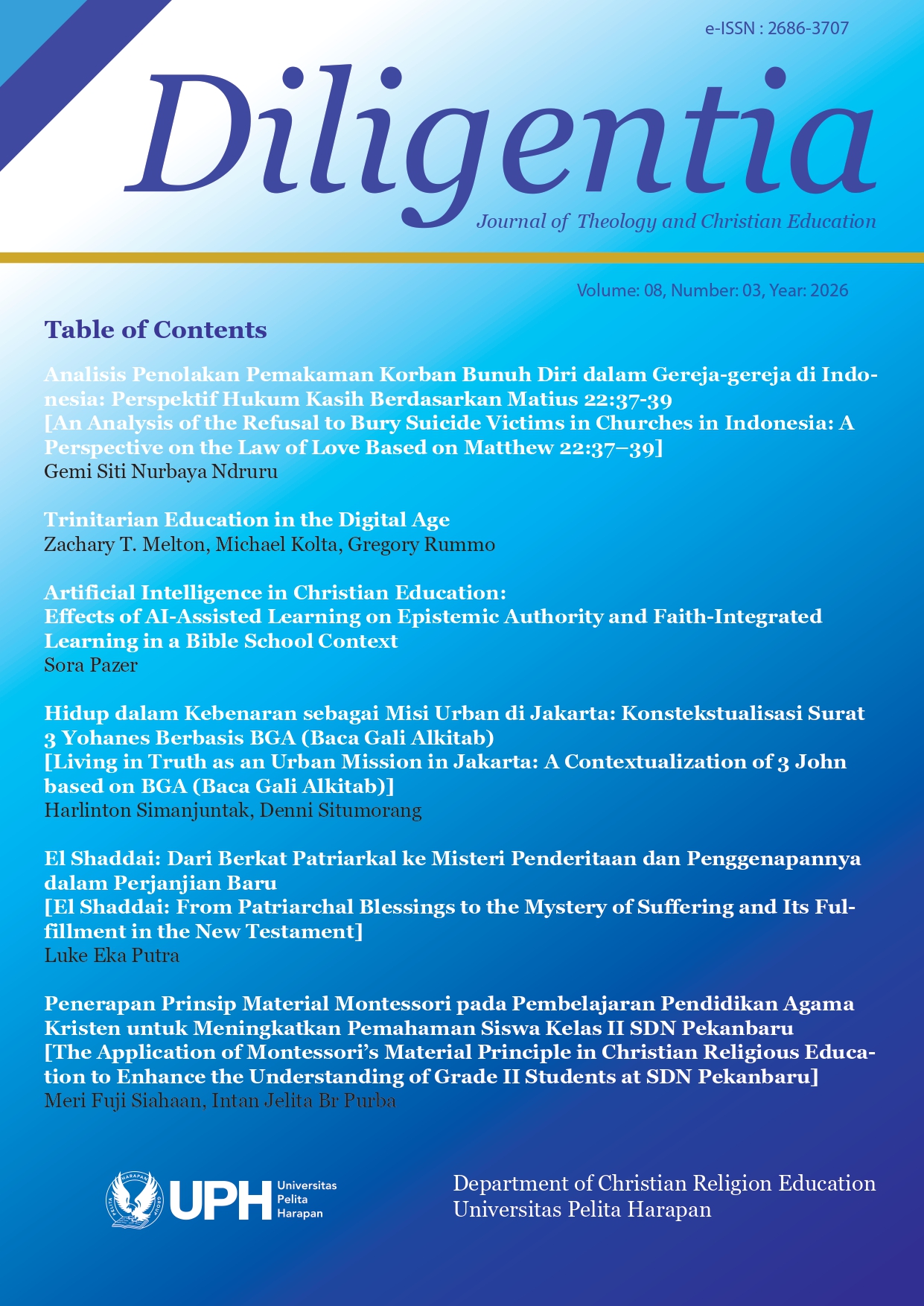
Trinitarian Education in the Digital Age
DOI:
https://doi.org/10.19166/dil.v8i3.11256Keywords:
Artificial Intelligence, Trivium, Education, Trinity, Trinitarian, Logic, Dialectic, Rhetoric, Grammar, Memory, Saint Augustine of Hippo, Augustinian, imago deiAbstract
With the rise of generative artificial intelligence (AI) that has greatly affected modern thought and education, this paper examines Trinitarian theology through the Augustinian framework of memory, understanding, and love, connecting it to the medieval Trivium: Grammar, Logic, and Rhetoric, and to the Trinity: God the Father, God the Son, and God the Holy Spirit. It contends, through logical arguments that connect the findings of several Christian authors to each other and to modern technology in novel ways, that an educational model grounded in the Trinity promotes human flourishing. While expressing concern that improper design and use of technology can rob us of our humanity if we let it do too much of the hard work for us, this paper concludes that the Trivium can serve as a tool to navigate learning alongside AI, while being cautious to preserve our unique human faculties, especially love (agape), rooted in the imago Dei.
References
Alter, Adam. Irresistible: The Rise of Addictive Technology and the Business of Keeping Us Hooked. New York, NY: Penguin Press, 2017.
Anglican Church in North America. The Book of Common Prayer. Colorado, CO: Anglican Liturgy Press, 2019.
Aristotle. The “Art” of Rhetoric. Translated by John Henry Freese. London, UK: W. Heinemann, 1926.
Augustine, Saint. The City of God: De Civitate Dei. Translated by William Babcock. Hyde Park, NY: New City Press, 2013.
Augustine, Saint. The Confessions of Saint Augustine: A Modern Translation for Contemporary Readers. Inspired by Edward Bouverie Pusey’s Work. Translated by Michael Jay Jones, Edited by Scriptaviva. Orlando, FL: Independently Published, 2024.
Augustine, Saint. The Trinity: De Trinitate. 2nd ed. Translated by Edmund Hill. Edited by John E. Rotelle. Hyde Park, NY: New City Press, 2015.
Barth, Karl. Dogmatics in Outline. New York, NY: Harper & Row, 1959.
Caldecott, Stratford. Beauty in the Word: Rethinking the Foundations of Education. Tacoma, WA: Angelico Press, 2012.
Carr, Nicholas. The Shallows: What the Internet is Doing to Our Brains. New York, NY: W. W. Norton & Company, 2010.
Frame, John M. The Doctrine of the Christian Life (A Theology of Lordship). Phillipsburg, NJ: P&R Publishing, 2008.
Haidt, Jonathan. The Anxious Generation: How the Great Rewiring of Childhood is Causing an Epidemic of Mental Illness. New York, NY: Penguin Press, 2024.
Kant, Immanuel. Groundwork of the Metaphysics of Morals. Narrated by John H. Fehskens. Eternal Echoes, 2023. Audiobook. https://www.audiobooksnow.com/audiobook/groundwork-of-the-metaphysics-of-morals/8779234/.
Kolta, Michael. Christian Ethics in Computers, Software and Artificial Intelligence. Dubuque, IA: Kendall/Hunt Publishing Company, 2025.
Lewis, C. S. Mere Christiainity. New York, NY: Harper One, 1952.
Owen-Ball, David T. “Rabbinic Rhetoric and the Tribute Passage (Mt. 22:15–22; Mk. 12:13–17; Lk. 20:20–26).” Novum Testamentum 35, no. 1 (January 1993): 1–14. https://doi.org/10.2307/1561422.
Papakostas, Christos. “Artificial Intelligence in Religious Education: Ethical, Pedagogical, and Theological Perspectives.” Religions 16, no. 5 (April 2025): 1-22. https://doi.org/10.3390/rel16050563.
Reeves, Michael. Delighting in the Trinity: An Introduction to the Christian Faith. Downers Grove, IL: InterVarsity Press, 2012.
Smith, James K. A. You Are What You Love: The Spiritual Power of Habit. Grand Rapids, MI: Brazos Press, 2016.
Swain, Scott R. Trinity, Revelation and Reading: A Theological Introduction to the Bible and its Interpretation. New York, NY: T&T Clark International, 2011.
Sayers, Dorothy L. The Lost Tools of Learning: Paper Read at a Vacation Course in Education Oxford, 1947. London, UK: Methuen, 1948.
University of Dallas. “Classical vs Modern ‘Progressive’ Education: What’s the Difference?” Last modified April 17, 2025. https://blog.udallas.edu/tower-thoughts/classical-education-vs-modern-education-whats-the-difference.
University of San Diego MS-AAI Faculty. “39 Examples of Artificial Intelligence in Education.” Accessed August 21, 2026. https://onlinedegrees.sandiego.edu/artificial-intelligence-education/.
Vilcarino, Jennifer, and Lauraine Langreo. “Rising Use of AI in Schools Comes with Big Downsides for Students.” Last modified October 8, 2025. https://www.edweek.org/technology/rising-use-of-ai-in-schools-comes-with-big-downsides-for-students/2025/10.
Downloads
Published
How to Cite
Issue
Section
License
Copyright (c) 2026 Zachary T. Melton, Michael Kolta, Gregory Rummo

This work is licensed under a Creative Commons Attribution-ShareAlike 4.0 International License.
Authors who publish with this journal agree to the following terms:
1) Authors retain copyright and grant the journal right of first publication with the work simultaneously licensed under a Creative Commons Attribution License (CC-BY-SA 4.0) that allows others to share the work with an acknowledgement of the work's authorship and initial publication in this journal.
2) Authors are able to enter into separate, additional contractual arrangements for the non-exclusive distribution of the journal's published version of the work (e.g., post it to an institutional repository or publish it in a book), with an acknowledgement of its initial publication in this journal.
3) Authors are permitted and encouraged to post their work online (e.g., in institutional repositories or on their website). The final published PDF should be used and bibliographic details that credit the publication in this journal should be included