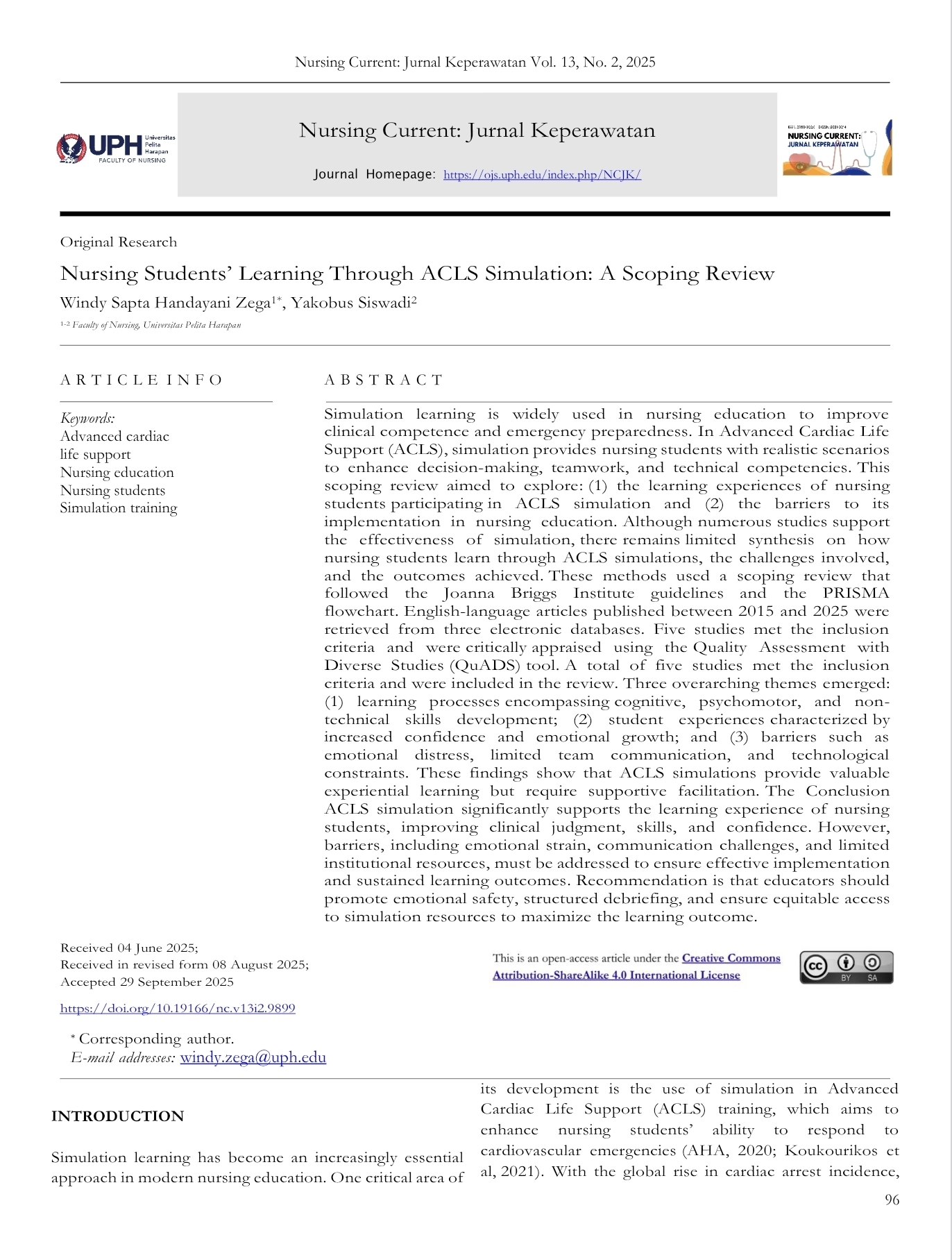
Nursing Students’ Learning Through ACLS Simulation: A Scoping Review
DOI:
https://doi.org/10.19166/nc.v13i2.9899Kata Kunci:
Nursing Students, Nursing Education, advanced cardiac life support, simulationAbstrak
ABSTRAK
Pendahuluan: Pembelajaran melalui simulasi secara luas digunakan dalam pendidikan keperawatan untuk meningkatkan keterampilan klinis dan kesiapsiagaan menghadapi situasi kegawatdaruratan. Dalam konteks Advanced Cardiac Life Support (ACLS), simulasi memberikan skenario realistis yang membantu mahasiswa keperawatan mengasah kemampuan pengambilan keputusan, kerja tim, dan keterampilan teknis. Meskipun bukti mengenai efektivitasnya terus berkembang, sintesis menyeluruh terkait proses pembelajaran mahasiswa melalui simulasi ACLS, tantangan yang dihadapi, serta hasil yang dicapai masih terbatas.
Metode: Scoping review ini dilakukan berdasarkan pedoman dari Joanna Briggs Institute dan alur PRISMA. Artikel berbahasa Inggris yang terbit antara tahun 2016 hingga 2025 ditelusuri dari tiga basis data. Lima studi yang memenuhi kriteria inklusi dianalisis dan dinilai menggunakan alat QuADS. Hasil: Lima studi yang memenuhi kriteria dimasukkan dalam tinjauan ini. Tiga tema utama yang muncul meliputi: (1) proses pembelajaran yang mencakup pengembangan keterampilan kognitif, psikomotor, dan non-teknis; (2) pengalaman mahasiswa yang ditandai dengan peningkatan kepercayaan diri dan pertumbuhan emosional; serta (3) hambatan seperti tekanan emosional, komunikasi tim yang terbatas, dan kendala teknologi. Temuan ini menunjukkan bahwa simulasi ACLS memberikan pengalaman belajar yang bermakna, namun membutuhkan fasilitasi yang mendukung. Kesimpulan: Simulasi ACLS secara signifikan mendukung pengalaman belajar mahasiswa keperawatan, dengan meningkatkan clinical judgment, keterampilan, dan rasa percaya diri. Namun, hambatan seperti beban emosional, tantangan komunikasi, dan keterbatasan sumber daya perlu diatasi. Rekomendasi: Pendidik disarankan untuk menciptakan lingkungan yang aman secara emosional, menerapkan structured debriefing, dan memastikan akses yang setara terhadap sumber daya simulasi guna mengoptimalkan hasil pembelajaran.
Kata kunci: Mahasiswa keperawatan, pelatihan simulasi, advanced cardiac life support, pendidikan keperawatan.
Referensi
Alharbi, A., Nurfianti, A., Mullen, R. F., McClure, J. D., & Miller, W. H. (2024). The effectiveness of simulation-based learning (SBL) on students’ knowledge and skills in nursing programs: a systematic review. BMC Medical Education, 24(1), 1099. https://doi.org/10.1186/s12909-024-06080-z
American Heart Association. (2020). Pedoman CPR dan ECC.
Arrogante, O., Jiménez-Gómez, M. A., & Sáez de Asteasu, M. L. (2021). Are you prepared to save a life? Nursing students’ experience in advanced life support practice. Nurse Education Today, 100, 104837. https://doi.org/10.1016/j.nedt.2021.104837
Billings, D. M., & Halstead, J. A. (Eds). (2024). Teaching in nursing: A guide for faculty. 7th edition. Elsevier.
Chen, H. W., O’Donnell, J. M., Chiu, Y. J., Chen, Y. C., Kang, Y. N., Tuan, Y. T., Kuo, S. Y., & Wu, J. C. (2022). Comparison of learning outcomes of interprofessional education simulation with traditional single-profession education simulation: A mixed-methods study. BMC Medical Education, 22, 651. https://doi.org/10.1186/s12909-022-03640-z
Díaz Agea, J. L., Megías Nicolás, A., García Méndez, J. A., Adánez Martínez, M. de G., & Leal Costa, C. (2019). Improving simulation performance through Self-Learning Methodology in Simulated Environments (MAES©). Nurse Education Today, 76(December 2018), 62–67. https://doi.org/10.1016/j.nedt.2019.01.020
Erica, B., Chiara, A., Silvia, C., Carmela, R., Eleonora, G., Barisone, M., Luigi, I. P., Paolo, M., Flavia, P., Daniela, S., Maria, G. C., Patrizia, Z., Alberto, D. M., & Massimiliano, P. (2022). The Impact of an Interprofessional Simulation-Based Education Intervention in Healthy Ageing: A Quasi-Experimental Study. Clinical Simulation in Nursing, 64, 1–9. https://doi.org/10.1016/j.ecns.2021.11.003
Feng, J., Zhang, Y., & Zhang, J. (2024). Epidemiology and Burden of Heart Failure in Asia. JACC: Asia, 4(4), 249–264. https://doi.org/10.1016/j.jacasi.2024.01.013
Guerrero, J. G., Tungpalan-Castro, G. M., & Pingue-Raguini, M. (2022). Impact of simulation debriefing structure on knowledge and skill acquisition for postgraduate critical care nursing students: Three-phase vs. multiphase. BMC Nursing, 21, 318. https://doi.org/10.1186/s12912-022-01100-z
Erica, B., Chiara, A., Silvia, C., Carmela, R., Eleonora, G., Barisone, M., Luigi, I. P., Paolo, M., Flavia, P., Daniela, S., Maria, G. C., Patrizia, Z., Alberto, D. M., & Massimiliano, P. (2022). The Impact of an Interprofessional Simulation-Based Education Intervention in Healthy Ageing: A Quasi-Experimental Study. Clinical Simulation in Nursing, 64, 1–9. https://doi.org/10.1016/j.ecns.2021.11.003
Kassabry, M. F. (2023). The effect of simulation-based advanced cardiac life support training on nursing students’ self-efficacy, attitudes, and anxiety in Palestine: a quasi-experimental study. BMC Nursing, 22(1), 1–9. https://doi.org/10.1186/s12912-023-01588-z
Koukourikos, K., Tsaloglidou, A., Kourkouta, L., Papathanasiou, I. V., Iliadis, C., Fratzana, A., & Panagiotou, A. (2021). Simulation in clinical nursing education. Acta Informatica Medica, 29(1), 15–20. https://doi.org/10.5455/AIM.2021.29.15-20
Li, Z., Huang, F. F., Chen, S. L., Wang, A., & Guo, Y. (2021). The Learning Effectiveness of High-Fidelity Simulation Teaching Among Chinese Nursing Students: A Mixed-Methods Study. Journal of Nursing Research, 29(2), E141. https://doi.org/10.1097/JNR.0000000000000418
Molina, G.J., Fernández, S.C., López, D. E., Hernández, P.J. M., Preto, L. S. R., & Castro-Sánchez, A. M. (2015). Effects of web-based electrocardiography simulation on strategies and learning styles. Revista da Escola de Enfermagem da USP, 49(4), 645–651. https://doi.org/10.1590/S0080-623420150000400016
Harley, J. M., Bilgic, E., Lau, C. H. H., Gorgy, A., Marchand, H., Lavoie-Tremblay, M., & Fried, G. M. (2023). Nursing students reported more positive emotions about training during Coronavirus Disease 2019 (COVID-19) after using a virtual simulation paired with an in-person simulation. Clinical Simulation in Nursing, 81, 101420. https://doi.org/10.1016/j.ecns.2023.04.006
Harrison, R., Jones, B., Gardner, P., & Lawton, R. (2021). Quality assessment with diverse studies (QuADS): an appraisal tool for methodological and reporting quality in systematic reviews of mixed- or multi-method studies. BMC Health Services Research, 21(1), 144. https:// doi.org/ 10.1186/ s12913- 021- 06122- y.
Kang, K. A., & Lee, M. (2025). Effectiveness of a blended (distance and face-to-face) learning program for ACLS using the PARTNER model in nursing students: A quasi-experimental study. BMC Nursing, 24, 25. https://doi.org/10.1186/s12912-024-02684-y
Erica, B., Chiara, A., Silvia, C., Carmela, R., Eleonora, G., Barisone, M., Luigi, I. P., Paolo, M., Flavia, P., Daniela, S., Maria, G. C., Patrizia, Z., Alberto, D. M., & Massimiliano, P. (2022). The Impact of an Interprofessional Simulation-Based Education Intervention in Healthy Ageing: A Quasi-Experimental Study. Clinical Simulation in Nursing, 64, 1–9. https://doi.org/10.1016/j.ecns.2021.11.003
Kassabry, M. F. (2023). The effect of simulation-based advanced cardiac life support training on nursing students’ self-efficacy, attitudes, and anxiety in Palestine: a quasi-experimental study. BMC Nursing, 22(1), 1–9. https://doi.org/10.1186/s12912-023-01588-z
Koukourikos, K., Tsaloglidou, A., Kourkouta, L., Papathanasiou, I. V., Iliadis, C., Fratzana, A., & Panagiotou, A. (2021). Simulation in clinical nursing education. Acta Informatica Medica, 29(1), 15–20. https://doi.org/10.5455/AIM.2021.29.15-20
Li, Z., Huang, F. F., Chen, S. L., Wang, A., & Guo, Y. (2021). The Learning Effectiveness of High-Fidelity Simulation Teaching Among Chinese Nursing Students: A Mixed-Methods Study. Journal of Nursing Research, 29(2), E141. https://doi.org/10.1097/JNR.0000000000000418
World Health Organization. (2021). Cardiovascular Diseases. World Health Organization. Diakses dari:https://www.who.int/health-topics/cardiovascular-diseases/
Yoo, H. B., Park, J. H., & Ko, J. K. (2012). An effective method of teaching advanced cardiac life support (ACLS) skills in simulation-based training. Korean Journal of Medical Education, 24(1), 7–14. https://doi.org/10.3946/kjme.2012.24.1.7
Unduhan
Diterbitkan
Cara Mengutip
Terbitan
Bagian
Lisensi
Hak Cipta (c) 2025 Windy Zega, Yakobus Siswadi

Artikel ini berlisensiCreative Commons Attribution-ShareAlike 4.0 International License.
Authors who publish with this journal agree to the following terms:
1) Authors retain copyright and grant the journal right of first publication with the work simultaneously licensed under a Creative Commons Attribution License (CC-BY-SA 4.0) that allows others to share the work with an acknowledgement of the work's authorship and initial publication in this journal.
2) Authors are able to enter into separate, additional contractual arrangements for the non-exclusive distribution of the journal's published version of the work (e.g., post it to an institutional repository or publish it in a book), with an acknowledgement of its initial publication in this journal.
3) Authors are permitted and encouraged to post their work online (e.g., in institutional repositories or on their website). The final published PDF should be used and bibliographic details that credit the publication in this journal should be included.

This work is licensed under a Creative Commons Attribution-ShareAlike 4.0 International License.





 Faculty of Nursing | Universitas Pelita Harapan | Lippo Karawaci, Tangerang, Indonesia, 15811 |