DEMENTIA SCREENING IN OLDER PEOPLE IN TANGERANG
DOI:
https://doi.org/10.19166/nc.v6i2.1858Kata Kunci:
Dementia screening, Rowland Universal Dementia Assessment Scale, aging population, older peopleAbstrak
Early recognition of dementia syndrome can result in earlier intervention, thus earlier prevention and better management of dementia. However, there is a difficulty with instruments to screen for dementia in developing country. Low education, illiteracy and innumeracy of the ageing population may be screened positive for dementia. The Rowland Universal Dementia Screening Assessment Scale (RUDAS) was developed for cognitive function measurement for multi-cultural population with strong reliability and validity and had been validated in countries across the world. However, the literatures had reported no dementia screening studies with the use of the RUDAS in the Indonesian community. This study was the first study to screen for dementia utilising the Rowland Universal Dementia Assessment in the Indonesian community, which was undertaken in 2016 in Bencongan Indah, a subdistrict of a city in Banten. This was a descriptive study to screen for dementia using the RUDAS in the Indonesian community. Data was collected using purposive sampling with inclusion criteria: adults age 60 and over, Indonesian-speaking participants, there was no apparent acute illness that could affect the performance of the test. The validity and reliability of the RUDAS were assessed prior to the main study on 35 participants who had similar characteristics with the study respondents. The Indonesian version of the RUDAS instrument was assessed for validity and reliability prior to the main study. This study showed that out of 60 elderly respondents of 60-74 years old in the study, half (50%) had mild to moderate cognitive impairment, as scored 22-26 on the RUDAS. However, the study lacked investigation of demographic factors affecting the RUDAS performance. Recommendations Further study validating the use of the Indonesian version of the RUDAS is warranted.
Referensi
Bomasang-Layno, E., & Bronsther, R. (2013). Diagnosis and treatment of Alzheimer's Disease: An update. Delaware Journal of Public Health, 7(4): 74-85. https://www.ncbi.nlm.nih.gov/pmc/articles/PMC8482985/
Basic, D., Khoo, A., Conforti, D., Rowland, J., Vrantsidis, F., LoGiudice, D., Hill, K., Harry, J., Lucero, K., & Prowse, R. (2009). Rowland Universal Dementia Assessment Scale, mini-mental state examination and general practitioner assessment of cognition in a multicultural cohort of community-dwelling older persons with early dementia. Australian Psychologist, 44(1), 40-53. https://doi.org/10.1080/00050060802593593
Chaaya, M., Phung, T. K., El Asmar, K., Atweh, S., Ghusn, H., Khoury, R. M., Prince, M., Nielsen, T. R., & Waldemar, G. (2016). Arabic Rowland Universal Dementia Assessment Scale. PsycTESTS Dataset. https://doi.org/10.1037/t58446-000
Chen, C., Chu, H., Tsai, C., Yang, H., Tsai, J., Chung, M., . . . Chou, K. (2015). The reliability, validity, sensitivity, specificity and predictive values of the Chinese version of the Rowland Universal Dementia Assessment Scale. Journal of Clinical Nursing, 24(21-22), 3118-3128. https://doi.org/10.1111/jocn.12941Escobar, J. I., Burnam, A., Karno, M., Forsythe, A., Landsverk, J., & Golding, J. M. (1986). Use of the Mini-Mental State Examination (MMSE) in a Community Population of Mixed Ethnicity. The Journal of Nervous and Mental Disease, 174(10), 607-614. https://doi.org/10.1097/00005053-198610000-00005
World Population Review. (N.d.). Indonesia population 2021 (live). https://worldpopulationreview.com/countries/indonesia-population
Iype, T. (2006). Usefulness of the Rowland Universal Dementia Assessment Scale in South India. Journal of Neurology, Neurosurgery & Psychiatry, 77(4), 513-514. https://doi.org/10.1136/jnnp.2005.069005Limpawattana, P, Tiamkao, S, Sawanyawisuth, K. (2012). The performance of the Rowland Universal Dementia Assessment Scale (RUDAS). Aging Clinical and Experimental Research; 27(4): 495-500. https://doi.org/10.1177/1533317512447886
Mateos-Ãlvarez, R., Ramos-RÃos, R., & López-MorÃñigo, J. (2017). Comparative analysis between the MMSE and the RUDAS for dementia screening in low educated people in a Spanish psychogeriatric clinic. The European Journal of Psychiatry, 31(3), 119-126. https://doi.org/10.1016/j.ejpsy.2017.06.003
Naqvi, R. M., Haider, S., Tomlinson, G., & Alibhai, S. (2015). Cognitive assessments in multicultural populations using the Rowland Universal Dementia Assessment Scale: A systematic review and meta-analysis. Canadian Medical Association Journal, 187(5). https://doi.org/10.1503/cmaj.140802Nielsen, T. R., Vogel, A., Gade, A., & Waldemar, G. (2012). Cognitive testing in non-demented Turkish immigrants - comparison of the RUDAS and the MMSE. Scandinavian Journal of Psychology, 53(6), 455-460. https://doi.org/10.1111/sjop.12018
Pedoman Tutorial Praktik Dan Praktikum. (N.d.). http://cbt.smkalbarokah.sch.id/mpQ0H_pedoman-tutorial-praktik-dan-praktikum.pdf
Pusat Data Dan Informasi. Pusat Data dan Informasi - Kementerian Kesehatan Republik Indonesia. (n.d.). https://pusdatin.kemkes.go.id/folder/view/01/structure-publikasi-pusdatin-info-datin.html
Rowland, J. T., Basic, D., Storey, J. E., & Conforti, D. A. (2006). The Rowland Universal Dementia Assessment Scale (RUDAS) and the Folstein MMSE in a multicultural cohort of elderly persons. International Psychogeriatrics, 18(1), 111-120. https://doi.org/10.1017/S1041610205003133
Shaaban, J., Aziz, A. A., Abdullah, Z., & Razak, A. A. (2013). Rowland Universal Dementia Assessment Scale--Malay Version. PsycTESTS Dataset. https://doi.org/10.1037/t72373-000
Storey, J. E., Rowland, J. T., Conforti, D. A., & Dickson, H. G. (2004). The Rowland Universal Dementia Assessment Scale (RUDAS): A multicultural cognitive assessment scale. International Psychogeriatrics, 16(1), 13-31. https://doi.org/10.1017/S1041610204000043
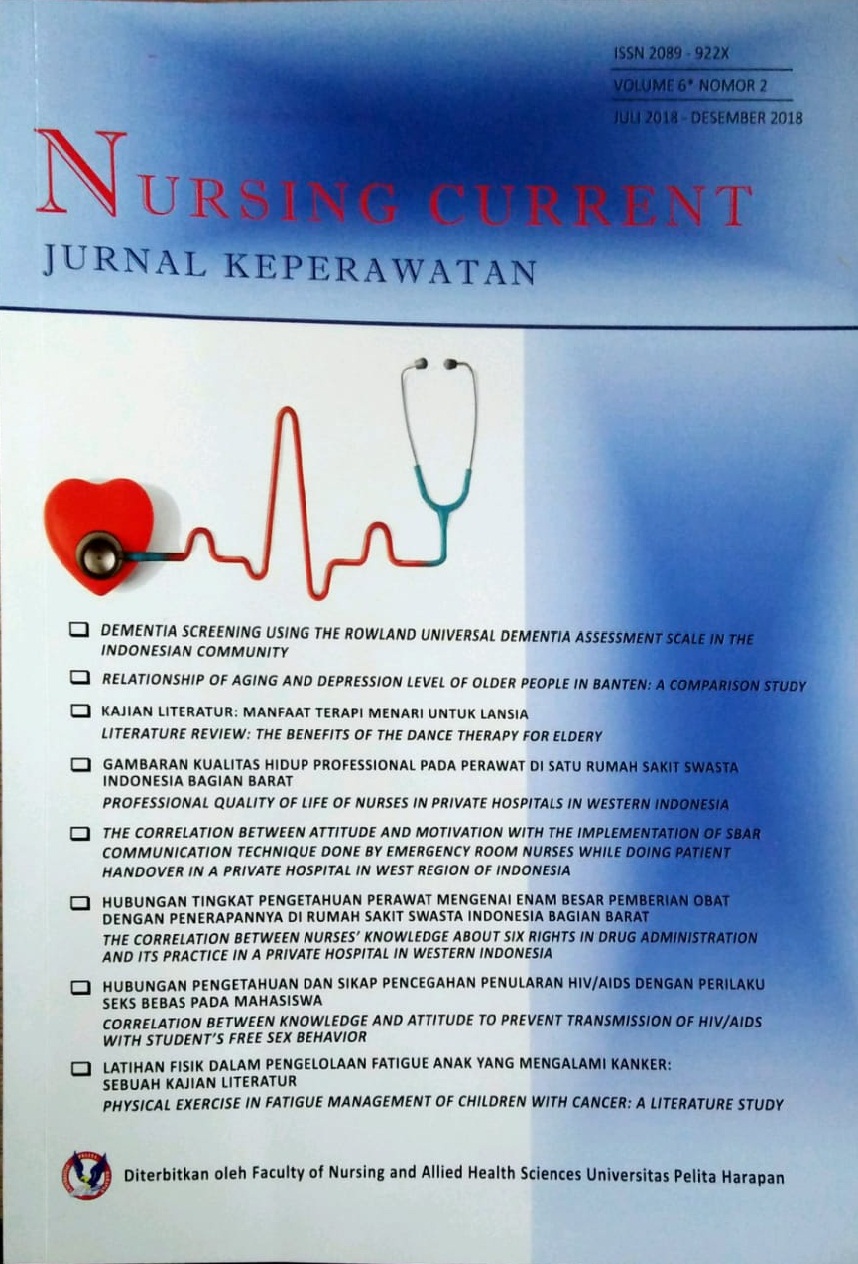
Unduhan
Diterbitkan
Cara Mengutip
Terbitan
Bagian
Lisensi
Authors who publish with this journal agree to the following terms:
1) Authors retain copyright and grant the journal right of first publication with the work simultaneously licensed under a Creative Commons Attribution License (CC-BY-SA 4.0) that allows others to share the work with an acknowledgement of the work's authorship and initial publication in this journal.
2) Authors are able to enter into separate, additional contractual arrangements for the non-exclusive distribution of the journal's published version of the work (e.g., post it to an institutional repository or publish it in a book), with an acknowledgement of its initial publication in this journal.
3) Authors are permitted and encouraged to post their work online (e.g., in institutional repositories or on their website). The final published PDF should be used and bibliographic details that credit the publication in this journal should be included.

This work is licensed under a Creative Commons Attribution-ShareAlike 4.0 International License.






 Faculty of Nursing | Universitas Pelita Harapan | Lippo Karawaci, Tangerang, Indonesia, 15811 |