
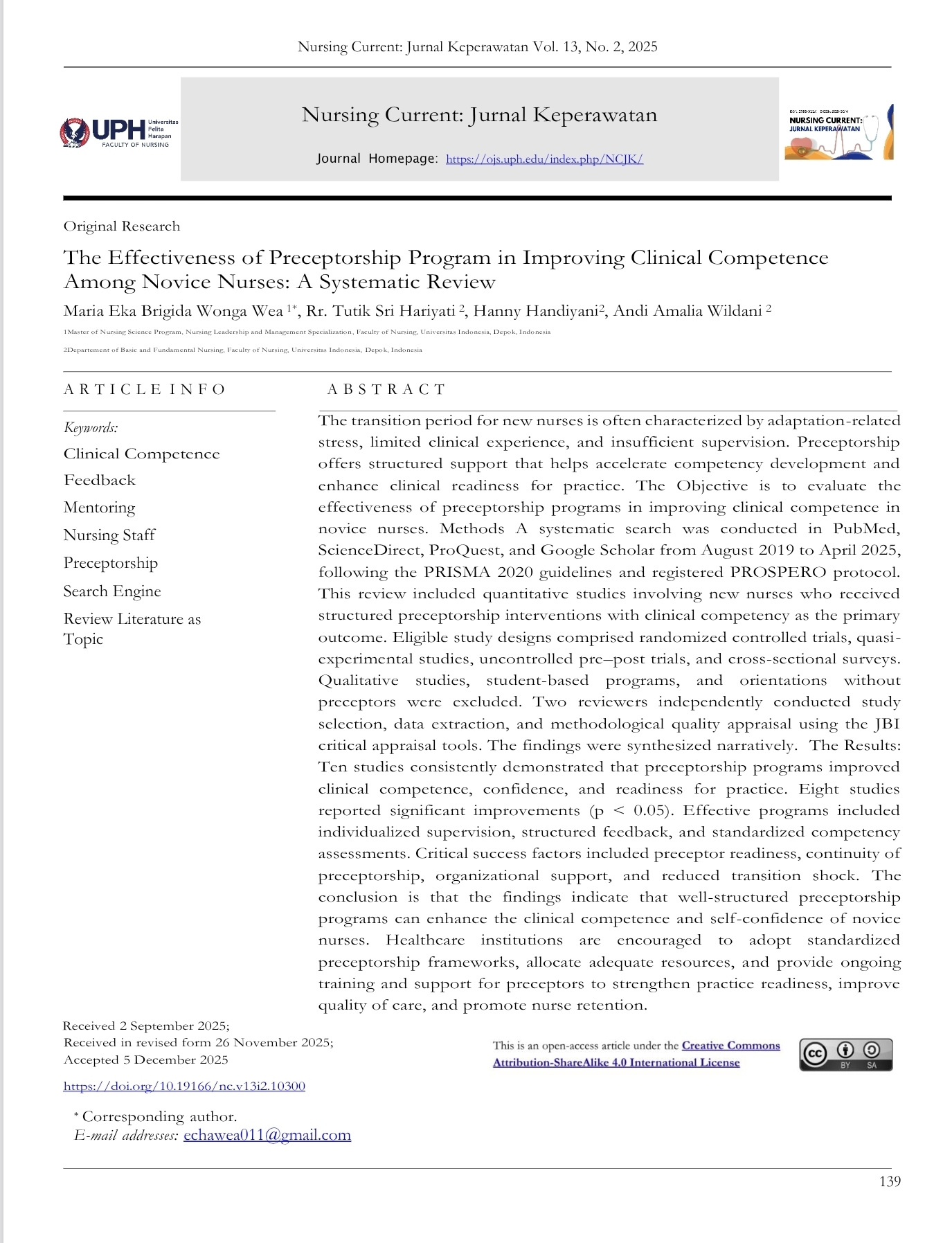
The Effectiveness of Preceptorship Programs in Improving Clinical Competence among Novice Nurses: A Systematic Review
DOI:
https://doi.org/10.19166/nc.v13i2.10300Schlagworte:
Clinical competence, Clinical nursing, Novice nurses, Professional mentoring, PreceptorshipAbstract
Background: Novice nurses face considerable challenges in transitioning from education to clinical practice, including a lack of preparedness, low confidence, and workplace pressures that may compromise care quality. Preceptorship has been introduced to facilitate adaptation and competency development, yet its effectiveness requires systematic evaluation.
Objective: To analyze the effectiveness of preceptorship programs in enhancing novice nurses’ clinical competence and to identify supporting factors and implementation challenges.
Methods: A systematic literature review was conducted using the PICO framework. Articles were retrieved from ScienceDirect, PubMed, ProQuest, and Google Scholar with the keywords nurse, preceptorship program, and clinical competence. Eligible studies included quantitative research published between 2019 and 2025 in English or Indonesian. Ten articles meeting the criteria were synthesized narratively.
Results: Preceptorship programs were effective in improving clinical competence, particularly knowledge, technical skills, confidence, and self-efficacy. Supporting factors included preceptor readiness, adequate training, manageable workload, and managerial support. Challenges included inconsistent preceptor rotation, time constraints, and a lack of standardized program structures.
Conclusion: Preceptorship is an effective strategy to support novice nurses’ professional transition and strengthen clinical competence. Structured implementation, supported by trained preceptors and institutional commitment, is crucial to optimizing program benefits and improving nursing care quality.
Keywords: Clinical competence, Clinical nursing, Novice nurses, Professional mentoring, Preceptorship
Literaturhinweise
Abdelaliem, S. M. F., Alsleem, D. K., Aladdad, S. K., Alqahtani, A. S., Alenazi, R. K., Alotaibi, M. G., Oqailan, H. K., & Almarshad, L. B. (2025). The relationship between practical skills confidence and readiness for transition to practice among nursing internship students: Exploring the mediating role of preceptorship. Nurse Education Today, 147. https://doi.org/10.1016/j.nedt.2025.106587
Ahn, S., & Jeong, H. W. (2025). Analysis of clinical nurse educators’ mentoring feedback on new nurse journals at a tertiary hospital in South Korea: utilizing text network analysis. BMC Nursing, 24(1). https://doi.org/10.1186/s12912-025-03625-5
Baharum, H., Ismail, A., McKenna, L., Mohamed, Z., Ibrahim, R., & Hassan, N. H. (2023). Success factors in adaptation of newly graduated nurses: a scoping review. BMC Nursing, 22(1). https://doi.org/10.1186/s12912-023-01300-1
Berthelsen, C., Kjærgaard, K. M., & Aviaja-Hansen, C. (2025). Experiences of an ongoing preceptorship programme for newly employed nurses in medical departments – A qualitative study. Clinical Nursing Studies, 13(1), 1. https://doi.org/10.5430/cns.v13n1p1
Charette, M., McKenna, L., McGillion, A., & Burke, S. (2023). Effectiveness of transition programs on new graduate nurses’ clinical competence, job satisfaction and perceptions of support: A mixed-methods study. Journal of Clinical Nursing, 32(7–8), 1354–1369. https://doi.org/10.1111/jocn.16317
Chen, F., Liu, Y., Wang, X., & Dong, H. (2021). Transition shock, preceptor support and nursing competency among newly graduated registered nurses: A cross-sectional study. Nurse Education Today, 102. https://doi.org/10.1016/j.nedt.2021.104891
Chen, T. T., Hsiao, C. C., Chu, T. P., Chen, S. H., Liao, M. N., & Hung, C. C. (2021). Exploring core competencies of clinical nurse preceptors: A nominal group technique study. Nurse Education in Practice, 56. https://doi.org/10.1016/j.nepr.2021.103200
Chipwanya, E., Downing, C., & Nkosi, E. (2024). The effect of a preceptorship programme on newly hired experienced professional nurses’ self-efficacy in nursing clinical competency in Saudi Arabia. International Journal of Africa Nursing Sciences, 20. https://doi.org/10.1016/j.ijans.2024.100682
Choi, E., & Yu, S. (2022). Effects of preceptors’ mentoring function on novice nurses’ self-efficacy and organizational commitment: A cross-sectional study. Nurse Education in Practice, 64. https://doi.org/10.1016/j.nepr.2022.103431
Kim, J. H., & Shin, H. S. (2020). Exploring barriers and facilitators for successful transition in new graduate nurses: A mixed methods study. Journal of Professional Nursing, 36(6), 560–568. https://doi.org/10.1016/j.profnurs.2020.08.006
Kim, K. H., & Shin, S. (2025). Factors influencing preceptor nurses’ clinical teaching behavior: A cross-sectional study. Nurse Education Today, 146. https://doi.org/10.1016/j.nedt.2024.106555
Lima, M. S., & Alzyood, M. (2024). The impact of preceptorship on the newly qualified nurse and preceptors working in a critical care environment: An integrative literature review. Nursing in Critical Care, 29(5), 1178–1189. https://doi.org/10.1111/nicc.13061
Lindfors, K., Flinkman, M., Kaunonen, M., Huhtala, H., & Paavilainen, E. (2022). New graduate registered nurses’ professional competence and the impact of preceptors’ education intervention: a quasi-experimental longitudinal intervention study. BMC Nursing, 21(1). https://doi.org/10.1186/s12912-022-01133-4
Mashayekh, R., Ebadi, A., Nehrir, B., & Moayed, M. S. (2024). The effect of the preceptorship training program on the participation of clinical nurses in training nursing internship students: a quasi-experimental study. BMC Nursing, 23(1). https://doi.org/10.1186/s12912-024-02034-4
Motefakker, S., Shirinabadi Farahani, A., Nourian, M., Nasiri, M., & Heydari, F. (2022). The impact of the evaluations made by mini-cex on the clinical competeny of nursing students. BMC Medical Education, 22(1). https://doi.org/10.1186/s12909-022-03667-2
Nielsen, K., Finderup, J., Brahe, L., Elgaard, R., Elsborg, A. M., Engell-Soerensen, V., Holm, L., Juul, H., & Sommer, I. (2017). The art of preceptorship. A qualitative study. Nurse Education in Practice, 26, 39–45. https://doi.org/10.1016/j.nepr.2017.06.009
Pohjamies, N., Haapa, T., Kääriäinen, M., & Mikkonen, K. (2022). Nurse preceptors’ orientation competence and associated factors—A cross-sectional study. Journal of Advanced Nursing, 78(12), 4123–4134. https://doi.org/10.1111/jan.15388
Renning, K., Thompson, J. A., Hartman, A. M., Nyondo, A. N., Mann, J., Chepuka, L., Mula, C., Gowero, N., Wilson, G., Ramwell, C., & van de Water, B. (2024). Effectiveness of a pediatric critical care pilot preceptor program: Improved confidence and competency outcomes among a cohort of professional nurses in Blantyre, Malawi. Nurse Education Today, 142. https://doi.org/10.1016/j.nedt.2024.106351
Song, Y., Lafond, C. M., Vincent, C., Kim, M. J., Park, C. G., & McCreary, L. L. (2024). Critical soft skill competencies that clinical nurse educators consider important to evaluate in nurses. Nursing Open, 11(10). https://doi.org/10.1002/nop2.70047
Tulleners, T., Ryan, L., Stratton-Maher, D., Elliott, J., Terry, D., Southern, J., Jayasinghe, T., Roderick, G., Ng, L., Tan, J. Y., Gleeson, D., Buckley, J., & Peck, B. (2025). Exploring the development of early career nurses: Insights 4 years after graduation. Journal of Advanced Nursing. https://doi.org/10.1111/jan.16987
Xu, H., Dong, C., Lv, Y., & Yu, L. (2025). Determining core components of clinical competency for the students of master of nursing specialists: a descriptive qualitative study. BMC Medical Education, 25(1). https://doi.org/10.1186/s12909-025-06974-6
Downloads
Veröffentlicht
Zitationsvorschlag
Ausgabe
Rubrik
Lizenz
Copyright (c) 2025 Maria Wea, Rr. Tutik Sri Hariyati, Hanny Handiyani, Andi Amalia Wildani

Dieses Werk steht unter der Lizenz Creative Commons Namensnennung - Weitergabe unter gleichen Bedingungen 4.0 International.
Authors who publish with this journal agree to the following terms:
1) Authors retain copyright and grant the journal right of first publication with the work simultaneously licensed under a Creative Commons Attribution License (CC-BY-SA 4.0) that allows others to share the work with an acknowledgement of the work's authorship and initial publication in this journal.
2) Authors are able to enter into separate, additional contractual arrangements for the non-exclusive distribution of the journal's published version of the work (e.g., post it to an institutional repository or publish it in a book), with an acknowledgement of its initial publication in this journal.
3) Authors are permitted and encouraged to post their work online (e.g., in institutional repositories or on their website). The final published PDF should be used and bibliographic details that credit the publication in this journal should be included.

This work is licensed under a Creative Commons Attribution-ShareAlike 4.0 International License.






 Faculty of Nursing | Universitas Pelita Harapan | Lippo Karawaci, Tangerang, Indonesia, 15811 |