
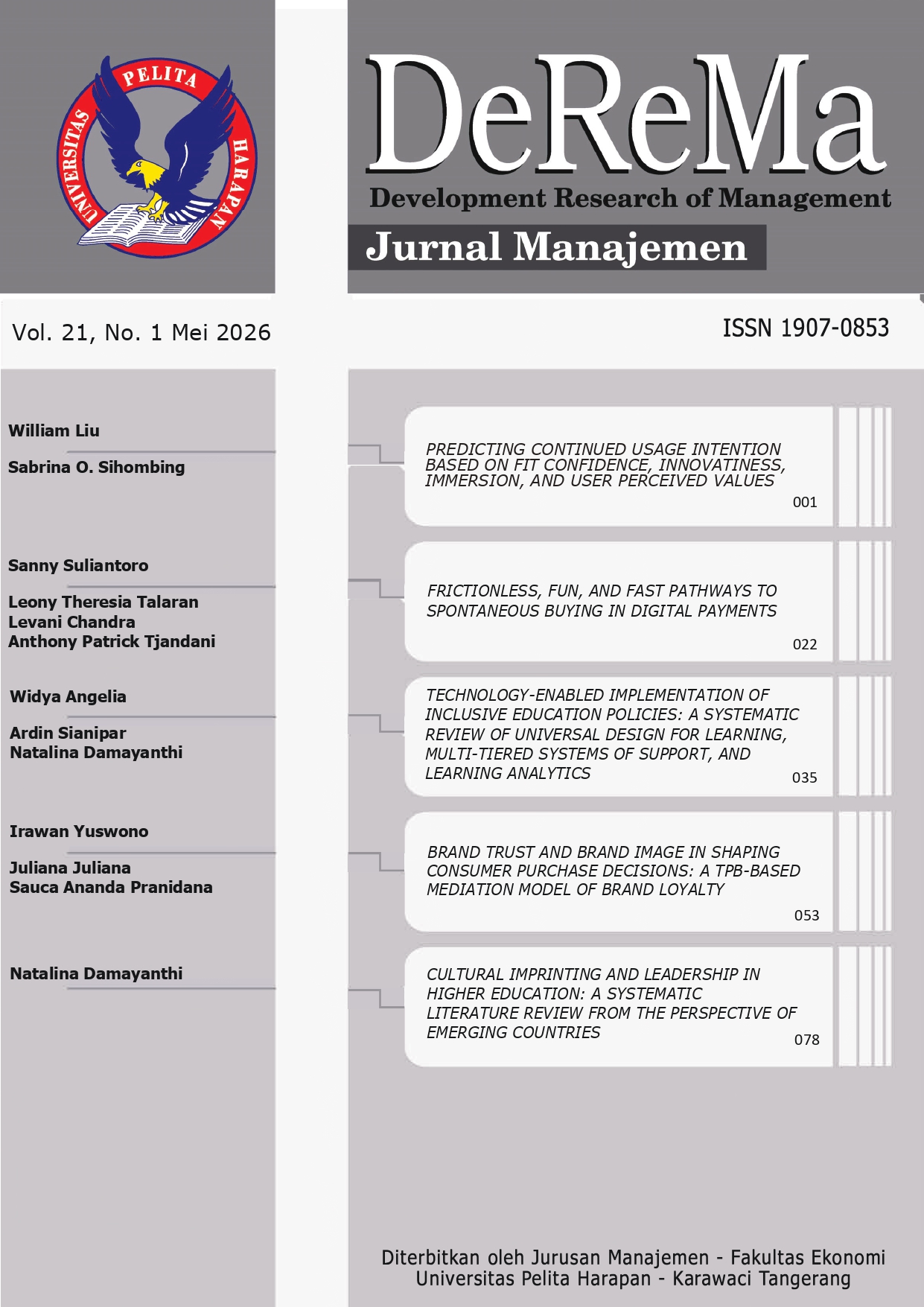
TECHNOLOGY-ENABLED IMPLEMENTATION OF INCLUSIVE EDUCATION POLICIES: A SYSTEMATIC REVIEW OF UDL, MTSS, AND LEARNING ANALYTICS
DOI:
https://doi.org/10.19166/derema.v21i1.10356Abstract
This article synthesises evidence on the implementation of inclusive education policies by examining the interplay of technology, pedagogical frameworks, and systemic support in shaping adoption, consistency, adherence, and feasibility across various school contexts. Design/methodology/approach: A Systematic Literature Review (SLR) was conducted in accordance with the PRISMA 2020 guidelines. Seventeen Scopus-indexed articles (2016–2024) were analysed, focusing on study characteristics, theoretical foundations, and implementation indicators. Quality was assessed using JBI checklists. Findings reveal that the combination of assistive technologies, learning management systems, and analytics dashboards enhances adoption and consistency when paired with teacher professional development and Leadership support. The UDL and MTSS frameworks strengthen coherence in curriculum adaptation and monitoring. Nevertheless, affordability, teacher readiness, and infrastructure gaps particularly in LMICs remain significant challenges. Temporal differences emerged: pre-COVID studies emphasised classroom level interventions, while post COVID research highlighted systemic digital infrastructure and accountability. Research limitations include reliance on English only sources, methodological heterogeneity, and potential publication bias. Implications: Policymakers must align inclusion mandates with funding and infrastructure, while school leaders should integrate teacher training and data driven monitoring to support inclusive practices. Researchers are encouraged to adopt mixed method and longitudinal designs across contexts. This study presents a comparative synthesis of pre and post COVID literature, highlighting systemic strategies and justice-oriented perspectives as crucial for sustaining inclusive education.
References
Almeqdad, Q. I., Alghamdi, A. K. H., & Ihmeideh, F. M. (2023). The effectiveness of universal design for learning: A systematic review and meta-analysis. Cogent Education, 10(1), 2218191. https://doi.org/10.1080/2331186X.2023.2218191
Ariesty, W. (2018). Pengaruh relationship satisfaction dalam business performance. DeReMa Jurnal Manajemen, 13, 248–249. https://doi.org/10.19166/derema.v13i2.719
Ardianuari, S., Pasaribu, E., Amannullah, G., & Prana, A. (2023). Assistive technology unmet needs in Indonesia: Challenges and opportunities for enhancing equitable access. Disability and Rehabilitation: Assistive Technology, 19(6), 1–9. https://doi.org/10.1080/17483107.2023.2244996
Bouck, E. C. (2016). A national snapshot of assistive technology for students with disabilities. Journal of Special Education Technology, 31(1), 4–13. https://doi.org/10.1177/0162643416633330
Bouck, E. C., & Flanagan, S. M. (2016). Exploring assistive technology and post-school outcomes for students with severe disabilities. Disability and Rehabilitation: Assistive Technology, 11(8), 645–652. https://doi.org/10.3109/17483107.2015.1029537
Damschroder, L. J., Reardon, C. M., Widerquist, M. A. O., & Lowery, J. (2022). The updated consolidated framework for implementation research (CFIR): Enhancements for equity and construct clarity. Implementation Science, 17, 75. https://doi.org/10.1186/s13012-022-01245-1
Durach, C. F., Kembro, J., & Wieland, A. (2017). A new paradigm for systematic literature reviews in supply chain management. Journal of Supply Chain Management, 53(4), 67–85. https://doi.org/10.1111/jscm.12145
Fernández-Batanero, J. M., Román-Graván, P., & Montenegro-Rueda, M. (2022). Assistive technology for the inclusion of students with disabilities: A systematic review. Educational Technology Research and Development, 70, 1589–1620. https://doi.org/10.1007/s11423-022-10127-7
Hardy, I., & Woodcock, S. (2024). Inclusive education policies—Objects of observance, omission and obfuscation, ten years on. International Journal of Inclusive Education. https://doi.org/10.1080/13603116.2023.2257697
Hooshyar, D., Pedaste, M., & Wang, M. (2023). Learning analytics in supporting student agency: A systematic review. Sustainability, 15(18), 13662. https://doi.org/10.3390/su151813662
Huang, L., Liang, M., Xiong, Y., Wu, X., & Lim, C. P. (2024). A systematic review of technology-enabled teacher professional development during the COVID-19 pandemic. Computers & Education, 223, 105168. https://doi.org/10.1016/j.compedu.2024.105168
JBI. (2020). JBI manual for evidence synthesis. https://doi.org/10.46658/JBIMES-20-01
King-Sears, M. E., Stefanidis, A., Evmenova, A. S., Rao, K., Brunsell, E., & Strimel, M. (2023). Achievement of learners receiving UDL instruction: A meta-analysis. Teaching and Teacher Education, 122, 103956. https://doi.org/10.1016/j.tate.2022.103956
Majeika, C. E., & Rafferty, L. A. (2024). Integrated multi-tiered systems of support in elementary schools: Practical applications. Intervention in School and Clinic, 60(1), 3–13. https://doi.org/10.1177/10534512241254031
Matsieli, M., & Mutula, S. (2024). COVID-19 and digital transformation in higher education institutions: Towards inclusive and equitable access to quality education. Education Sciences, 14(8), 819. https://doi.org/10.3390/educsci14080819
McKenzie, J. (2023). Implementation of universal design for learning in low- and middle-income countries. Access: Inclusive Education and Technology, 3(4), 43. https://doi.org/10.3390/access3040043
Mukhtarkyzy, K., Smagulova, L., Tokzhigitova, A., Amanzholov, T., Abdibaitova, G., & Omarova, A. (2025). A systematic review of the utility of assistive technologies for SEND students in schools. Frontiers in Education, 10, 1523797. https://doi.org/10.3389/feduc.2025.1523797
Navas-Bonilla, C. R., Jiménez-Carvajal, K., & Chaves-García, C. (2025). Inclusive education through technology: A systematic literature review. Frontiers in Education, 10, 1527851. https://doi.org/10.3389/feduc.2025.1527851
Nordström, T., Nilsson, S., Gustafson, S., & Svensson, I. (2019). Assistive technology applications for students with reading and writing difficulties. Disability and Rehabilitation: Assistive Technology, 14(8), 797–806. https://doi.org/10.1080/17483107.2018.1499142
Novrizal, N., & Manaf, S. (2024). The policy of inclusive education in Indonesia. Multicultural Islamic Education Review, 2(1), 37–44. https://doi.org/10.23917/mier.v2i1.4297
Ozdowska, A., & Scanlon, A. (2021). Using assistive technology with SRSD to support students on the autism spectrum with persuasive writing. British Journal of Educational Technology, 52(2), 624–641. https://doi.org/10.1111/bjet.13063
Page, M. J., et al. (2021). PRISMA 2020 statement. BMJ, 372, n71. https://doi.org/10.1136/bmj.n71
Paolucci, C., et al. (2024). Learning analytics opportunities and challenges for K–12 education. Heliyon, 10(4), e25767. https://doi.org/10.1016/j.heliyon.2024.e25767
Petticrew, M., & Roberts, H. (2006). Systematic reviews in the social sciences: A practical guide. Blackwell Publishing.
Rethlefsen, M. L., et al. (2021). PRISMA-S extension. Journal of Clinical Epidemiology, 134, 49–57. https://doi.org/10.1016/j.jclinepi.2021.02.006
Rundquist, R., et al. (2024). Use of learning analytics in K–12 mathematics education. Journal of Learning Analytics, 11(3), 174–191. https://doi.org/10.18608/jla.2024.8299
Samaniego López, M. E., et al. (2025). Technologies in inclusive education: Solution or challenge? Education Sciences, 15(6), 715. https://doi.org/10.3390/educsci15060715
Shepley, C., Lane, J. D., & Graley, D. (2022). Progress monitoring data for learners with disabilities. Remedial and Special Education, 44(4), 235–247. https://doi.org/10.1177/07419325221128907
Soeharto, S., Subasi Singh, S., & Afriyanti, F. (2024). Attitudes toward inclusive education and teaching for creativity. Thinking Skills and Creativity, 51, 101469. https://doi.org/10.1016/j.tsc.2024.101469
Thelwall, M. (2018). Dimensions: A competitor to Scopus and Web of Science? Journal of Informetrics, 12(2), 430–435. https://doi.org/10.1016/j.joi.2018.03.006
Tuğtekin, E. B. (2023). Scrutinising learning management systems in practice. IRRODL, 24(2). https://doi.org/10.19173/irrodl.v24i2.6905
Zhang, Z., Wu, Y., Li, J., & Sun, H. (2025). Factors influencing teacher adoption of digital education management systems. Scientific Reports, 15(1), 1552. https://doi.org/10.1038/s41598-025-01552-8
Downloads
Published
Issue
Section
License
Copyright (c) 2026 Widya Angelia, Ardin Sianipar, Natalina Damayanthi

This work is licensed under a Creative Commons Attribution-ShareAlike 4.0 International License.
Authors who publish with this journal agree to the following terms:
1) Authors retain copyright and grant the journal right of first publication with the work simultaneously licensed under a Creative Commons Attribution License (CC-BY-SA 4.0) that allows others to share the work with an acknowledgement of the work's authorship and initial publication in this journal.
2) Authors are able to enter into separate, additional contractual arrangements for the non-exclusive distribution of the journal's published version of the work (e.g., post it to an institutional repository or publish it in a book), with an acknowledgement of its initial publication in this journal.
3) Authors are permitted and encouraged to post their work online (e.g., in institutional repositories or on their website). The final published PDF should be used and bibliographic details that credit the publication in this journal should be included.



 Department of Management | Business School | Universitas Pelita Harapan | Indonesia | +62 21 546 0901 | jurnal.derema@uph.edu