
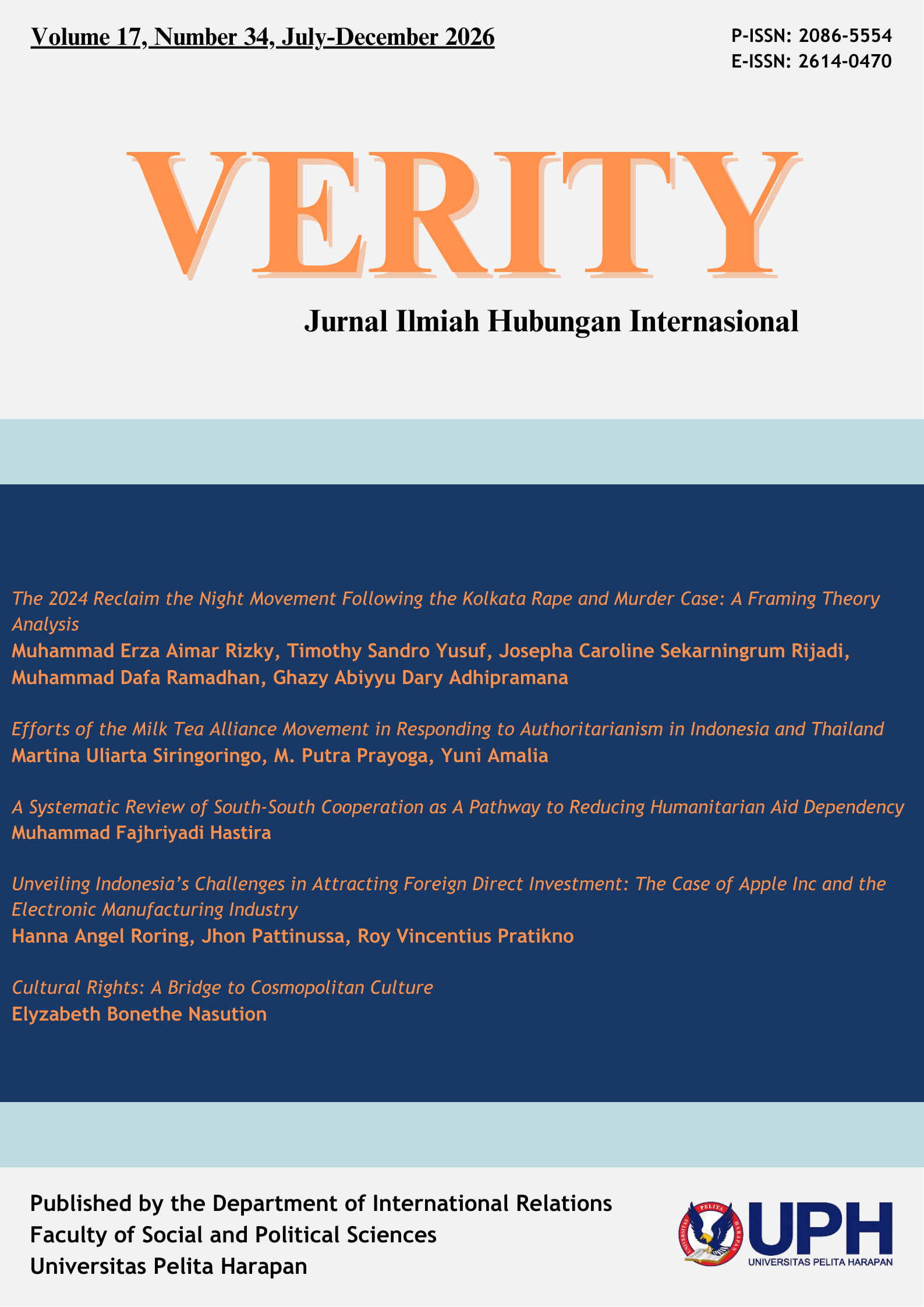
Efforts of the Milk Tea Alliance Movement in Responding to Authoritarianism in Indonesia and Thailand
DOI:
https://doi.org/10.19166/verity.v17i34.9821Schlagworte:
Authoritarianism, Milk Tea Alliance, Society, Transnational, NetworksAbstract
The phenomenon of democratic backsliding and the resurgence of authoritarianism has become a major concern in Southeast Asia, including in Indonesia and Thailand. This study aims to analyze how transnational civil society movements, particularly the Milk Tea Alliance (MTA), respond to and resist authoritarianism in these two countries. Using the theory of Transnational Advocacy Networks (TANs) by Keck and Sikkink, this study identifies the strategies of information politics, symbolic politics, leverage politics, and accountability politics employed by the MTA. The research adopts a qualitative-descriptive approach with literature study as the main method. The findings indicate that the MTA has succeeded in building cross-national solidarity that strengthens local advocacy, despite facing challenges such as state repression and nationalist resistance. These findings contribute to the understanding of the role of global civil networks in supporting democratization and civil liberties amidst the current wave of authoritarianism.
Literaturhinweise
Agustina, L. (2023). Digital Authoritarianism in Southeast Asia: State Responses to Transnational Digital Activism. Journal of Contemporary Asia, 53(2), 281-300.
Amnesty International. (2021). Thailand: Authorities Must Stop Outrageous Targeting of Children with Lèse-Majesté Law. London: Amnesty International Publications.
Amnesty International. (2022). State of the World's Human Rights 2021/22: Asia Pacific Regional Overview. London: Amnesty International Publications.
Ardianto, H. (2022). The Dispersion of Digital Activism in Indonesia: Challenges for Cohesive Movement Building. Indonesia and the Malay World, 50(146), 120-142.
Arisandy, D. (2021). The Rise of Digital Solidarity: Milk Tea Alliance as a New Form of Transnational Social Movement. Global: Jurnal Politik Internasional, 23(1), 95-119.
Artha, D., Firdaus, A., & Pratama, I. (2022). Civil Society Under Pressure: Comparing State Restrictions in Thailand and Indonesia. Contemporary Southeast Asia, 44(1), 107-134.
Artha, G. W., Sosio, S., & Sosio, M. Peran Politik Masyarakat Sipil Dalam Membangun Demokrasi.
Aspinall, E. (2020). Semi-Authoritarian Indonesia. Journal of Democracy, 31(4), 109-123.
Blitt, R. C. (2004). Who Will Watch the Watchdogs? Human Rights Nongovernmental Organizations and the Case for Regulation. Buffalo Human Rights Law Review, 10, 261-398.
Brillyanto, A. (2021). Digital Activism in Indonesia: Connectivity and Social Change. Communication and Critical/Cultural Studies, 18(2), 176-194.
Butt, S. (2020). The Constitutional Court and Indonesian Democratic Decline. International Journal of Constitutional Law, 18(2), 576-605.
Brillyanto, R. A. R. (2021). Aktivisme Digital Dalam Mempromosikan Hak Asasi Manusia Di Indonesia (Studi Kasus Amnesty International Indonesia) (Bachelor's thesis, Fakultas Ilmu Sosial Dan Ilmu Politik Universitas Islam Negeri Syarif Hidayatullah Jakarta).
Chachavalpongpun, P. (2022). Young Thais and Democratic Aspirations: Resistance, Resilience and Repertoires. Singapore: ISEAS-Yusof Ishak Institute.
Chambers, P., & Waitoolkiat, N. (2020). Khaki Capital: The Political Economy of the Military in Southeast Asia. Copenhagen: NIAS Press.
Chamnan, P. (2021). Thailand's Military-Monarchy Alliance and the Crisis of Democracy. Critical Asian Studies, 53(2), 240-262.
Chen, A., & Hioe, B. (2021). The Unexpected Trajectory of the Milk Tea Alliance. The Diplomat, April 28.
Digital Rights Monitor. (2023). Digital Rights in Southeast Asia: Annual Report 2022. Bangkok: Digital Rights Monitor.
Fakih, M. (Ed.). (1996). Masyarakat sipil. InsistPress.
Farchan, Y. (2022). Dinamika Sistem Politik Otoritarianisme Orde Baru. Jurnal Adhikari, 1(3), 152-161.
George, M. W. (2008). The elements of library research: What every student needs to know.
Hadi, K. (2019). Perbandingan Penegakan Demokrasi Di Indonesia Pasca-Rezim Suharto Dan Filipina Pasca-Rezim Marcos. Insignia: Journal of International Relations, 6(1), 13-29.
Hartoko, V. D. S. (2016). Otoritarianisme versus dukungan terhadap demokrasi: Kajian meta-analisis. Buletin Psikologi, 24(2), 136–159. https://doi.org/10.22146/buletinpsikologi.22771
Kusumastuti, A., & Khoiron, A. M. (2019). Metode penelitian kualitatif. Lembaga Pendidikan Sukarno Pressindo (LPSP).
Lubis, S., & Zamharir, H. (2024). Politik Pemerintahan Thailand Era Thaksin Shinawatra & Malaysia Era Anwar Ibrahim dalam Perspektif Illiberal Democracy serta Relevansinya dengan Indonesia. Populis: Jurnal Sosial dan Humaniora, 9(2), 118-131.
Nasution, A. F. (2023). Metode penelitian kualitatif.
Putra, A. (2021). Visual Politics and Digital Protests: Aesthetic Convergence in Southeast Asian Pro-Democracy Movements. Visual Communication, 20(4), 516-538.
Ramdhan, M. (2021). Metode penelitian. Cipta Media Nusantara.
Rohma, M. N. (2020). Upaya Transnational Advocacy Networks dalam Memengaruhi Perubahan Hukum Pidana Pasal 475 Maroko.
Stoan, S. K. (1984). Research and library skills: An analysis and interpretation. College & research libraries, 45(2), 99-109.
Sukma, R. (2020). The Challenges of Press Freedom in Indonesia: Freedom, Law, and State Power. Journal of Asian Studies, 19(3), 85-102.
Downloads
Veröffentlicht
Ausgabe
Rubrik
Lizenz
Copyright (c) 2025 Martina Uliarta Siringoringo

Dieses Werk steht unter der Lizenz Creative Commons Namensnennung - Weitergabe unter gleichen Bedingungen 4.0 International.
Authors who publish with this journal agree to the following terms:
1) Authors retain copyright and grant the journal right of first publication with the work simultaneously licensed under a Creative Commons Attribution License (CC-BY-SA 4.0) that allows others to share the work with an acknowledgement of the work's authorship and initial publication in this journal.
2) Authors are able to enter into separate, additional contractual arrangements for the non-exclusive distribution of the journal's published version of the work (e.g., post it to an institutional repository or publish it in a book), with an acknowledgement of its initial publication in this journal.
3) Authors are permitted and encouraged to post their work online (e.g., in institutional repositories or on their website). The final published PDF should be used and bibliographic details that credit the publication in this journal should be included.
 Department of