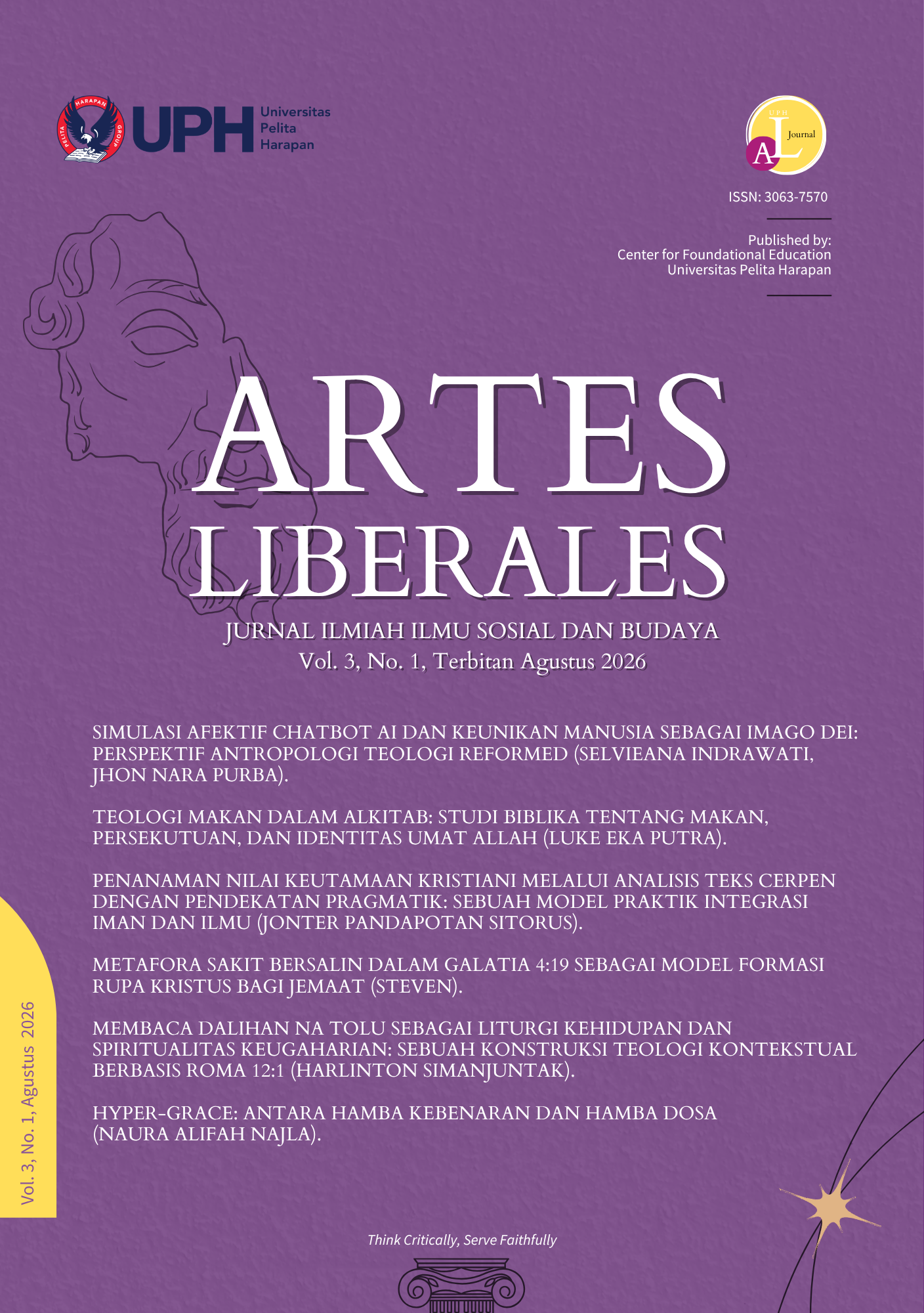
Teologi Makan dalam Alkitab: Studi Teologia Biblika tentang Makan, Persekutuan, dan Identitas Umat Allah
Schlagworte:
teologi makan;, teologi biblika;, Perjanjian Lama;, Perjanjian Baru;, Persekutuan;, Identitas umat Allah;, Hospitalitas;, teologi makanAbstract
Makan merupakan aktivitas biologis universal, tetapi dalam Alkitab ia tampil sebagai tindakan yang sarat makna teologis, sosial, liturgis, dan eskatologis. Banyak peristiwa penting dalam Kitab Suci berlangsung dalam konteks makan, mulai dari Taman Eden, perayaan Paskah, manna di padang gurun, perjamuan-perjamuan Israel, mukjizat roti, Perjamuan Terakhir, hingga perjamuan kawin Anak Domba. Artikel ini menelaah tema makan dalam keseluruhan kanon Alkitab dengan menggunakan metode kualitatif-deskriptif dan pendekatan teologi biblika tematik-kanonik. Kajian dilakukan melalui pembacaan eksegetis terhadap teks-teks kunci dalam Perjanjian Lama dan Perjanjian Baru, khususnya Kejadian 2–3, Yohanes 6, dan 1 Korintus 11, disertai dialog kritis dengan literatur teologi kontemporer. Hasil penelitian menunjukkan bahwa teologi makan dalam Alkitab sekurang-kurangnya memiliki empat dimensi utama, yaitu makan sebagai anugerah pemeliharaan Allah, makan sebagai tanda persekutuan, makan sebagai penanda identitas komunitas iman, dan makan sebagai antisipasi perjamuan eskatologis. Selain itu, tema makan berkaitan erat dengan persoalan ketaatan, pembentukan hasrat, solidaritas sosial, hospitalitas, kritik terhadap eksklusi, dan tanggung jawab ekologis. Temuan-temuan tersebut berimplikasi langsung bagi kehidupan gereja masa kini, khususnya dalam pengembangan spiritualitas makan, etika konsumsi, keadilan pangan, persekutuan lintas-batas, dan pemeliharaan ciptaan.
Literaturhinweise
DAFTAR PUSTAKA
Alves, I. R. (2025). A Experiência Alimentar como um Instrumento de
Construção de uma Consciência Mística. Revista Caminhos, 23(1), 56–
72.
Altmann, Peter. Festive Meals in Ancient Israel: Deuteronomy's Identity
Politics in Their Ancient Near Eastern Context. Beihefte zur Zeitschrift
für die alttestamentliche Wissenschaft 424. Berlin: De Gruyter, 2011.
Boaheng, I. (2023). The institution of the Eucharist: Exegesis of Mark 14:12–
26. International Journal of Social Science Research and Review, 6(10),
78–91.
Boulton, Matthew Myer. "Subsessionist Typology: The Eucharist as a Christian
Rendition of Passover." Modern Theology 38, no. 3 (2022): 456–478.
Childs, B. S. (1974). The book of Exodus: A critical, theological commentary.
Westminster Press.
Childs, B. S. (1992). Biblical theology of the Old and New Testaments:
Theological reflection on the Christian Bible. Fortress Press.
Collins, J. J. (1993). Daniel: A commentary on the book of Daniel. Fortress
Press.
Conradie, E. M. (2016a). What do we do when we eat? Part II: A theological
inquiry. Scriptura, 115, 1–15.
Conradie, E. M. (2016b). Eat and/or Be Eaten: The Evolutionary Roots of
Violence? Scriptura, 114, 1–22. https://doi.org/10.7833/114-0-1143.
De Klerk, B. "Liturgiese afleidings uit die kontinuïteit en diskontinuïteit van die
Pasga en die Nagmaal." Acta Theologica 31, no. 1 (2011): 20–38.
Dunn, T. K. (2024). "Take and Eat": A Biblical Theology. Eugene, OR: Cascade
Books.
Fee, G. D. (2014). The first epistle to the Corinthians (Rev. ed.). Eerdmans.
Fretheim, T. E. (1999). First and Second Kings. Westminster John Knox Press.
Hombana, Mphumezi, and Thembelani Maqajana. "Meals, Identity and
Othering in Mark 14:12–26." Verbum et Ecclesia 46, no. 1 (2025): 1–8.
https://doi.org/10.4102/ve.v46i1.3306.
Jeremias, J. (1966). The Eucharistic words of Jesus (N. Perrin, Trans.). SCM
Press.
Karris, R. J. (2006). Eating your way through Luke's Gospel. Liturgical Press.
Kelly, Brian Spencer. "Blessed is anyone who will eat bread in the kingdom of
God: reading the Lukan meal-scenes as proleptic messianic banquets
signaling the dawn of the end of exile." Tesis Master, Pepperdine
University, 2025. https://digitalcommons.pepperdine.edu/etd/1657/.
Kim, Se-kwang. "Paul's View of Individualism and Communalism in the
Conflict in the Corinthian Congregation at the Lord's Supper." KCI
Journal, 2021.
Kobel, E. (2011). Dining with John: Communal meals and identity formation in
the Fourth Gospel and its historical and cultural context. Brill.
MacDonald, N. (2008). What did the ancient Israelites eat? Diet in biblical
times. Eerdmans.
Manurung, Donny Jhon Lionel. "Do This in Remembrance of Me: A Socio-
Rhetorical Interpretation of the Lord's Supper in 1 Corinthians 11:23-
29." Global Education Journal 4, no. 2 (2026): 1049–1056.
https://doi.org/10.59525/gej.1867.
Méndez Montoya, A. F. (2009). The theology of food: Eating and the
Eucharist. Wiley-Blackwell.
Milgrom, J. (1991). Leviticus 1–16. Doubleday.
Newall, M. (2024). 'Faith working through love': a new food law for a new
world. Theology, 127(1), 22-29.
Paulraj, G.S.S. (2023). Food Justice and Hospitality in Luke-Acts: A Historical
and Contemporary Interpretation. Pickwick Publications.
Prabowo, P. D. "Perjamuan Kudus Menurut 1 Korintus 10-11 dan Fungsinya
dalam Lensa Psikologi Agama." Jurnal Misioner 2, no. 2 (2022): 169–
192. https://doi.org/10.51770/jm.v2i2.75.
Pranoto, I. (2011). Hubungan antara kristologi Paulus dan ajaran tentang
makanan persembahan berhala (eidolothuta). Veritas: Jurnal Teologi
dan Pelayanan, 12(2), 257–277.
Rhodes, Michael. "Can We Consume Character? How to Learn Justice by
Feasting." Christianity Today, 17 Desember 2023.
https://www.christianitytoday.com/2023/12/social-justice-old-
testament-deuteronomy-discipleship/.
Richardson, Andrew W. "The Canonical Use of the Psalter in the Formal
Quotations of Jesus, Didactically Applied to His Self-Identification as
Messiah." PhD diss., Liberty University, 2026.
Scarlata, M. (2025). Wine, Soil, and Salvation in the Hebrew Bible and New
Testament. Cambridge University Press.
Schmemann, A. (1973). For the Life of the World: Sacraments and Orthodoxy.
St. Vladimir's Seminary Press.
Seheri, M. "The Abrahamic Call through Canonical Criticism: Genesis 12:1-9
and the Theological Reorientation of Scripture." Old Testament Essays
39, no. 1 (2026): 1–25. doi:10.17159/2312-3621/2026/v39n1a2.
Sine, C. (2022). From Shared Meals to Interreligious Conversations. Journal of
Ecumenical Studies, 57(3), 410–428.
Smit, P.-B. (2022). Exploring the Eschaton: The Lord's Supper as a Cultural
Technique Enabling Prefigurative Politics. Yearbook for Ritual and
Liturgical Studies, 38, 59-72.
Spellman, Ched. "Two Testaments to Tell: Biblical Theology and the Canonical
Shape of the Gospel." Journal of Theological Interpretation 18, no. 2
(2024): 281–299.
Szumislawska Bengtsson, M. (2021). "When You Come Together to Eat..." A
Social-Scientific Study of Community Meals in the Pauline
Congregations. (Tesis Doktoral, Lund University).
Tangen, K. I. (2018). Leadership as participation in the hospitality of God.
Journal of Pentecostal Theology, 27(2), 284–306.
"The Eucharist as Peacemaking: A Practical Understanding of 1 Corinthians
11:17-34 in the Korean Church Context." Korean Journal of Christian
Studies, 2024.
Vall, Gregory. Ecclesial Exegesis: A Synthesis of Ancient and Modern
Approaches to Scripture. Verbum Domini. Washington, D.C.: The
Catholic University of America Press, 2022.
Wenham, G. J. (1987). Genesis 1–15. Word Books.
Wenham, G. J. (2000). Story as Torah: Reading Old Testament narrative
ethically. Baker Academic.
Winarjo, H. (2023). Makan sebagai sarana pengasuhan, persekutuan, dan
hospitalitas: Sebuah konstruksi teologi Trinitarian. Veritas: Jurnal
Teologi dan Pelayanan, 22(2), 189–204.
Wirzba, N. (2011). Food and faith: A theology of eating. Cambridge University
Press.
Wirzba, N. (2021). This Sacred Life: Humanity's Place in a Wounded World.
Cambridge: Cambridge University Press.
Wright, N. T. (1996). Jesus and the victory of God. Fortress Press.
Downloads
Veröffentlicht
Ausgabe
Rubrik
Lizenz
Copyright (c) 2026 Luke Putra

Dieses Werk steht unter der Lizenz Creative Commons Namensnennung - Weitergabe unter gleichen Bedingungen 4.0 International.
Authors who publish with this journal agree to the following terms:
1) Authors retain copyright and grant the journal right of first publication with the work simultaneously licensed under a Creative Commons Attribution License (CC-BY-SA 4.0) that allows others to share the work with an acknowledgement of the work's authorship and initial publication in this journal.
2) Authors are able to enter into separate, additional contractual arrangements for the non-exclusive distribution of the journal's published version of the work (e.g., post it to an institutional repository or publish it in a book), with an acknowledgement of its initial publication in this journal.
3) Authors are permitted and encouraged to post their work online (e.g., in institutional repositories or on their website). The final published PDF should be used and bibliographic details that credit the publication in this journal should be included.”