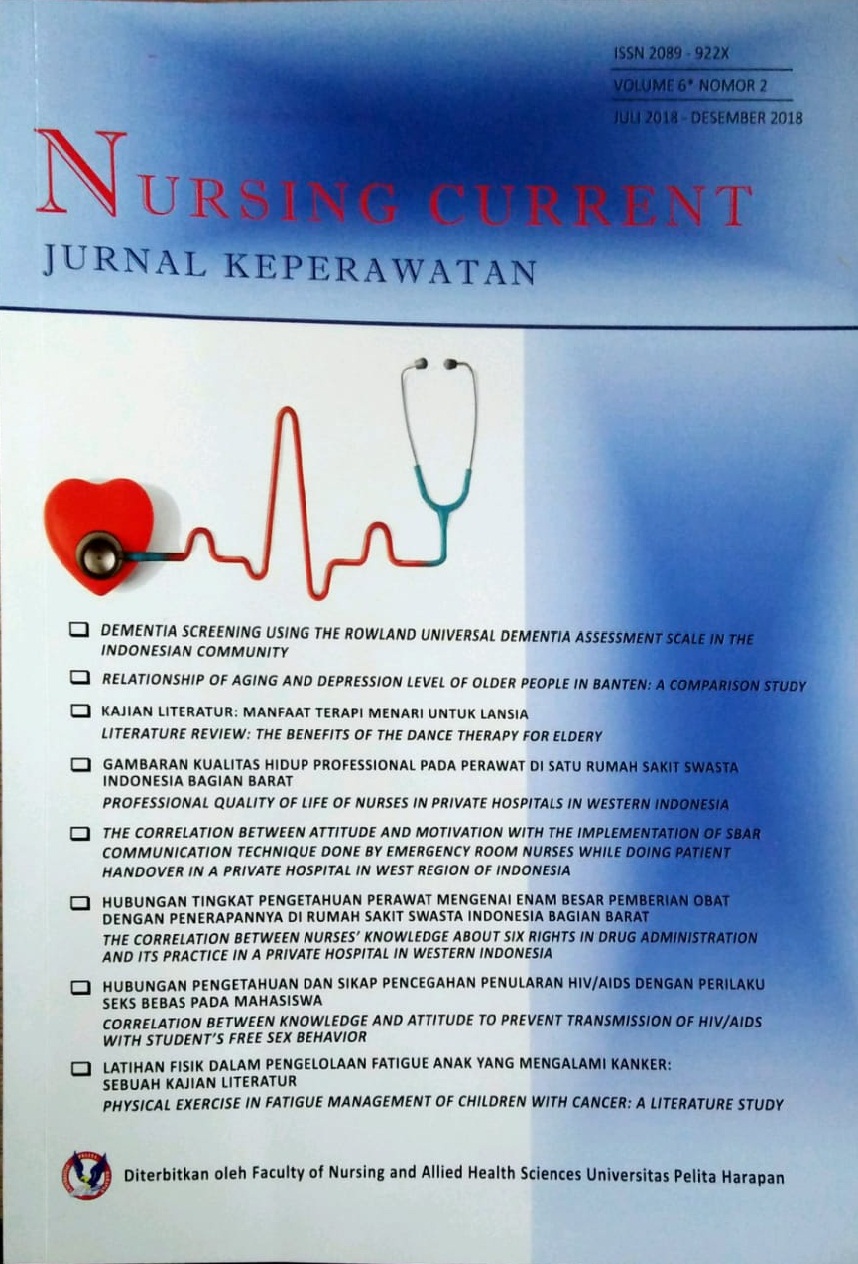
PHYSICAL EXERCISE IN FATIGUE MANAGEMENT OF CHILDREN WITH CANCER: A LITERATURE STUDY [LATIHAN FISIK DALAM PENGELOLAAN FATIGUE ANAK YANG MENGALAMI KANKER: SEBUAH KAJIAN LITERATUR]
DOI:
https://doi.org/10.19166/nc.v6i2.1910Keywords:
Physical Exercise, Children with Cancer, Cancer-related FatigueAbstract
Fatigue is a symptom that arises from cancer and as a result of chemotherapy treatment. This subjective feeling is difficult to explore because of the children's limitations to express their feelings. Continuous fatigue will affect the growth and development of children, so that adequate anticipation is needed to manage fatigue. This literature review aimed to explore articles about physical exercise as the part of fatigue management. The searching process involved two databases; the e-resources page of the National Library of the Republic of Indonesia and Google Scholar in the 2011-2018 period. Keywords used in literature search include children, physiology related to cancer, physical exercise, exercise, children, cancer related fatigue, physical activity, exercise. 243 articles obtained and through selection process, 5 articles were found that were in accordance with the inclusion and exclusion criteria. Thematic analysis revealed four themes: the effectiveness of physical exercise, the characteristics of physical exercise, the extra benefits of physical exercise, and the biological effects of physical exercise. The recommendation from this literature review is to conduct research to identify the factors that influence the effectiveness of physical exercise in managing symptoms of fatigue in children with cancer.
BAHASA INDONESIA ABSTRAK Fatigue merupakan gejala yang muncul dari penyakit kanker dan sebagai dampak dari pengobatan kemoterapi. Perasaan subyektif ini sulit digali karena keterbatasan anak mengungkapkan perasaannya. Fatigue yang berkelanjutan akan mempengaruhi pertumbuhan dan perkembangan anak, sehingga diperlukan antisipasi yang adekuat untuk mengelola fatigue. Kajian literatur ini bertujuan untuk menggali artikel tentang latihan fisik dalam pengelolaan fatigue. Penelusuran melibatkan dua pangkalan data yaitu laman e-resources Perpustakaan Nasional Republik Indonesia dan Google Cendekia dalam rentang waktu 2011-2018. Kata kunci yang digunakan dalam pencarian literatur meliputi anak, fatigue yang berhubungan dengan kanker, latihan fisik, olahraga, children, cancer related fatigue, physical activity, exercise. Dari 243 artikel yang diperoleh, didapatkan 5 artikel yang sesuai dengan kriteria inklusi dan eksklusi. Analisis tematik memunculkan empat tema, yaitu: efektifitas latihan fisik, karakteristik latihan fisik, manfaat ekstra latihan fisik, dan efek biologis latihan fisik. Rekomendasi dari kajan literatur ini adalah dilakukannya penelitian untuk mengidentifikasi faktor-faktor yang mempengaruhi keefektifan latihan fisik dalam pengelolaan gejala kelelahan anak dengan kanker.
References
Andersen, C., Rørth, M., Ejlertsen, B., Stage, M., Møller, T., Midtgaard, J., Quist, M., Bloomquist, K., & Adamsen, L. (2013). The effects of a six-week supervised Multimodal Exercise Intervention during chemotherapy on cancer-related fatigue. European Journal of Oncology Nursing, 17(3), 331-339. https://doi.org/10.1016/j.ejon.2012.09.003
Aveyard, H. (2010). Doing a literature review in health and social care: A practical guide (2nd Ed). McGraw-Hill Open University Press.Aveyard, H. (2014). Doing a literature review in health and social care: A practical guide (3rd Ed). McGraw-Hill Open University Press.
Baky, A. M. A. E., & Elhakk, S. M. A. (2017). Impact of aerobic exercise on physical fitness and fatigue in children with acute lymphoblastic leukemia. International Journal of Therapies and Rehabilitation Research, 6(2), 137-145. https://doi.org/10.5455/ijtrr.000000255
Bogdanis, G. C. (2012). Effects of physical activity and inactivity on muscle fatigue. Frontiers in Physiology, 3(142), 1-5. https://doi.org/10.3389/fphys.2012.00142
Bower, J. E. (2007). Cancer-related fatigue: links with inflammation in cancer patiients and survivors. Brain, Behavior and Immunity, 21(7), 863-871. https://doi.org/10.1016/j.bbi.2007.03.013
Chiang, Y., Yeh, C., Wang, K. K., & Yang, C. (2009). The experience of cancer-related fatigue in Taiwanese children. European Journal of Cancer Care, 18(1), 43-49. https://doi.org/10.1111/j.1365-2354.2007.00884.x
Herman, H., & Novrianda, D. (2017). Reducing fatigue score with physical exercise in children with cancer. Jurnal Ilmu Keperawatan, 5(2), 139-151. https://doi.org/10.21776/ub.jik.2017.005.02.4
Hooke, M. C., Garwick, A. W., & Gross, C. R. (2011). Fatigue and physical performance in children and adolescents receiving chemotherapy. Oncology Nursing Forum, 38(6), 649. https://doi.org/10.1188/11.ONF.649-657
James, S. R., Nelson, K. A., & Ashwill, J. N. (2013). Nursing care of children: Principles & practice (4th Ed.). St. Louis, MO: Sauders/Elsevier.
Jung, M., Zepf, N., & Fuchs, B. (2016). Bewegungstherapie für Kinder mit Cancer Related Fatigue. Klinische Pädiatrie, 228(3), 157-163. https://doi.org/10.1055/s-0042-105291
Lam, K. K. W., Li, W. H. C., Chung, O. K., Ho, K. Y., Chiu, S. Y., Lam, H. S., & Chan, G. C. F. (2018). An integrated experiential training programme with coaching to promote physical activity and reduce fatigue among children with cancer: A randomised controlled trial. Patient Education and Counseling, 1-10. https://doi.org/10.1016/j.pec.2018.07.008
Li, W. H. C., Hoa, K. Y., Lama, K. K. W., Lamb, H. S., Chuic, S. Y., Chanb, G. C. F.,Cheunga, A. T., Hoa, L. L. K., & Chunga, O. K. (2018). Adventure-based training topromote physical activity and reduce fatigue among childhood cancer survivors: A randomized controlled trial. International Journal of Nursing Studies, 83, 65-74. https://doi.org/10.1016/j.ijnurstu.2018.04.007
McArdle, W. D., Katch, F. I., & Katch, V. L. (2016). Essential of exercise physiology (5th ed.). Wolters Kluwer.
Miller, E., Jacob, E., & Hockenberry, M. J. (2011). Nausea, pain, fatigue, and multiple symptoms in hospitalized children with cancer. Oncology Nursing Forum, 38(5), E382-E393. https://doi.org/10.1188/11.ONF.E382-E393
Mitchell, S. A., Hoffman, A. J., Clark, J. C., DeGennaro, R. M., Poirier, P., Robinson, C. B., & Weisbrod, B. L. (2014). Putting evidence into practice: An update of evidence-based interventions for cancer-related fatigue during and following treatment. Clinical Journal of Oncology Nursing, 18(s6), 38-58. https://doi.org/10.1188/14.cjon.s3.38-58
Moher, D., Liberati, A., Tetzlaff, J., & Altman, D. G. (2009). Preferred Reporting Items for Systematic Reviews and Meta-Analyses: The PRISMA Statement. Physical Therapy, 89(9), 873-880. https://doi.org/10.1371/journal.pmed.1000097Mustian, K. M., Sprod, L. K., Janelsins, M., Peppone, L. J., & Mohile, S. (2012). Exercise recommendations for cancer-related fatigue, cognitive impairment, sleep problems, depression, pain, anxiety, and physical dysfunction””a review. Oncology & Hematology Review, 8(2), 81. https://doi.org/10.17925/ohr.2012.08.2.81
Naga, B. S. H. B., & Kassab, M. I. (2013). Fatigue experience among cancer patients receiving chemotherapy. Journal of Research in Nurisng and Midwifery, 2(1), 1-5. https://www.interesjournals.org/articles/fatigue-experience-amongcancer-patients-receiving-chemotherapy.pdfPusat Data dan Informasi Kementerian Kesehatan RI. (2015). Situasi penyakit kanker. http://www.depkes.go.id/download.php?file=download/pusdatin/buletin/buletinkanker.pdf
Tanir, M. K., & Kuguoglu, S. (2012). Impact of exercise on lower activity levels in children with acute lymphoblastic leukemia: A randomized controlled trial from Turkey. Rehabilitation Nursing, 36, 48-59. https://doi.org/10.1002/rnj.58
UICC. (2015, November). Childhood cancer advocacy. https://www.uicc.org/newsletter/February-2015/Childhood-Cancer-Advocacy
Viña, C. C., Wurz, A. J., & Culos-Reed, S. N. (2013). Promoting physical activity in pediatric oncology. where do we go from here? Frontiers in Oncology, 3. https://doi.org/10.3389/fonc.2013.00173
Winningham, M., L., Barton-Burke, M. (2000). Fatigue in Cancer. A multidimensional approach. Jones and Bartlett Publisher, Inc.Winter, C. C., Milller, C., Hardes, J., Gosheger, G., Boos, J., & Rosenbaum, D. (2013). The effect of individualized exercise interventions during treatment in pediatric patients with a malignant bone tumor. Supportive Care in Cancer, 21(6), 1629-1636. https://doi.org/10.1007/s00520-012-1707-1
Yeh, C. H., Wai, J. P. M., Lin, U., & Chiang, Y. (2011). A pilot study to examine the feasibility and effects of a home-based aerobic program on reducing fatigue in children with acute lymphoblastic leukemia. Cancer Nursing, 34(1), 3-12. https://doi.org/10.1097/NCC.0b013e3181e4553c
Zick, S. M., Alrawi, S., Merel, G., Burris, B., Sen, A., Litzinger, A., & Harris, R. E. (2011). Relaxation acupressure reduces persistent cancer-related fatigue. Evidence-Based Complementary and Alternative Medicine, 2011, 1-10. https://doi.org/10.1155/2011/142913
Downloads
Published
How to Cite
Issue
Section
License
Authors who publish with this journal agree to the following terms:
1) Authors retain copyright and grant the journal right of first publication with the work simultaneously licensed under a Creative Commons Attribution License (CC-BY-SA 4.0) that allows others to share the work with an acknowledgement of the work's authorship and initial publication in this journal.
2) Authors are able to enter into separate, additional contractual arrangements for the non-exclusive distribution of the journal's published version of the work (e.g., post it to an institutional repository or publish it in a book), with an acknowledgement of its initial publication in this journal.
3) Authors are permitted and encouraged to post their work online (e.g., in institutional repositories or on their website). The final published PDF should be used and bibliographic details that credit the publication in this journal should be included.

This work is licensed under a Creative Commons Attribution-ShareAlike 4.0 International License.
 Published by Faculty of Nursing | Universitas Pelita Harapan | Lippo Karawaci, Tangerang, Indonesia, 15811 |