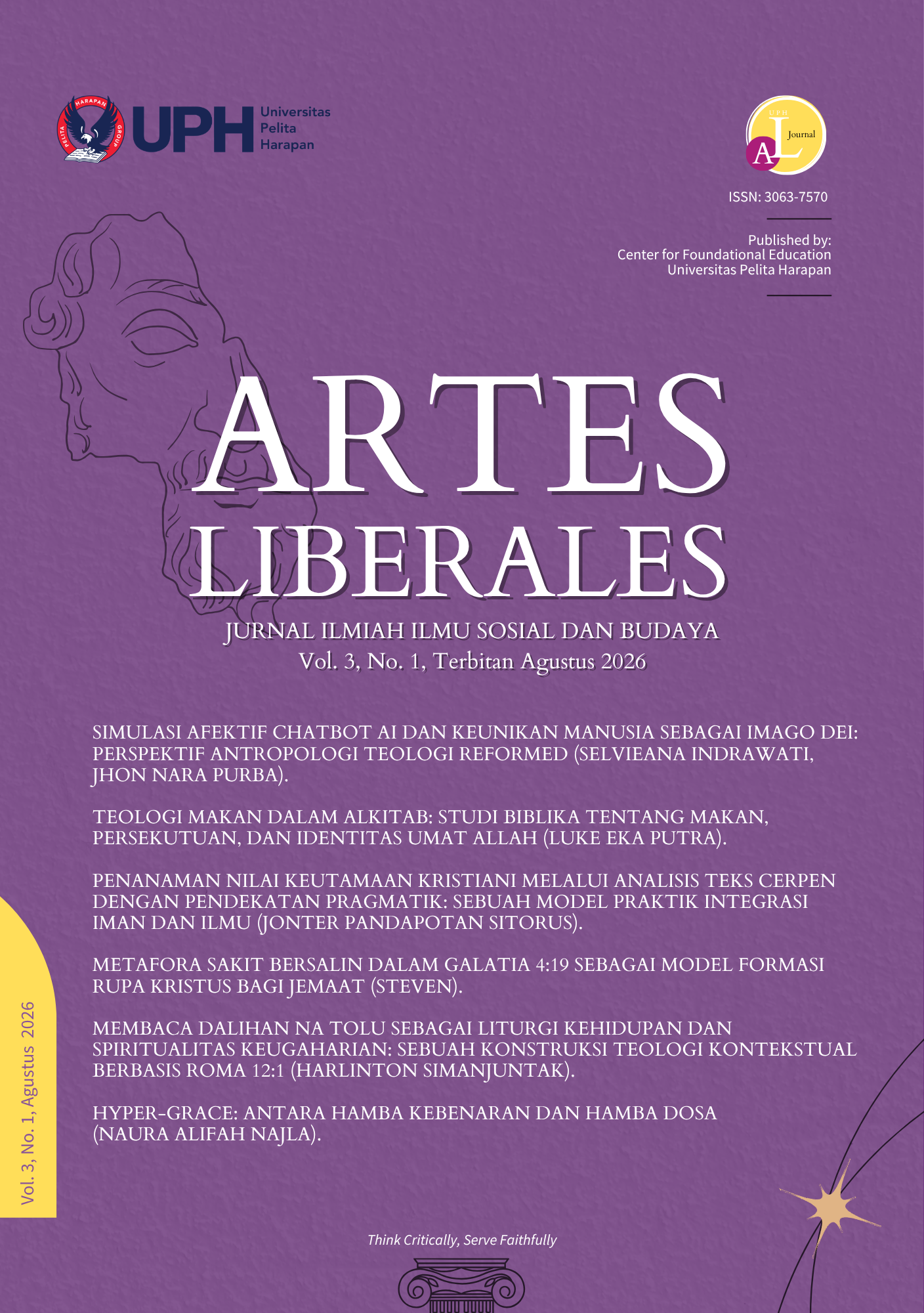
Imago Dei dan Simulakra Digital: Respons Antropologi Teologi Reformed terhadap Chatbot AI
Keywords:
Imago Dei, Artificial Intelligence, simulasi emosi digital, teologi Reformed, Westminster Larger Catechism, Heidelberg CatechismAbstract
Perkembangan kecerdasan buatan (Artificial Intelligence/ AI), khususnya Chatbot AI yang mampu mensimulasi respon emosional dalam percakapan, memunculkan pertanyaan mengenai batasan keunikan manusia sebagai Imago Dei. Penelitian ini bertujuan mengevaluasi kemampuan afektif Chatbot AI melalui prespektif antropologi teologis Reformed berdasarkan Kejadian 1:26-27, Westminster Larger Catechism dan Heidelberg Catechism. Penilitian ini menggunakan studi kepustakaan dengan pendekatan analisis teologis-komparatif terhadap teks Kejadian 1:26-27, katekismus dalam tradisi Reformed dan literatur pendukung lainnya. Hasil penelitian menunjukkan, meskipun Chatbot AI dapat mensimulasikan ekspresi emosional manusia tetapi AI tidak memiliki jiwa, kesadaran moral dan kapasitas untuk berelasi dengan Allah. Oleh karena itu, kemampuan afektif AI tidak dapat disamakan dengan keberadaan manusia sebagai Imago Dei. Penelitian ini berkontribusi menawarkan kerangka antropologi teologi Reformed sebagai pembeda konseptual antara simulasi afektif dan hakikat manusia sebagai Imago Dei. Pemanfaatan AI, khususnya Chatbot AI harus tetap menjaga keutamaan manusia dalam relasi yang autentik dan martabatnya sebagai Imago Dei.
References
Bamidele, Janet Olufunke, and Donald A. Odeleye. "The Future of Pastoral Counselling: A Human-AI Partnership." The Pastoral Counsellors: Journal of Nigerian Association of Pastoral Counsellors 4 (January 2025): 117–122.
Bavinck, Herman. Reformed Dogmatics. Vol. 2, God and Creation. Edited by John Bolt. Translated by John Vriend. Grand Rapids, MI: Baker Academic, 2004.
BibleWorks. BibleWorks 9. Computer software. Norfolk, VA: BibleWorks, LLC, 2014.
Calvin, John. Commentary on Genesis. Translated by John King. Grand Rapids, MI: Baker Books, 1996. Originally published 1554.
Herzfeld, Noreen. In Our Image: Artificial Intelligence and the Human Spirit. Minneapolis: Fortress Press, 2002.
Hoekema, Anthony A. Created in God's Image. Grand Rapids, MI: William B. Eerdmans, 1986.
Reformed Church in America. "The Heidelberg Catechism." Accessed September 25, 2025. https://www.rca.org/about/theology/creeds-and-confessions/the-heidelberg-catechism/.
The Orthodox Presbyterian Church. "Westminster Larger Catechism." Accessed September 25, 2025. https://opc.org/lc.html.
Turkle, Sherry. Alone Together: Why We Expect More from Technology and Less from Each Other. New York: Basic Books, 2011.
Walton, John H. Genesis 1 as Ancient Cosmology. Winona Lake, IN: Eisenbrauns, 2011.
Wang, Yuhang, and Wei Liu. "Emotional Simulation of Artificial Intelligence and Its Ethical Reflection." Academic Journal of Humanities & Social Sciences 6, no. 5 (2023): 11–15. https://doi.org/10.25236/AJHSS.2023.060503.
Waters, Brent. Christian Moral Theology in the Emerging Technoculture. Farnham: Ashgate, 2014.
Downloads
Published
Issue
Section
License
Copyright (c) 2026 Selvieana Indrawati, Jhon Nara Purba

This work is licensed under a Creative Commons Attribution-ShareAlike 4.0 International License.
Authors who publish with this journal agree to the following terms:
1) Authors retain copyright and grant the journal right of first publication with the work simultaneously licensed under a Creative Commons Attribution License (CC-BY-SA 4.0) that allows others to share the work with an acknowledgement of the work's authorship and initial publication in this journal.
2) Authors are able to enter into separate, additional contractual arrangements for the non-exclusive distribution of the journal's published version of the work (e.g., post it to an institutional repository or publish it in a book), with an acknowledgement of its initial publication in this journal.
3) Authors are permitted and encouraged to post their work online (e.g., in institutional repositories or on their website). The final published PDF should be used and bibliographic details that credit the publication in this journal should be included.”