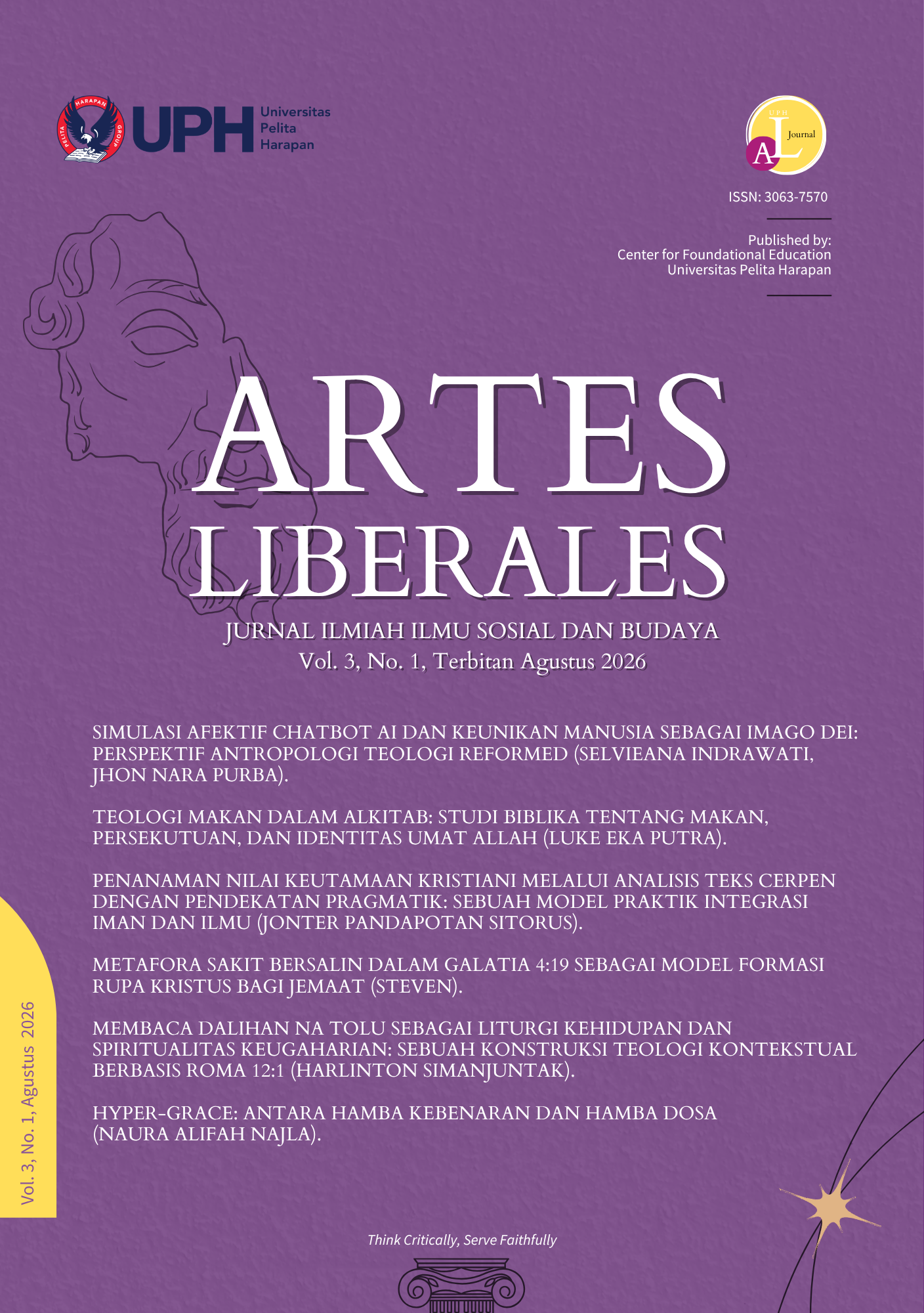
Metafora Sakit Bersalin dalam Galatia 4:19 sebagai Model Formasi Rupa Kristus bagi Jemaat
Keywords:
Galatians 4, metafora sakit bersalin, formasi kristusAbstract
Artikel ini mengkaji metafora sakit bersalin dalam Galatia 4:19 sebagai kunci teologis untuk memahami krisis identitas jemaat Galatia. Ungkapan penderitaan Paulus tidak dimaksudkan untuk meragukan keaslian pertobatan mereka, melainkan untuk menyingkap proses pembentukan yang terus berlangsung agar rupa Kristus nyata dalam kehidupan komunitas. Melalui analisis tekstual yang memperhatikan alur argumentasi surat Galatia serta konteks sosial-imperialnya, artikel ini menunjukkan bahwa metafora tersebut mengungkap regresi dari identitas yang berpusat pada anugerah menuju formasi religius yang dibangun atas tanda-tanda pembeda dan regulasi manusia. Dengan demikian, Galatia 4:8–20 berfungsi sebagai jembatan pastoral yang menghubungkan argumentasi doktrinal dan nasihat etis, serta menegaskan bahwa distorsi Injil bukan hanya kesalahan teologis, tetapi krisis relasional dan komunal. Metafora ini akhirnya meneguhkan kembali adopsi sebagai anak sebagai dasar formasi Kristen yang sejati.
References
Written Allegorically’ (Galatians 4:21–31).” The Southern Baptist Journal of Theology 14, no. 3 (2010): 30–49.
Kahl, Brigitte. Galatians Re-Imagined: Reading with the Eyes of the Vanquished. Paul in Critical Contexts. Minneapolis (Minn.): Fortress Press, 2014.
Lührmann, Dieter. Galatians. 1st Fortress Press ed. Minneapolis: Fortress Press, 1992.
Schreiner, Thomas R. Galatians. Zondervan Exegetical Commentary on the New Testament 9. Grand Rapids, Mich: Zondervan, 2010.
Smiles, Vincent M. The Gospel and the Law in Galatia: Paul’s Response to Jewish-Christian Separatism and the Threat of Galatian Apostasy. A Michael Glazier Book. Collegeville, Minn: Liturgical Press, 1998.
Downloads
Published
Issue
Section
License
Copyright (c) 2026 Steven

This work is licensed under a Creative Commons Attribution-ShareAlike 4.0 International License.
Authors who publish with this journal agree to the following terms:
1) Authors retain copyright and grant the journal right of first publication with the work simultaneously licensed under a Creative Commons Attribution License (CC-BY-SA 4.0) that allows others to share the work with an acknowledgement of the work's authorship and initial publication in this journal.
2) Authors are able to enter into separate, additional contractual arrangements for the non-exclusive distribution of the journal's published version of the work (e.g., post it to an institutional repository or publish it in a book), with an acknowledgement of its initial publication in this journal.
3) Authors are permitted and encouraged to post their work online (e.g., in institutional repositories or on their website). The final published PDF should be used and bibliographic details that credit the publication in this journal should be included.”